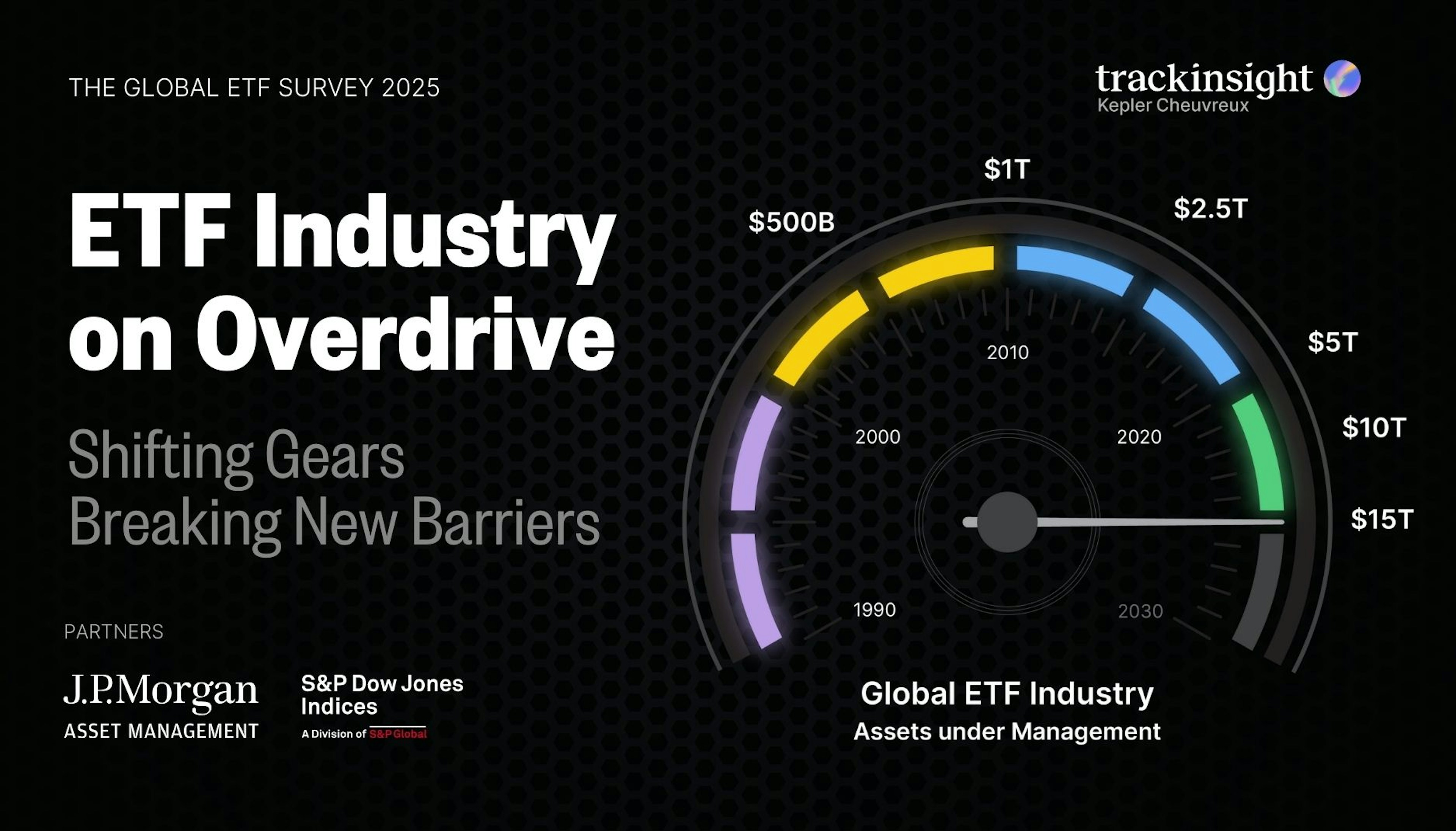
O que o relatório inclui
- 600+ investidores (US$ 1,1 tri em ETF)
- Tendências quentes: renda fixa, cripto, ESG
- 80+ previsões para 2025
How many ETFs should you own?
How many ETFs should you own depends on your diversification strategy. Diversifying your portfolio is one of the most important aspects of investing. If you are not familiar with the concept of diversification, we have written an article introducing it for you. Read about what is diversification.
Why should you diversify your portfolio?
Diversification is not a recent concept in finance. It comes from the Modern Portfolio Theory, Harry Markowitz’s Nobel Prize-winning theory that dates back from the ’50s. It remains a widely accepted framework for managing investment portfolios even nowadays.
Publicidade
Diversification helps investors design an optimal portfolio that maximizes returns for their chosen level of expected risk, and vice-versa. In simple terms, the main idea is that by combining investments with different characteristics, you can decrease the risk of your overall portfolio significantly, while retaining most of the performance.
Long story short, your portfolio should obey the famous saying “Don’t put all your eggs in one basket”. However, over-diversifying your portfolio can sometimes take a toll on your performance. This article helps you understand where to set the bar to build an optimally diversified portfolio without giving away performance.
How many ETFs is enough? Fewer than 10 ETFs is likely enough to diversify your portfolio
ETFs are wonderful instruments offering diversification at a minimal cost. Indeed, ETFs are investment vehicles containing many investments and are therefore already diversified. They also allow investors to obtain access to instruments that would be otherwise reserved to institutional investors. Sometimes, however, this low-cost diversification can act as a double-edged sword on your portfolio.
How to build an optimally diversified portfolio?
Experts agree that for most personal investors, a portfolio comprising 5 to 10 ETFs is perfect in terms of diversification. But the number of ETFs is not what you should be looking at. Rather, you should consider the number of different sources of risk you are getting with those ETFs.
Risk comes from many sources, but a typical breakdown considers first the type of security (equity, bonds, or commodities) and the geography (US, Europe, World, Emerging Markets, etc.). Selecting investments across these characteristics already does a good job at diversifying.
———
›› TIP: Our powerful ETF screener is perfect for building a diversified portfolio. Then, for each investment objective, compare ETFs to find your winner.
———
Publicidade
A typical well-diversified portfolio consists of an equity bucket and a fixed income bucket.
What is in the equity bucket?
Equity ETFs invest in a basket of company stocks (also known as equities or shares). They are the most common type of ETFs and enable you to own part of hundreds or even thousands of companies in a single trade.
To diversify your equity bucket, you can play on geographies. For example, you can buy a domestic equity ETF (that invests in your home country’s stock market) and an international equity ETF (that invests globally outside of your home country).
You can also play on companies’ size and invest in Small-Cap ETFs in the pursuit of higher returns. Academic studies have shown that small-cap stocks tend to outperform bigger companies over the long run, for a variety of reasons. Learn more about factor investing here.
You can also personalize your portfolio with ideas that interest and excite you by investing in thematic ETFs. Thematic ETFs follow new social, technological, or economic themes that fall outside of traditional investment classifications. Examples include environmental, economic, and demographic shifts, next-generation technological advances, or new emerging industries. For instance, if you are expecting rapid growth in the clean energy industry, you could invest in a clean energy ETF.
What is in the fixed income bucket?
Fixed income is a wonderful, often misunderstood asset class.
While a share gives you ownership of part of a company, a bond is a debt that a company or government can issue/sell to raise money. When you invest in a bond, you are effectively loaning money to a company or government with the promise that they will repay you (with interest) down the line. Bond ETFs enable you to buy many different bonds in a single trade.
Bond ETFs are especially important for investors as buying individual bonds is very difficult. They have opened up investment opportunities for the regular person that would normally only have been available to the professionals.
Bonds tend to behave differently than stocks, meaning they can offer important diversification to a portfolio.
Publicidade
The many ways to build a diversified fixed income bucket
As for equities, there are many ways to build a diversified fixed income bucket. Debt issued by different entities will have different risk levels. Usually, government debt is a good instrument to break the correlation with the equity bucket since governments are not supposed to fail as frequently as companies. In times of uncertainty, investors will tend to buy government debt, which means its value goes up when stocks go down.
You can also play on geographies within the fixed income bucket and invest in a domestic bond ETF, international global bond ETF, or even choose specific countries’ debt that seems attractive to you.
There are also some thematic and factor ETFs available within fixed income. Overall, expressing views on your fixed income bucket requires more education and experience. Stay tuned for upcoming articles about the subject!
Another option is to invest in other asset classes
Besides equity and fixed income, you can also invest in other asset classes such as commodities or cryptocurrencies.
For example, Gold is a ‘store of value’ asset, it is often used as a hedge against inflation or as a safe haven in periods of geopolitical and macroeconomic uncertainty. Many investors consider Gold ETFs to be a good portfolio diversifier as they offer a low correlation with equities and fixed income.
On the other end of the spectrum, Cryptocurrency ETFs allow you to expand your portfolio beyond traditional assets. They can focus on a single cryptocurrency like Bitcoin or Ethereum, or even investing in a basket of cryptocurrencies for further diversification.
You know which ETFs to buy, now what? Portfolio allocation to the different buckets
Once you have decided which ETFs you want to buy, you will have to decide in what proportions. A well-known portfolio allocation is the 60/40 where your investment is split mostly in equity with a minor of bonds. Of course, you do not have to follow a fixed allocation and you can modify it to express your views and adapt your portfolio to the current state of the economy.
For example, when the economy performs well, you will want to allocate more weight to the equity portion of your portfolio as it offers the highest expected return on average. However, when the economy is facing challenging times, you will need to increase the weight of the fixed income bucket or invest in gold to protect your portfolio.
How many are too many? The dark side of owning too many ETFs
Don’t ignore the overlap between ETFs
Owning a lot of ETFs in your portfolio is likely a counterproductive move. With a rising number of ETFs in your portfolio, chances are that some will be redundant (i.e., overlap) with each other. You might have the illusion of diversification, but a closer look will reveal otherwise.
For example, if you own an S&P 500 ETF like the iShares Core S&P500 and a US ETF with a focus on the Information Technology sector such as the iShares US Technology, you will probably be over-exposed to US tech companies like the “GAFAM” (Google, Amazon, Facebook, Apple, and Microsoft). In simple terms, you bought the same stocks through two different ETFs, so you are not really diversifying your risk.
Overlaps between ETFs are the main challenge to overcome to reach a well-diversified portfolio when investing in ETFs. At Trackinsight, we compute the ETF exposure to countries and sectors for over 10,000 ETFs. You can check it for free as well as the list of the top holdings of the funds, to make sure the overlap between your ETFs is limited.
Too much diversification can dilute performance
Not enough diversification can be risky, but too much diversification can also dilute the effect of well-performing holdings in your portfolio’s return.
To illustrate this point, let’s take the example of an Energy ETF that has incredibly well performed at the beginning of 2021. Adding new ETFs to a portfolio that includes this Energy ETF would decrease its performance. Since the allocation to the Energy ETF will naturally decrease - and so will its contribution to the total portfolio return.
Don’t forget to consider fees
Even though ETFs are quite cheap, the fees add up when you hold many of them and could have a significant impact on your portfolio’s performance.
In addition, you will pay a fee every time you buy or sell an ETF to adjust your portfolio. Some fees are a percentage of the amount traded but some fees are fixed, which can become a drag if you do numerous small trades over a high number of ETFs.
In order to have a cost-efficient portfolio, you should seek an optimal degree of diversification while limiting the number of ETFs in your portfolio.
Concentrated portfolios are easier to manage
Besides the fees and other inefficiencies of a portfolio containing numerous ETFs, managing a more complex portfolio can turn out to be very time-consuming. It is easier to manage a portfolio of a handful of ETFs, where each ETF fulfills a clear purpose, than a portfolio of many ETFs without clear roles. With a simpler portfolio, your reaction time to important market news will be faster as it is easier to process the impact on your investments.
How many ETFs should you own? Key Takeaways
When it comes to building an ETF portfolio, fewer can be better. Holding too many ETFs in your portfolio introduces inefficiencies that in the long term will have a detrimental impact on the risk/reward profile of your portfolio. For most personal investors, an optimal number of ETFs to hold would be 5 to 10 across asset classes, geographies, and other characteristics. Thereby allowing a certain degree of diversification while keeping things simple.
Mais conteúdos educativos


Sobre o Trackinsight
Trackinsight é um fornecedor líder de dados e tecnologia sobre ETFs, capacitando instituições a tomarem decisões informadas na seleção de ETFs, construção de portfólios e otimização.
Desde a nossa fundação em 2016, estamos na vanguarda da indústria, oferecendo ferramentas acessíveis, abrangentes e confiáveis para apoiar as necessidades em constante evolução dos investidores.
Ao longo da última década, a Trackinsight expandiu suas operações em seis países, atendendo milhares de investidores profissionais. Temos inovado consistentemente para fornecer soluções de ponta que atendam às demandas em mudança do mercado de ETFs.
Em 2024, a Kepler Cheuvreux, uma importante empresa independente de serviços financeiros europeia, adquiriu uma participação majoritária na Trackinsight, tornando-se o principal acionista da empresa.
Essa parceria estratégica solidifica a posição da Trackinsight como um fornecedor de destaque de ferramentas de seleção e análise de ETFs, enquanto fortalece o compromisso da Kepler Cheuvreux em se tornar um jogador de destaque no setor de ETFs.
Juntos, estamos comprometidos em oferecer serviços avançados que capacitem investidores profissionais, consultores, instituições e emissores. Este novo passo nos permite fornecer soluções tecnológicas ainda mais abrangentes e inovadoras, levando o investimento em ETFs a novos patamares.
Mais sobre o TrackinsightFerramentas ETF
PLATAFORMA
Notícias e pesquisas sobre ETFs
SOLUÇÕES PROFISSIONAIS
SOLUÇÕES PARA
Política de privacidade | Política de bolachas | | Termos de uso | Impressão