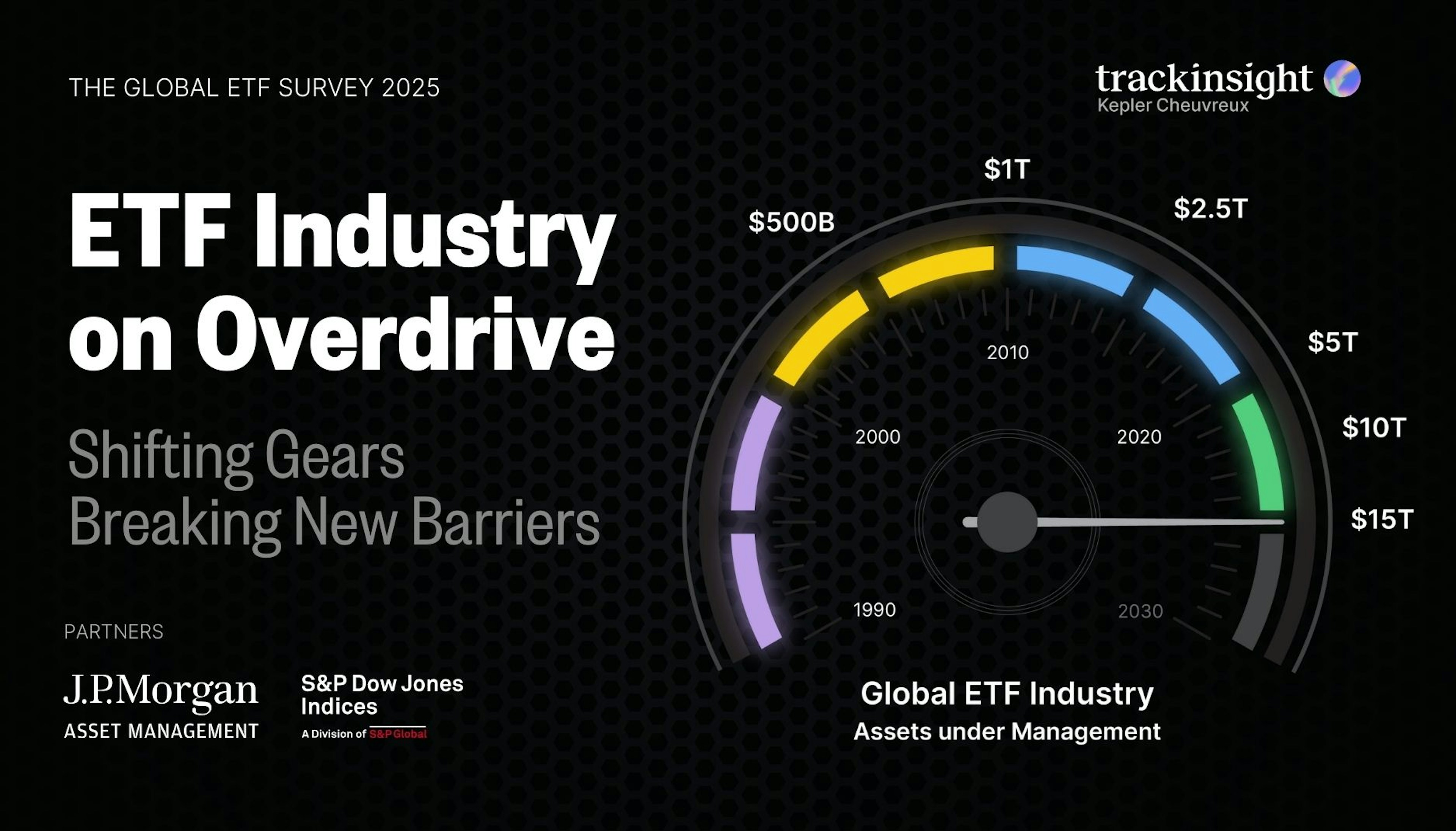
O que o relatório inclui
- 600+ investidores (US$ 1,1 tri em ETF)
- Tendências quentes: renda fixa, cripto, ESG
- 80+ previsões para 2025
How to invest sustainably: ESG vs SRI vs Impact Investing
Who’s not concerned about climate change nowadays? Alerting reports keep getting released - like that of the IPCC about the impact of a 1.5 degrees Celsius Global Warming on the planet. Sustainability is now more than ever a critical matter for us all to act upon, and this also translates through our investments.
The financial industry has understood this well and the offer of green, sustainable and impactful financial products has exploded in the recent years. According to our data, total assets invested in ESG reached $316.7 billion as of June 2021, and grew at a double-digit pace of 17.5% over the past 3 months.
Publicidade
If you want to invest sustainability, you probably have come across three terms commonly used by fund providers: ESG, SRI, and Impact Investing. Those terms are used frequently and sometimes interchangeably - this can quickly become quite confusing. What do they mean? Is there a difference between them? Which one is right for you?
What is ESG Investing?
In the world of sustainable investing, “ESG” is tremendously larger than “SRI” and “Impact Investing”. For this reason, it is common practice to use ESG as the default term for sustainable investing and have it englobe SRI and impact investing. For example, Trackinsight’s ESG classification highlights four ESG strategies and they comprise all kinds of sustainable investing approaches.
This doesn’t mean that there are no differences between those terms.
So what’s ESG? ESG is an acronym that stands for:
- ‘E’ - Environment, with concerns like lowering carbon emissions, investing in green energy production, or electric vehicles.
- ‘S’ - Social, focuses on ideas that include ethical considerations like gender equality, supply chain treatment, anti-slavery.
- ‘G’ - Governance, considers how well a company is run and managed, and seeks to avoid companies that may be corrupt, poorly run or carry a high reputational risk.
Funds that label themselves as ESG will often give you a more sustainable version of some famous broad exposures filtered in terms of environmental and social impact.
However, as we mentioned, “ESG” is a broad term and there is no consensus on what it underlies. Two funds that claim to implement an ESG investing approach can have completely different portfolios in the end. ESG is complex to assess. It has many dimensions, some of which are not always explicit (sustainability metrics are called “extra-financial”). Also, even though ESG approaches rely on quantitative metrics, the choice of the metrics is a subjective process, and their assessment has a high qualitative component too – which will vary from person to person, or from sustainable rating agency to another. While some initiatives like the Sustainability Accounting Standards Board is trying to correct it, the industry agrees that there is still a need for standardized extra-financial reporting.
An example of ESG ETF would be the Xtrackers MSCI U.S.A. ESG Leaders Equity ETF which tracks the MSCI USA ESG Leaders Index. The index is derived from the MSCI USA and only includes best ESG performing companies in their sectors.
See all ESG ETFs in our screener.
What is SRI Investing?
As mentioned previously, Socially Responsible Investments (SRI) are a sub-set of ESG investing. Funds that label themselves as SRI usually focus on a specific ethical or environmental matter. For example, some SRI funds completely exclude companies that are not fossil fuel-free.
Publicidade
Compared with ESG investing, SRI investing can be stricter as it completely excludes companies that do not comply with the policy of the funds. This approach can be especially useful to comply with one’s values or religious beliefs. However, exclusion (or “negative screening”) is not only used by SRI funds. It can be a step in the process of constructing other types of sustainable strategies.
Common exclusions for SRI investments include:
- Alcohol, tobacco, cannabis
- Gambling
- Firearms and other weapons
- Human rights violation
- Negative environment impact
- Adult industry
SRI funds are mainly offered in Europe. They represent around 8% of the whole sustainable investing universe. The simplicity of the exclusion approach allows SRI ETFs to have an average expense ratio of 0.25% which makes them cheaper than other sustainable investing products.
An example of SRI fund would be the iShares MSCI Europe SRI UCITS ETF which replicates the performance of the MSCI Europe SRI Select Reduced Fossil Fuel Index. The index is derived from the MSCI Europe index and only comprises companies consistent with specific values and climate change based criteria. Thus, companies exposed to fossil fuels through extraction and production activities are excluded.
See all SRI ETFs in our screener.
What is Impact Investing?
Lastly, you might have heard about Impact Investing. Funds that claim to invest with an impact usually go one step further than ESG and SRI funds. They take a more integrated approach where they select only companies that have a positive, scalable impact on society and/or the environment. Some impact investing funds invest in a non-profit organization to help them to accomplish a specific goal such as one of United Nations’ Sustainable Development Goals (SDG). Some even give back some of their profit and donate it to non-profits.
Here again, there is no universal standard to measure the concrete significance of the impact these funds claim to have. However, the United Nations Sustainable Development Goals are concrete metrics that can help investors navigate impact investing with more serenity.
An example of an impact investing ETF is the Impact Shares Sustainable Development Goals Global Equity ETF which tracks an index designed to cover worldwide companies that actively contribute to the achievement of United Nations’ SDGs.
Publicidade
ESG vs SRI vs Impact Investing: Which is the best for you?
When determining which option is the best, there is no one size fits all answer. Your choice will depend on your preferences and your goals.
If you want to get broad exposure to the best practitioners in terms of social and environmental impact, then you should look into ESG ETFs.
However, if you have specific values and you would not compromise under any circumstances, then SRI ETFs can be the right fit for you.
Finally, if you want to measure your impact and are willing to invest in a non-profit organization and help businesses achieve their goals, you might find your gem in impact investing ETFs.
If you want to learn more about sustainable investing, our ESG Investing hub is the right place to be!
Interested in seeing lists of top performing ESG ETFs? Check out our ESG investing guide.
Keep reading:
Mais conteúdos educativos


Sobre o Trackinsight
Trackinsight é um fornecedor líder de dados e tecnologia sobre ETFs, capacitando instituições a tomarem decisões informadas na seleção de ETFs, construção de portfólios e otimização.
Desde a nossa fundação em 2016, estamos na vanguarda da indústria, oferecendo ferramentas acessíveis, abrangentes e confiáveis para apoiar as necessidades em constante evolução dos investidores.
Ao longo da última década, a Trackinsight expandiu suas operações em seis países, atendendo milhares de investidores profissionais. Temos inovado consistentemente para fornecer soluções de ponta que atendam às demandas em mudança do mercado de ETFs.
Em 2024, a Kepler Cheuvreux, uma importante empresa independente de serviços financeiros europeia, adquiriu uma participação majoritária na Trackinsight, tornando-se o principal acionista da empresa.
Essa parceria estratégica solidifica a posição da Trackinsight como um fornecedor de destaque de ferramentas de seleção e análise de ETFs, enquanto fortalece o compromisso da Kepler Cheuvreux em se tornar um jogador de destaque no setor de ETFs.
Juntos, estamos comprometidos em oferecer serviços avançados que capacitem investidores profissionais, consultores, instituições e emissores. Este novo passo nos permite fornecer soluções tecnológicas ainda mais abrangentes e inovadoras, levando o investimento em ETFs a novos patamares.
Mais sobre o TrackinsightFerramentas ETF
PLATAFORMA
Notícias e pesquisas sobre ETFs
SOLUÇÕES PROFISSIONAIS
SOLUÇÕES PARA
Política de privacidade | Política de bolachas | | Termos de uso | Impressão