Trackinsight Enterprise, a unified platform for institutional ETF research, analytics, and compliance, is now live. Explore Trackinsight Enterprise →
Help us improve your experience. Please confirm your investor type:
The ETF Industry Is Evolving Fast
From AI infrastructure to active strategies, the ETF landscape is shifting. Share your perspective in the 7th Annual Global ETF Survey.
Finding the best Gold ETFs: A guide
How can you use Gold ETFs to gain exposure to this asset & how do Gold ETFs compare to other investment products? Find best Gold ETFs with our guide.


By Simon Mott
September 27, 2021
- Gold
Advertisement
Gold is a staple feature of many portfolios, but how can investors use Gold ETFs to gain exposure to this asset and how do Gold ETFs compare to other investment products?
Investing in Gold
Gold is a feature of almost all modern portfolios and can serve as a source of returns, a store of value, an inflation hedge and a source of diversification against traditional equities and bonds.
📊 Share your ETF outlook
From AI infrastructure to active strategies, the ETF landscape is shifting. Share your perspective in the 7th Annual Global ETF Survey and get exclusive early access to the final report.
Gold is often seen as a ‘safe haven’ investment in that it tends to perform well when stock markets are doing badly. Gold can be used as an alternative form of currency in the event that the investors’ home currency becomes devalued.
There are many ways that investors can own gold. This guide will look at the different choices that investors have and how they can decide between the 80+ Gold ETFs that are now available in the market.
Gold basics
Gold is a precious metal which originates in the stars. Gold does not form naturally on earth and instead was brought to us during the early period of the planet’s formation via millions of asteroids. Subsumed into the fabric of the planet, gold has been valued for millennia for its scarcity, beauty, lack of reactivity and ease of use.
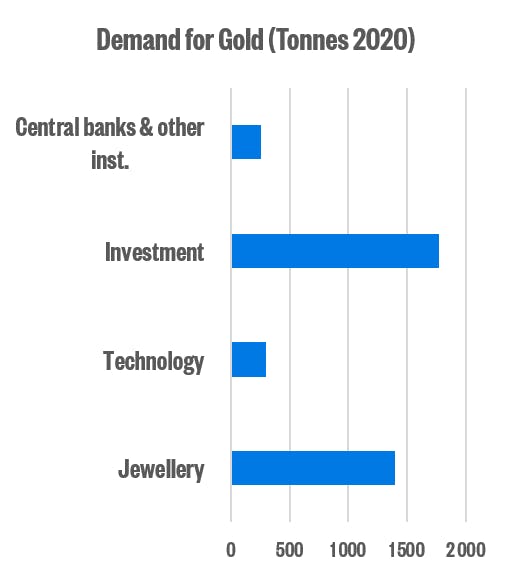
In terms of production, about 3,500 tonnes[1] of gold are mined every year and about 1,200 tonnes of gold are recycled for a total annual production of about 4,700 tonnes.
While the jewelry industry is one of the largest sources of demand, accounting for about 1,400 tonnes of gold a year, gold’s increasing popularity as an investment vehicle saw the investment industry account for a record 1,770 tonnes of gold demand in 2020.
The different ways of investing in gold
Gold ETFs
Gold ETFs are an increasingly popular way for investors to own this asset. Gold ETFs work in the same way as other ETFs in that they are regulated investment products that can be bought and sold on exchange throughout the day and can be held in a standard brokerage account. They have the advantages characteristic of ETFs – tradability, low costs, low minimum investments and ease of use.
Gold ETFs can be both physically replicated (the ETF issuer owns gold bullion on your behalf) or synthetically replicated (the ETF issuer tracks the price of a gold futures index). An example of a physically-backed Gold ETF is the WisdomTree Core Physical Gold ETC, whereas an example of a future-based Gold ETF is the CSOP Gold Futures Daily 2x Leverage ETF.
Physically backed Gold ETFs are the most common type and account for nearly half of total investment gold demand. As of July 2021, Gold ETFs have a combined AuM of $193 billion – equivalent to ~3,600 tonnes of gold.
Advertisement
In physically-backed Gold ETFs, each ETF share corresponds to a specific amount of gold which will be detailed in the funds’ documentation.
Some ETFs allow for physical delivery of gold – i.e. when you sell, the issuer can give you cash value, or send you bullion or coins.
Gold ETFs typically have lower management fees than actively managed commodity funds and have far lower minimum investment limits that allocated gold accounts or vaulted gold.
This means that a smaller investor can easily gain access to gold through a regulated, liquid and transparent vehicle in a way where the costs and complexity of storage and security are embedded into the price of the fund. Large institutional investors can benefit from a deep and liquid market where they can trade in significant size.
Picking the right Gold ETF
With over 80 Gold ETFs in the world, how can investors pick the right one? Here are things to consider:
Replication
The first thing to check is if the ETF is physically replicated and owns actual gold bars or is synthetically replicated and holds gold futures contracts. If you want to ensure that there is real gold backing your investment, then a physically replicated ETF is the way to go.
Examples of physically replicated Gold ETFs include the SPDR Gold Shares ETF (GLD) and the Amundi Physical Gold ETC (GOLD).
You can explore and compare all Gold ETFs in our screening tool.
Advertisement
Costs
The higher the fees you pay to an ETF issuer, the less money goes back into your pocket, so compare the different options in your region to see what is the most cost-efficient. Gold is gold and there should be no difference to the underlying exposure, so why pay more?
The most expensive Gold ETFs we monitor are listed in Asia-Pacific: the Hang Seng RMB Gold ETF is priced at 281 bps, meaning that for every $1,000 you invest, you will pay a chunky $28.10 in fees each year.
On the cheaper end are ETFs such as Invesco Physical Gold USD ETF, iShares Physical Gold ETC and WisdomTree Core Physical Gold ETC priced at a far lower 15 bps. The average cost for a Gold ETF is 45bps per year.
Currency
Gold can be priced in various currencies, which can impact your returns. To minimize unintended currency risk an investor should look for a gold ETF that is denominated in their local currency.
Tracking difference
A Gold ETF is supposed to track the price of the underlying commodity very closely, but some ETFs do a better job than others. By comparing the tracking difference of the ETFs available in your region you can see who is doing the best job in tracking gold accurately.
Leverage
Some Gold ETFs will offer you the ability to short gold or to leverage a trade by 2 or 3x. They do this by entering into a swap contract with an investment bank counterparty to deliver the multiple returns, meaning that you will not own any physical gold, but you will receive a return stream equivalent to the spot price of gold from the swap provider. Leveraged products can expose investors to the counterparty risk of the swap provider – a risk that does not exist with physically backed products. Leveraged ETFs are also complex and not always suitable for retail investors who need to understand the impact of daily rebalancing and compounding on returns.
ESG
More investors want to create portfolios that support sustainable objectives, but gold has always posed a challenge as the process of mining and refining is environmentally damaging and since gold mines are often located in countries with less than ideal labor standards.
Some Gold ETFs are tracking ‘responsible gold’ or ‘ESG gold’. They buy gold from refiners that meet the LBMA (London Bullion Metals Association) standards.
However, some investors consider there is still a long way to go to fully address the wider issues of Gold’s environmental impact and social harm that most investors consider when developing ESG portfolios, meaning that gold’s status as an ESG asset remains a controversial issue.
Other ways to invest in Gold
If you want to own gold, there are many ways to do it, each with their own advantages and disadvantages.
Gold Bars and Coins
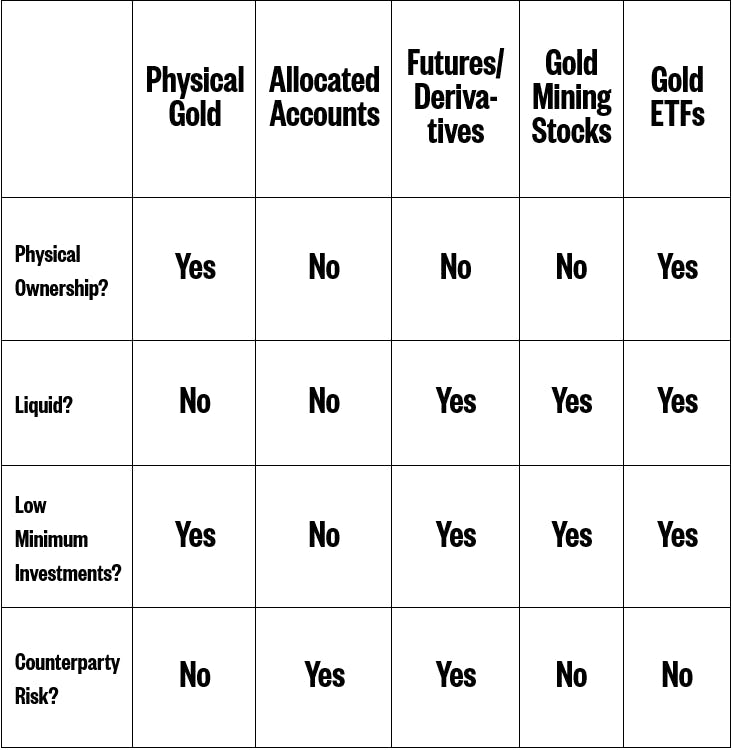
Owning physical gold bars or bullion is the most direct way that you can (literally) hold gold. Ingots or coins of investment-grade quality and purity are available from specialist brokers, mints and dealers and you can take physical delivery and store them in your own home should you wish.
Nonetheless, owning physical gold comes with additional difficulties and costs. Investors need to find a reputable dealer who they can trust to provide gold in the right purity and quality at a good price. Once they have purchased the gold, they will also need a way to transport and store the gold securely - paying for vault space, safes or deposit boxes is expensive will eat into any returns you may be getting.
There is also the obvious risk that the gold could be stolen or misappropriated from even the most secure vaults – for example, the Hatton Garden Heist of 2015.
Allocated Gold Accounts
Some banks offer High-Net-Worth clients allocated gold accounts. Here it’s important to understand that as an investor, you do not own specific gold bars or coins – rather you are ‘allocated’ a legally-defined portion of the gold the bank is handling.
While allocated gold accounts address the problems of how to store and secure gold, they do not typically provide the investor with the ability to take physical ownership and the investor may be exposed to the counterparty credit risk of the bank, whereby if the banks fails, they may not be able to access their gold.
As this service is typically available only to the wealthiest individuals, it may not be an option for the average investor, or someone who is just starting on their investment journey.
Futures
While gold futures are a very liquid and well-established method of trading gold, they are typically only used by sophisticated investors due to their complexity and the fact they trade on margin (leverage).
A future is a contract that is traded on an exchange whereby the investor agrees to buy a certain quantity of gold, on a certain date at a certain price. They hope that this price will be lower than the spot price of gold, enabling them to sell the contract and profit from the price difference.
Gold Mining Stocks and Funds
Investors can choose to add an ETF or fund to their portfolio that consists of shares in various gold mining companies. It is critical for investors to be aware that this is a very different investment to buying physical gold as the performance of these individual companies may bear no resemblance to the way the gold market is performing. You own shares in a company and not any gold.
Summary of Gold Investment Options
Finding the best Gold ETFs: summary
If you decide that you want to invest in Gold through an ETF, Trackinsight is here to help you with the tools and data you need to make the right decision for you.
You can check out the Gold ETFs that are available in your region and quickly compare their different characteristics using our screening tool.
You can also sign up to our newsletter to get weekly updates on key trends impacting the ETF markets, including Gold ETFs.
Find and compare over 7,000 ETFs with our free tools:
More articles


About Trackinsight
Since our founding in 2016, we have been at the forefront of the industry, delivering accessible, comprehensive, and reliable tools to support the evolving needs of investors.
Over the past decade, Trackinsight has expanded its operations across six countries, serving thousands of professional investors. We’ve consistently innovated to provide cutting-edge solutions that meet the changing demands of the ETF market.
In 2024, Kepler Cheuvreux, a leading independent European financial services firm, acquired a majority stake in Trackinsight, becoming the company's principal shareholder.
This strategic partnership solidifies Trackinsight's position as a premier provider of ETF selection and analysis tools, while strengthening Kepler Cheuvreux’s commitment to becoming a leading player in the ETF sector.
Together, we are committed to offering advanced services that empower professional investors, advisors, institutions, and issuers. This new step enables us to deliver even more comprehensive and innovative technological solutions, driving ETF investing to new heights.
More about TrackinsightETF TOOLS
PLATFORM
ETF NEWS & RESEARCH
Privacy policy | Cookie policy | | Terms of use | Imprint