Trackinsight is part of ETF One, the fully integrated ETF platform of Kepler Cheuvreux. Learn more →
Help us improve your experience. Please confirm your investor type:
The Ultimate ETF Comparison Tool - Try Now!
Analyze up to 5 ETFs side-by-side and gain instant insights on performance, fees, holdings, and more to make data-driven investment decisions.
What are corporate credit ratings?
Companies can issue bonds to raise money and finance projects. This means they are effectively borrowing money from investors, who need a clear idea of the creditworthiness of the company before lending out their money. In this article we dive into all aspects of corporate credit ratings that you need to know: credit rating agencies, methodology and diversification.
What are credit rating agencies?
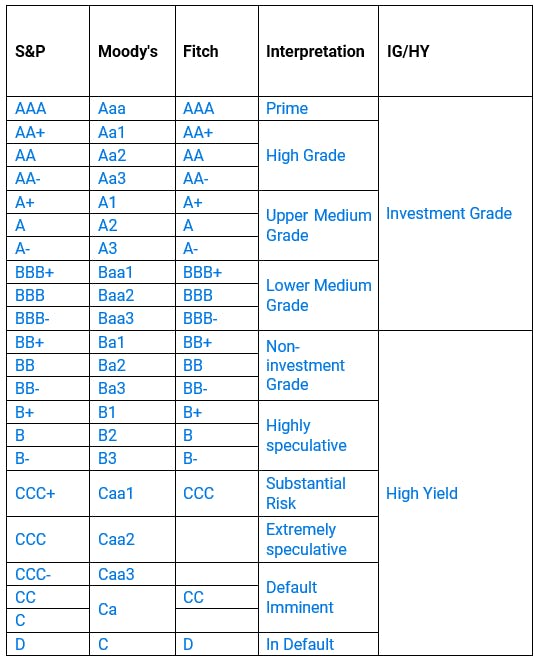
The creditworthiness is determined by credit rating agencies. Fitch Rating, Moody’s or Standard and Poor’s analyze the bonds and the companies issuing them to give investors the necessary information to help them make better decisions. They assess the likeliness of the company to default (or fail to repay the investors’ money).
広告
Companies with lower credit ratings are more likely to default. However, a good credit rating is not a guarantee. It is only the rating agency’s appreciation of the company’s ability to meet its financial commitments so investors should exercise caution and do their own research.
Credit ratings are often used to describe the investment objective of Bonds ETFs. Some will invest only in the highest-grade companies while some focus on the lower end of the spectrum (‘high-yield’).
Credit rating methodologies
While different credit rating agencies apply slightly different methodologies, they are overall based on the same metrics and use a similar approach.
Credit rating agencies grade both the companies (issuers) and the bonds (issues). Companies’ ratings are complex because they must assess the overall business and financial risks of the issuer as a whole. Rating individual bonds is more limited in scope and therefore simpler, as they mainly focus on the risks inherent to the project financed by the issue.
The rating methodology is based on three main items.
1. Business Risk Profile
First, the business risk profile of the company/project aims to assess the operating risk and sustainability of the company’s profitability. Several metrics are evaluated by agencies. Industry-specific risks cover the risks arising from the industry in which the issuer operates such as the cyclicality of its operation or the intensity of competition.
Competitive positioning is another business risk assessed by credit rating agencies. To do so, they analyze the company’s diversification in terms of products, geography, customers. More diversified companies are considered less risky. Indeed, if a part of the business is impacted by a specific even, other parts of the business carry on operations.
2. Financial Risk Profile
Then, the financial risk profile is assessed. Credit rating agencies dive deep into the company’s financial statements and especially the balance sheet. They calculate different financial ratios such as the financial leverage or the interest coverage. The purpose of these ratios is to assess the financial soundness and the ability of the company to pay back its creditor in the long term.
3. Supplementary Risks
Finally, supplementary risks are assessed such as the financial policy of the company, its ability to get parent or government support, or the soundness of its governance and structure.
広告
Credit ratings in a diversified portfolio
Investors can build diversified portfolios by investing in different asset classes such as equities, fixed income, and commodities. When building the fixed income bucket of the portfolio, investors must decide what risk/return profile they are looking for.
Usually in times of economic growth and bright prospect on the state of the economy, investors will prefer high-yield securities with a lower credit rating and higher interest to compensate them for the risk. The rationale behind is simple, since the economy is doing well, bonds with a lower credit rating are less likely to default. So, investors might feel more comfortable buying lower rated bonds to increase the return on their investments.
High-Yield Bonds ETFs are convenient investment products that enable investors to target the asset class in a diversified, low-cost and easy way. Look at all High Yield Bonds ETFs on our dedicated Fixed Income Channel.
However, when the economy prospects are not favorable, investors will prefer higher rated instruments and even government bonds to play it safe. Here, the rationale is the same, since challenging times lie ahead, lower rated companies are more likely to default. It is therefore safer to invest in high rated instruments.
Investment Grade Bonds ETFs are convenient investment products that enable investors to target the asset class in a diversified, low-cost and easy way. See all Investment Grade ETFs on our dedicated Fixed Income Channel.
To find out more about Fixed income ETFs, visit Trackinsight’s Fixed Income Channel.
その他の教育コンテンツ


About Trackinsight
Since our founding in 2016, we have been at the forefront of the industry, delivering accessible, comprehensive, and reliable tools to support the evolving needs of investors.
Over the past decade, Trackinsight has expanded its operations across six countries, serving thousands of professional investors. We’ve consistently innovated to provide cutting-edge solutions that meet the changing demands of the ETF market.
In 2024, Kepler Cheuvreux, a leading independent European financial services firm, acquired a majority stake in Trackinsight, becoming the company's principal shareholder.
This strategic partnership solidifies Trackinsight's position as a premier provider of ETF selection and analysis tools, while strengthening Kepler Cheuvreux’s commitment to becoming a leading player in the ETF sector.
Together, we are committed to offering advanced services that empower professional investors, advisors, institutions, and issuers. This new step enables us to deliver even more comprehensive and innovative technological solutions, driving ETF investing to new heights.
Trackinsightの詳細プラットフォーム
ETFニュース&リサーチ
プロフェッショナル・ソリューション
お問い合わせ