Get your free ETF data sample from our comprehensive offerings. Start your free trial→
Help us improve your experience. Please confirm your investor type:
The ETF Industry Is Evolving Fast
From AI infrastructure to active strategies, the ETF landscape is shifting. Share your perspective in the 7th Annual Global ETF Survey.
What are Fixed Income ETFs?
Fixed Income Exchange-Traded Funds (ETFs) are investment products that give you exposure to the performance of a diversified basket of bonds. Along with stocks, real estate, and commodities like gold or crude oil, bonds are one of the core traditional asset classes you can invest in. They can help you create a balanced portfolio that will weather market crises more smoothly. So, what is fixed income? And, why you should add fixed income ETFs to your portfolio?
What is Fixed Income?
Fixed income (commonly known as bonds) is debt that a company or a government can issue/sell to raise money and finance their development projects. When you invest in a bond, you are effectively lending money to a company or a government with the promise that they will repay you (with interest) down the line.
Advertisement
Why you should add Fixed Income to your portfolio
Fixed income can help you diversify your portfolio. Indeed, bonds’ value usually varies with less amplitude over time compared with stocks. Also, bond returns are usually not in sync with stocks. Adding bonds to your stock portfolio can help it weather crises more smoothly. Ideally, the losses in the stock portion of your portfolio would be offset by gains in the bond portion. This is good advice but not foolproof: in stressed markets, stocks and bonds might suddenly move together again.
Why invest in Fixed Income ETFs?
Fixed Income ETFs make investing in bonds cheaper and easier.
Fixed Income ETFs are especially important for investors as buying individual bonds is very difficult.
Bonds often trade at a minimum lot size of USD 1 million so buying bonds directly is normally something only large banks or investment companies could do. Bond ETFs have opened up investment opportunities for the regular person that would normally only have been available to the professionals.
Even for bonds that are accessible, Fixed Income ETFs bring another advantage to the table: liquidity.
While it is relatively easy to buy and sell stocks on the market, it can be a different story for bonds. After doing your research and identifying which bonds you want to buy, it might be hard to locate a seller since most bonds investors hold them until they mature – effectively taking the bonds out of the market. Bonds are also normally traded ‘over-the-counter’. For example, as a private transaction between two parties – not on exchanges. So, if you were in a position where you wanted to sell a bond, you would have to find a counterparty willing to buy at a fair price.
However, Fixed Income ETFs solve these issues. ETF shares trade like stocks on the market during the day, which adds liquidity compared with buying individual bonds directly. ETF providers pay trading companies (called Authorized Participants) to make sure that a minimum level of liquidity and intra-day pricing will always be there for ETF investors.
Finally, Fixed Income ETFs have the advantage of never expiring.
Bonds have a limited lifetime and once they reach maturity (the point at which the bond issuer must repay the bondholder in full), the ‘debt’ is canceled.
Most fixed-income ETFs do not mature and this makes managing your portfolio easier. You don’t have to worry about replacing maturing bonds with newer issues. Still, if you want to retain the concept of the loan and be paid back eventually, you should know that Fixed Income ETFs with a maturity date exists. They will pay back your capital at a specific future date and cease to exist, just like a regular bond.
Examples of Fixed Income ETFs:
- Government Bond ETFs: allow you to invest in the debt issued by governments.
- Municipal Bond ETFs: allow you to invest in debt issued by cities, states, or local governments.
- Investment Grade Corporate Bond ETFs: allow you to invest in the debt of companies with high credit quality, and typically lower interest.
- High Yield Corporate Bond ETFs: allow you to invest in the debt of companies with low credit quality, and typically higher interest.
Bonds in the COVID crisis
Theory is great but how do bonds ETFs really work in times of crisis? Let’s look at the recent COVID crisis.
Advertisement
In early 2020, the first COVID outbreak worried investors around the globe and equity markets tanked. ETFs tracking the famous S&P 500 index saw their price fall by more than half. At the same time, Fixed Income ETFs were much more resilient and the bond market lost less than 5% on average.
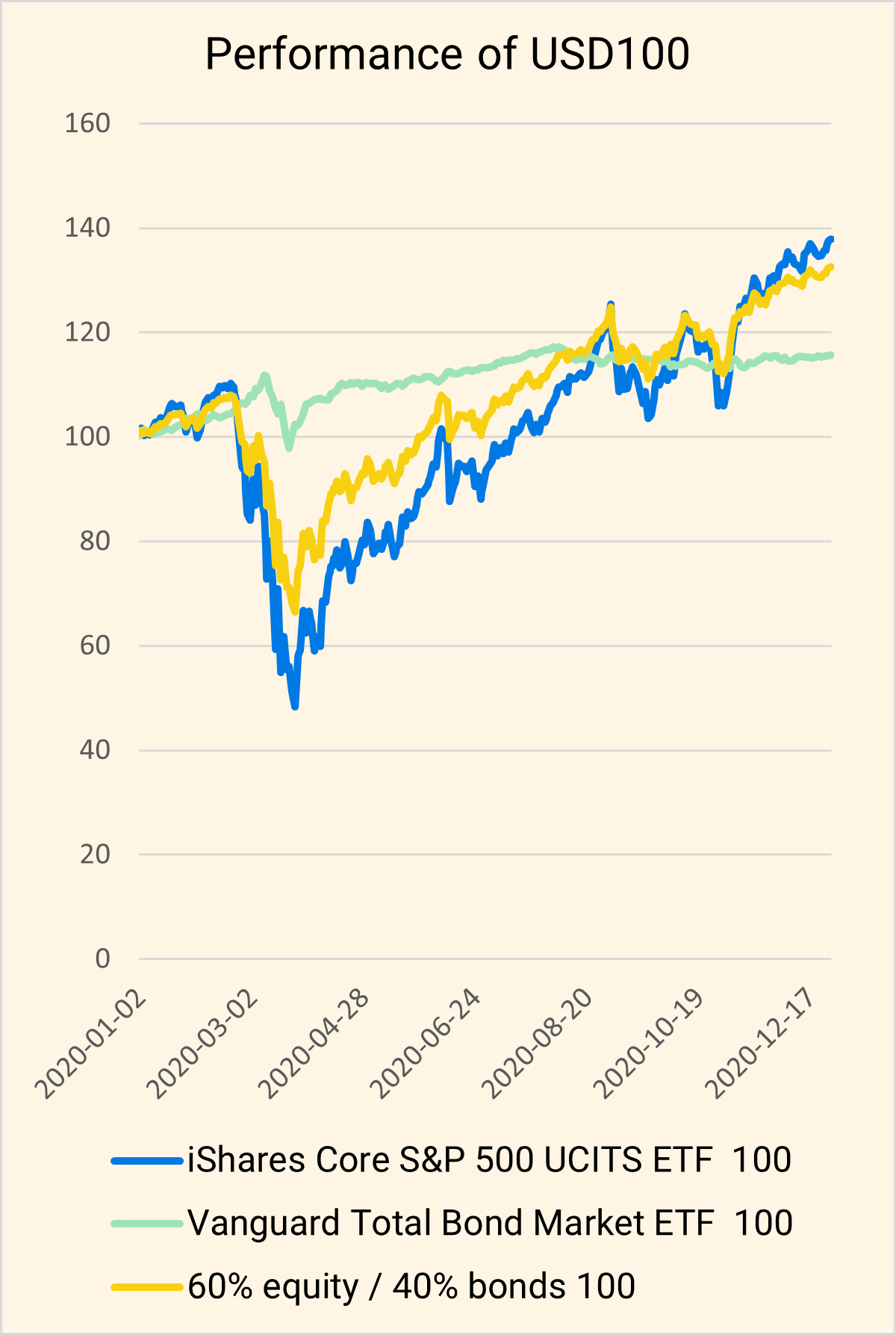
Why is that? The reason why bond prices are more stable than stocks is because of the scheduled payments (also known as coupon payments). While the price of a stock is linked to how much the company sells, the price of a bond depends on the company’s ability to pay back its debt. In periods of uncertainty, the sales of the company can temporarily decrease, but most companies will still be able to meet debt commitments. This means that investors can, in general, rely on a fairly predictable income stream from these regular payments.
Want to know more? Take a look at the Fixed Income ETFs available to buy in your region.
If you want to learn the basics of bonds, take a look at our bonds ETF guide.
More educational content


About Trackinsight
Since our founding in 2016, we have been at the forefront of the industry, delivering accessible, comprehensive, and reliable tools to support the evolving needs of investors.
Over the past decade, Trackinsight has expanded its operations across six countries, serving thousands of professional investors. We’ve consistently innovated to provide cutting-edge solutions that meet the changing demands of the ETF market.
In 2024, Kepler Cheuvreux, a leading independent European financial services firm, acquired a majority stake in Trackinsight, becoming the company's principal shareholder.
This strategic partnership solidifies Trackinsight's position as a premier provider of ETF selection and analysis tools, while strengthening Kepler Cheuvreux’s commitment to becoming a leading player in the ETF sector.
Together, we are committed to offering advanced services that empower professional investors, advisors, institutions, and issuers. This new step enables us to deliver even more comprehensive and innovative technological solutions, driving ETF investing to new heights.
More about TrackinsightETF TOOLS
PLATFORM
ETF NEWS & RESEARCH
Privacy policy | Cookie policy | | Terms of use | Imprint