All you need to get started with ETF selection and analysis. Create your account now →
Help us improve your experience. Please confirm your investor type:
Don’t Miss a Move in the ETF Market
Sign up and keep track of everything that moved the ETF industry this week. From new launches to regulatory shifts across the Atlantic.

Fixed Income: Making ground in ESG

By Amundi ETF
May 11, 2021
Advertisement
Fixed income has long lagged equities in the environmental, social and governance (ESG) investing space, currently accounting for only around 9% of sustainable assets globally[1]. But this is beginning to change. Demand for ESG debt is on the rise as is the availability of efficient passive ESG fixed income solutions, particularly since the outbreak of Covid-19. As increasingly socially conscious investors re-evaluate their allocations to fixed income, this presents significant investment opportunities.
A slow start but…
Compared to equities, progress to integrate ESG considerations into fixed income portfolios has been slow. The very first equity ESG index was launched over three decades ago, in 1990, but it was not until 2013 that the first ESG fixed income index materialised.
📊 Share your ETF outlook
From AI infrastructure to active strategies, the ETF landscape is shifting. Share your perspective in the 7th Annual Global ETF Survey and get exclusive early access to the final report.
One reason for this relates to historically perceived issues with engagement. Bondholders do not have voting rights like shareholders leading to a myth that they had a limited ability to engage and exert influence on companies.
However, times are changing fast and there is growing investor demand for ESG fixed income solutions. For example, between January 2018 and February 2021 assets under management in European fixed income ESG ETFs increased by six times to € 23.8 billion. So what has brought about this change and what opportunities does this bring?
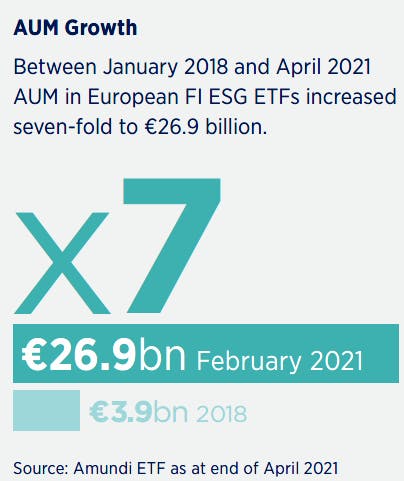
Making Ground
It is not hard to understand the potential benefits of incorporating ESG analysis into fixed income investing. ESG scrutiny on a corporate issuer may for instance reveal exposure to long-term investment risks such as climate change that may take years to materialise. Indeed, it is increasingly recognised that companies with strong ESG credentials are less likely to default. They are also likely to be more profitable over the long term and numerous studies attest to this.
In light of this, asset managers have been working hard to develop solutions that combine ESG with fixed income. ESG factors are occupying a more important role in credit ratings and we are seeing greater ESG integration and issuer engagement.
Bond investors, such as asset managers, are showing a greater willingness to directly communicate with companies and hold them to account on ESG issues. They recognise that whilst they may not have voting rights like equity holders, this in no way lessens their right, as stakeholders, to engage with bond issuers who are in many cases also stock issuers.
Bond issuers, keen to attract increasingly socially conscious investors and be included on the major indices, are now far more forthcoming in supplying information. There is also more information available from ESG information providers on previously neglected areas such as government debt. Government debt is far less advanced than corporate debt in terms of ESG integration for a host of reasons including a lack of consistency with regards to measuring material ESG factors, limits to data availability and less well-developed ESG integration tools and practices. However, increased investor scrutiny on ESG issues is driving progress in this area.
Of late, this trend towards greater ESG integration in fixed income has gathered newfound momentum. This has been accompanied by a greater investor adoption of fixed income ESG ETFs.
2020: The year that ESG went mainstream
Covid-19 precipitated market turmoil, and proved a real test of portfolio resilience leading many investors to re-evaluate their allocations to fixed income. Yet amidst the volatility, ETFs thrived, proving nimble and resilient and laying to rest any concerns that the passive universe would dry up in a market crisis. Notably, large volumes of fixed income ETFs were traded, even in segments with dwindling liquidity. Monetary authorities — including the Bank of England, the Bank for International Settlements and the Federal Reserve — recognised their versatility and even highlighted the role of ETF prices as a means of price discovery, again, particularly in the fixed income space.
Advertisement
The pandemic also sharpened investor focus on ESG illustrated by significant in-flows of € 71.6 billion in European ESG ETFs in the 12 months to April 2021, including € 18.5 billion in fixed income[2].
ETFs embraced as the vehicle of choice
Demand for fixed income ESG ETFs has since soared as shown by a recent survey which found that over 80% of investment professionals wanted to see more innovation within fixed income ESG ETFs[3].
Their attraction is clear:
- They are low cost, allowing investors incorporate sustainability into a portfolio at a fraction of the cost of an active fund.
- They offer transparency – investors can see what is in the portfolio by looking at the constituents of the underlying index.
- They provide diversification and resilience – risk can be spread across hundreds, even thousands of stocks.
- They are highly liquid – as discussed – even in times of market stress.
- They offer a high correlation with their parent (non-ESG) universe and minimal tracking error.
The increasing investor appetite for fixed income ESG ETFs has and will continue to drive greater product innovation and choice for investors. Over the past two years the proportion of fixed income ETFs incorporating ESG criteria has increased from 4% to 12%[4] and in the first quarter of 2021 we witnessed a significant investor shift towards ESG fixed income ETFs. European fixed income ESG ETFs have seen net inflows of € 9 billon versus a total of € 5 billion for the asset class overall[5].
There’s a long road ahead but…
ESG progress in the fixed income market has a long way to go. There is still a lack of consistency in the level of ESG information provided by bond issuers, particularly within the sovereign debt space, making ESG due diligence challenging. And fixed income assets still only account for a small proportion of sustainable assets globally.
But with sustainable investing increasingly seen as a necessity as opposed to a luxury in managing long term investment risks such as climate change, things are fast improving.
ETFs are increasingly being embraced as the vehicle of choice to implement ESG fixed income in investment portfolios and we expect continued innovation and assets under management in these dynamic tools to surge. Ultimately this should lead to greater choice for investors and an enhanced ability to incorporate sustainability in their investment portfolios in a way that reflects their beliefs and objectives.
About Amundi ETF
Amundi is a recognised European leader in the ETF market and offers over 150 ETFs across all main asset classes, geographic regions and a large number of sectors and themes. Amundi is leading the ESG transformation and its ETF, Indexing and Smart Beta platform is known for its wide range of high-quality, cost-effective ESG solutions spanning equity and fixed income and a range of levels of ESG intensity.
Advertisement
To learn more about Amundi’s ESG fixed income ETFs, visit https://www.amundietf.co.uk/professional/Investing-in-ETF/Responsible-Investing
[1] Source: Morningstar: Global Passive ESG Landscape 2020
[2] Source: Bloomberg Finance LP – Amundi ETF. From end of April 2020 to end of April 2021.
[3] Source: Tabula Investment Management
[4] Source: Amundi ETF as of end February 2021
[5] Source: Amundi ETF as of end of March 2021
More articles


About Trackinsight
Since our founding in 2016, we have been at the forefront of the industry, delivering accessible, comprehensive, and reliable tools to support the evolving needs of investors.
Over the past decade, Trackinsight has expanded its operations across six countries, serving thousands of professional investors. We’ve consistently innovated to provide cutting-edge solutions that meet the changing demands of the ETF market.
In 2024, Kepler Cheuvreux, a leading independent European financial services firm, acquired a majority stake in Trackinsight, becoming the company's principal shareholder.
This strategic partnership solidifies Trackinsight's position as a premier provider of ETF selection and analysis tools, while strengthening Kepler Cheuvreux’s commitment to becoming a leading player in the ETF sector.
Together, we are committed to offering advanced services that empower professional investors, advisors, institutions, and issuers. This new step enables us to deliver even more comprehensive and innovative technological solutions, driving ETF investing to new heights.
More about TrackinsightETF TOOLS
PLATFORM
ETF NEWS & RESEARCH
Privacy policy | Cookie policy | | Terms of use | Imprint