Global ETF Survey 2026: Answer now →
Help us improve your experience. Please confirm your investor type:
Don’t Miss a Move in the ETF Market
Sign up and keep track of everything that moved the ETF industry this week. From new launches to regulatory shifts across the Atlantic.

High Yield Corporate Bond ETFs: Use cases and risks in 2022
High-yield debt is making a resurgence. Here's why.


By Tony Dong
October 7, 2022
Advertisement
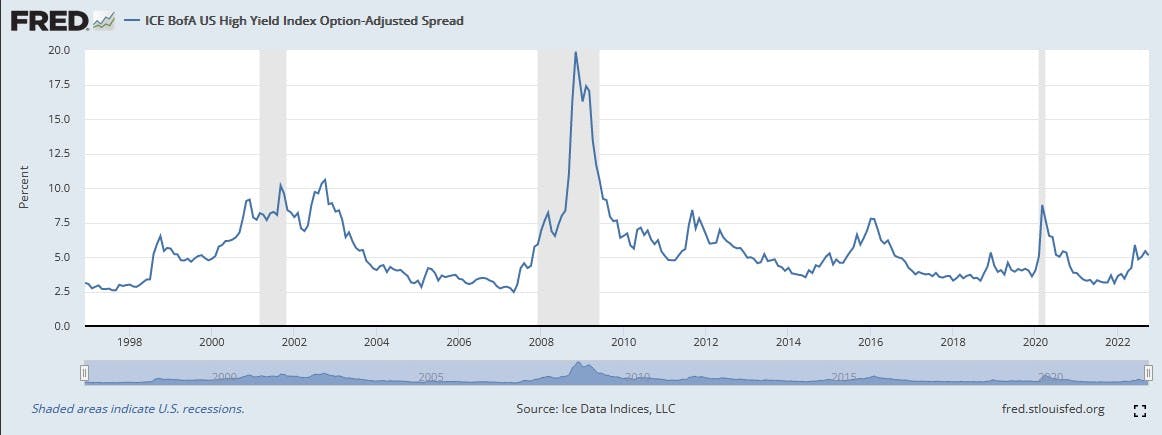
High-yield bond spreads are on the rise again. From the start of 2022 to the present, the ICE BofA US High Yield Index Option-Adjusted Spread increased from 3.05% to a high of 5.99% on July 6th, 2022, before settling down at 5.12% on October 4th.
These dynamics could reflect the decrease in risk tolerance for fixed-income investors. When high-yield spreads increase, investors gravitate towards lower-risk fixed-income assets like U.S. Treasury bonds, which raise their price and thus lower yields, widening spreads.
ETF Data Built for Precision
Trackinsight delivers reliable and comprehensive coverage on 14,000+ ETFs
Worries about economic slowdowns, continued aggressive Fed interest rate hikes, and inflation not abating are causing investors to worry about risky assets like high-yield bonds. Still, for those looking for enhanced income potential, the returns of high-yield bonds can be alluring.
What's going on with high-yield bonds?
A high-yield bond (also called "junk bonds") is a fixed-income security issued by a corporation with a credit rating of BB/Ba or lower. These bonds have a much higher risk of default but compensate for it via a higher coupon rate. All else being equal, high-yield bonds with worse credit ratings and thus higher default risk will pay out more interest.
The high-yield bond spread is the difference between the yield for "junk" bonds with a low credit rating and the yield for investment-grade corporate bonds or Treasury bonds of similar maturity. When this spread increases, it reflects the market's assessment of high-yield bonds having greater risk.
Rises in this spread can sometimes be a leading indicator of unease or weakness in credit markets. It can also be a predictor of recessions. When times get rough, investors demand higher compensation for the risk of junk bonds, and thus yields rise and the spread increases.
We can see this in play by observing the maximum history of the ICE BofA US High Yield Index Option-Adjusted Spread. The spread reached its highest levels at 19.88% in late 2008 at the height of the Great Financial Crisis, with second place going to the 2001 Dot-Com Bubble at 10.18% and third place going to the 2020 March COVID-19 Crash at 8.77%.
Investing in high yield bonds: pros and cons
High-yield bonds have very specific use cases that make them a niche investment. Generally, they are best suited for risk-tolerant investors seeking enhanced investment income above and beyond what can be provided by dividend stocks or preferred shares.
The main advantage of junk bonds is the ability to earn above-average yields while taking on below-average interest rate risk. Junk bonds often pay a much higher coupon rate than Treasury bonds of similar maturity and duration.
For example, the SPDR Bloomberg High Yield Bond ETF (JNK) has a yield to maturity of 9.0% with an average duration of 4.11 years. Compare this to the iShares 7-10 Year Treasury Bond ETF (IEF), which has a higher average duration of 7.85 years but a lower yield to maturity of 3.67%.
Advertisement
The advantage here is that high-yield bond investors can earn better yields while taking on less interest rate risk. If rates rose by 1%, all else being equal JNK would be expected to lose 4.11% in net asset value (NAV), while IEF would lose 7.85%.
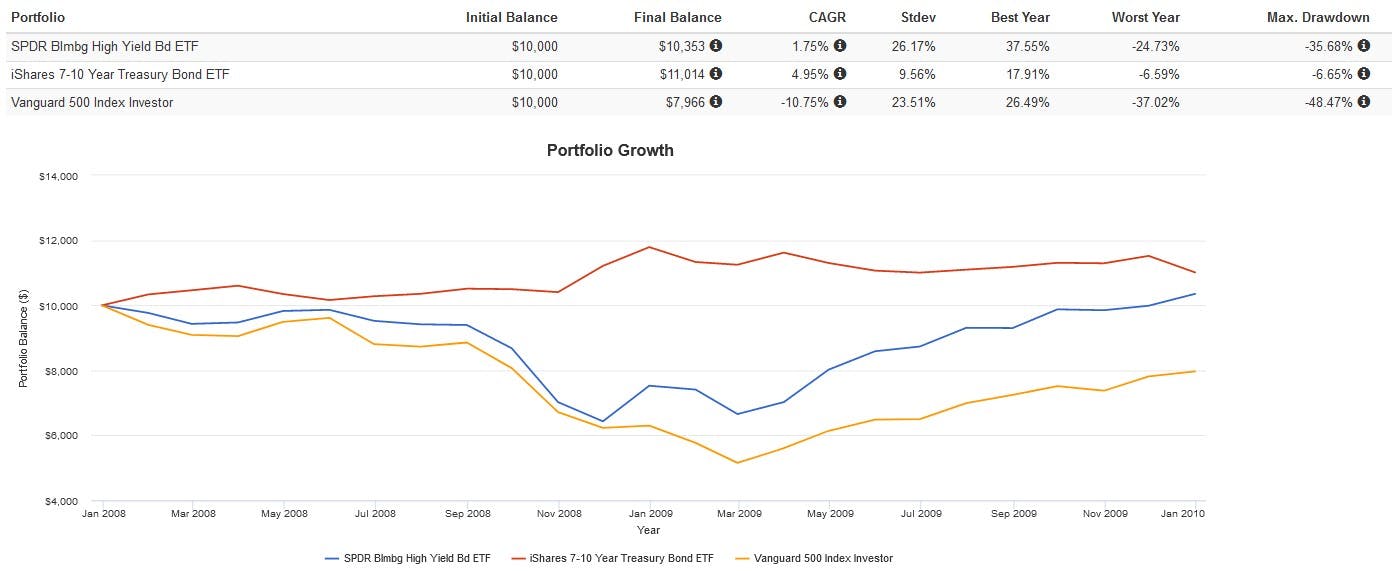
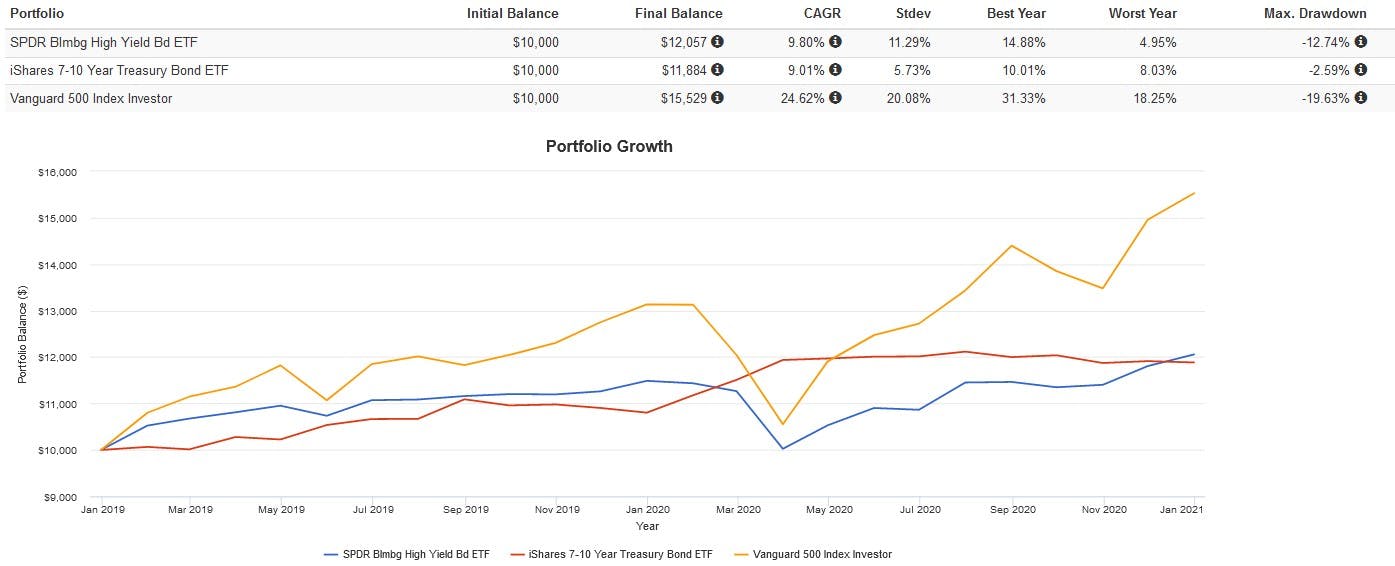
The downside to junk bonds is their greater default risk. This is primarily expressed in terms of a higher correlation with equities. For example, from 2008 – present IEF had a -0.18 correlation with the S&P 500, which made it an excellent diversifier and hedge against market corrections.
Compare this to JNK, which had a much higher 0.66 correlation with the S&P 500. In 2008 and 2020 when the market crashed, JNK suffered drawdowns of -35.68% and -12.74% respectively, falling nearly as hard as equities did. On the other hand, Treasury bonds like IEF soared.
High-yield bond ETFs
Asides from JNK, there are a variety of high-yield bond ETFs investors can buy. A great way to find them is via the Trackinsight ETF screener. Some examples include:
- iShares iBoxx High Yield Corporate Bond ETF (HYG)
- iShares Broad USD High Yield Corporate Bond ETF (USHY)
- Invesco Senior Loan ETF (BKLN)
- VanEck Fallen Angel High Yield Bond ETF (ANGL)
Data as of October 6, 2022.
Disclaimer: This article is limited to the dissemination of general information pertaining to investment strategies and financial planning and does not constitute an offer to issue or sell, or a solicitation of an offer to subscribe, buy, or acquire an interest in, any securities, financial instruments or other services, nor does it constitute a financial promotion, investment advice or an inducement or incitement to participate in any product, offering or investment.
More articles


About Trackinsight
Since our founding in 2016, we have been at the forefront of the industry, delivering accessible, comprehensive, and reliable tools to support the evolving needs of investors.
Over the past decade, Trackinsight has expanded its operations across six countries, serving thousands of professional investors. We’ve consistently innovated to provide cutting-edge solutions that meet the changing demands of the ETF market.
In 2024, Kepler Cheuvreux, a leading independent European financial services firm, acquired a majority stake in Trackinsight, becoming the company's principal shareholder.
This strategic partnership solidifies Trackinsight's position as a premier provider of ETF selection and analysis tools, while strengthening Kepler Cheuvreux’s commitment to becoming a leading player in the ETF sector.
Together, we are committed to offering advanced services that empower professional investors, advisors, institutions, and issuers. This new step enables us to deliver even more comprehensive and innovative technological solutions, driving ETF investing to new heights.
More about TrackinsightETF TOOLS
PLATFORM
ETF NEWS & RESEARCH
Privacy policy | Cookie policy | | Terms of use | Imprint