All you need to get started with ETF selection and analysis. Create your account now →
Help us improve your experience. Please confirm your investor type:
The Ultimate ETF Comparison Tool - Try Now!
Analyze up to 5 ETFs side-by-side and gain instant insights on performance, fees, holdings, and more to make data-driven investment decisions.
Which ESG strategy is right for you?
ESG Exchange-Traded Funds (ETFs) are pooled investment products that include Environmental, Social, and Governance dimensions in their investment process. There is more than one way to do so, and it is easy to feel lost among the different ESG strategies put forward by providers.
At Trackinsight, we review those products so that you don’t have to. Here’s what you need to know about the different strategies used to integrate an ESG perspective into the investment process of ETFs.
広告
Trackinsight defined four ESG strategies in collaboration with the United Nations Conference on Trade and Development (UNCTAD): Exclusion, Best-in-class, Thematic and Full Integration.
1. Exclusion ESG ETFs
Exclusion ESG ETFs do not invest in companies that do not meet certain ESG criteria. Exclusion is the simplest ESG strategy, and it is easy to apply to famous indices like the S&P 500 index to create a more sustainable version of it, by removing sectors or companies with the worst ESG scores from the portfolio.
It is frequent for funds to exclude companies involved in some ethically questionable sectors, like weapons, tobacco or gambling companies. But for ESG ETFs, the exclusion strategy can go further than this. Various criteria can be applied, such as the companies’ degree of involvement in fossil energy. The investment strategy can also set minimum standards of business practice and exclude companies that do not meet them.
The exclusion strategy was one of the first to be offered by providers, and is still very present in the ESG ETF landscape, because of its simplicity. ETFs using this ESG approach track indices that are derived from well-known indices by removing some constituents that do not fit with the ESG criteria. Exclusion ESG ETFs are easy to understand and a natural alternative for a first dip into the world of sustainable investing for investors who already have a portfolio of ETFs tracking famous market indices.
The drawback? Trackinsight research has shown that this method is the least efficient at improving the ESG score of ETFs compared with other ESG approaches. Funds adopting the exclusion screening barely improve ratings versus similar non-ESG peers. This makes sense as the strategy is the one with least modifications in portfolio holdings. This “soft” approach to ESG, merely removing the ESG laggards, cannot match shifting the investment approach to fully fulfil ESG principles.
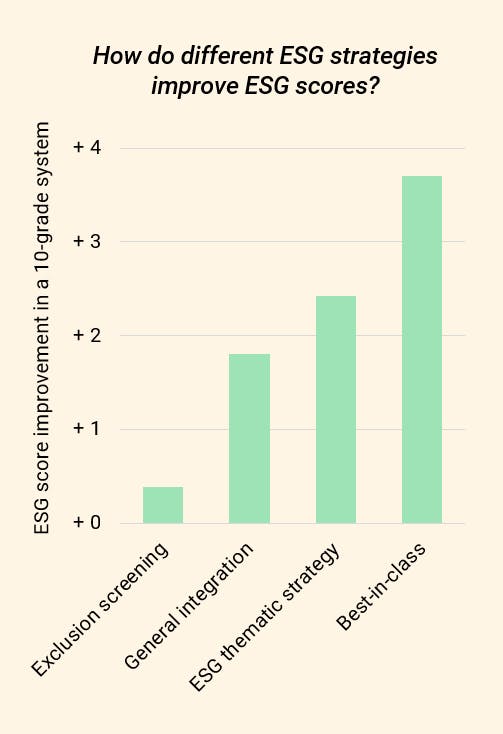
The Exclusion strategy results in ESG ETFs scoring slightly better than similar non-ESG ETFs, but this improvement is limited (less than 1 grade on average in our 10-grade scoring system). Also, by removing entire sectors, this method introduces some biases that can hurt performance when comparing with the original index. An investment bias occurs when a factor such as sector or geographical exposure is overrepresented in a portfolio.
Therefore, when choosing an ETF using the exclusion strategy, you should pay specific attention to the original investment universe, as well as to what is excluded and which biases this might introduce in your portfolio.
Examples of ESG ETFs using the Exclusion strategy
- SPDR Bloomberg SASB U.S. Corporate ESG
- iShares MSCI USA ESG Screened
- VanEck Vectors Global Equal Weight
- UBS ETF S&P Dividend Aristocrats ESG
- Wisdom Tree US Quality Dividend Growth
Is Exclusion ESG strategy right for you?
If you simply don’t want to invest in the “bad” businesses, such as weapons manufacturers, tobacco companies, or fossil fuel producers, Exclusion is the right strategy for you. ESG ETFs with this strategy will suit your needs as they screen out the worst companies in a given market. If you don’t have specific country or sector preferences, you may invest in an ETF with a broad market exposure and a “negative” ESG filter.
広告
See all Exclusion ESG ETFs available in your region.
2. Best-in-class ESG ETFs
The best-in-class approach, also known as positive screening, consists in shortlisting the most ESG-friendly companies per industry. Numerous best-in-class approaches exist but often the ETF will invest in the top companies of a given index or investment universe (like the S&P 500 index or U.S. Large Cap Stocks) ranked on specific ESG metrics.
Best-in-class ETFs are the second most popular ESG strategy in terms of assets invested around the globe. Even though this strategy has a wide range of applications with various degrees of efficiency, Trackinsight research shows the best-in-class strategy seems to be the approach that delivers the most difference in terms of ESG scores.
Not only do ESG ETFs with this strategy have a better rating, on average, than 95% of similar ETFs, but they also see the largest increase in ESG scores. This means they score better than most peers, and by a significant amount. While their peers score C+ on average (corresponding to a grade of 6 on the graph below), best-in-class ESG ETFs rank A- on average. That is a four-rank improvement!
One of the advantages to the best-in-class strategy versus exclusion is that it can respect the original index’s sector allocation, because it selects the best companies per industry. In this case, the fund’s performance will not be affected by differences in sectors exposure. For example, while Exclusion ETFs often remove companies in the oil sector altogether, some Best-in-class ETFs will keep the best (or least bad) oil companies in their portfolio.
However, not everyone agrees on the ESG rating of companies, so different providers implementing the Best-in-class strategy can end up with very different portfolios. Companies’ ESG rating often involves a part of subjectivity and it is rare for the industry to reach a consensus.
Therefore, when choosing an ETF using the Best-in-class strategy, you should pay specific attention to the original investment universe, as well as to what criteria are used to shortlist stocks and to what extent (top 20 or 50%?).
Examples of ESG ETFs using the Best-in-class strategy
- iShares MSCI Europe SRI
- UBS ETF – MSCI World Socially Responsible
- Xtrackers MSCI Japan ESG
- Amundi MSCI EMU ESG Leaders Select
- Lyxor MSCI Europe ESG Leaders
Is the Best-in-class ESG strategy right for you?
Do you only want to put your money in companies with the highest ESG scores? Then the Best-in-Class strategy is right for you. ETFs with this strategy compare the ESG scores of the companies in each industry (such as transportation, technology, healthcare) to select only the best. As a result, their portfolio contains the most sustainable companies across all industries.
広告
See all Best-in-class ESG ETFs available in your region.
3. Thematic ESG ETFs
ETFs with a Thematic ESG approach focus on a specific ESG theme such as Clean Water or Gender Equality. They invest accordingly to any of the three pillars of ESG, or a combination of them, with the underlying idea of a common theme such as Renewable Energy.
The Thematic ESG strategy is the third most popular in terms of assets, and it has seen tremendous growth recently with a lot of new ETF launches. Many of those Thematic ESG ETFs can be linked to some extent to a specific Sustainable Development Goal, so investors that are looking to invest accordingly to the sustainability principles expressed by the United Nations can easily find the right match amongst ETFs using this ESG strategy.
Check out all SDG-aligned ETFs.
While thematic investing is fun and might make you feel like you’re putting your money in future-leading industries, you should pay specific attention to the investment strategy and the resulting portfolio of Thematic ESG ETFs. Two ETFs tackling the same theme might implement the investment idea very differently, so make sure you know what is in the ETF before you buy it.
Also, compared with other strategies, Trackinsight research shows that the Thematic ESG approach is the second most efficient strategy to improve the sustainability of investments. ETFs with this strategy score better than similar ETFs 75% of the time – for an improvement of more than 2 points on average (out of a 10-grade scoring system). However, different themes result in different ESG rating. Therefore, the ESG score should not be the sole consideration when investing in an ESG thematic ETF.
When choosing an ETF using the ESG Thematic strategy, you should pay specific attention to the provider’s experience in thematic investing, as well as to what criteria are used to shortlist stocks belonging to the targeted theme and what biases are present in the final portfolio.
Examples of ESG ETFs using the Thematic strategy
- iShares Global Clean Energy
- iShares Healthcare Innovation
- Lyxor World Water
- UBS ETF – Sustainable Development Bank Bonds
- WisdomTree Battery Solutions
Is the Thematic ESG strategy right for you?
Do you have a very specific theme in mind when you think about sustainability? For example, you might want to invest in companies that derive their revenues from the clean energy business (such as solar, wind or alternative energy production). In this case, a Thematic ESG strategy is the best fit for you. Unlike the other strategies, this approach has a narrower investment focus, rather than buying the entire market.
See all Thematic ESG ETFs available in your region.
4. Full integration ESG ETFs
The Full Integration method is the most complete ESG strategy as it is a mix of other methods. In this approach, ESG criteria are incorporated at each step of the investment process, from picking stocks to deciding how much to invest in each of them.
The investment process starts with security selection. In this first step, Full Integration ETFs might exclude some companies because of their poor ESG metrics. Then during the weighting step, a company can be given a higher or lower weight based on its ESG performance. Then, each time the portfolio is reviewed (this is called “rebalancing”), the company weight in the portfolio can be adjusted upwards or downwards according to its financial performance and its ESG profile.
Today, the Full Integration strategy is the most popular ESG strategy in terms of assets invested. Surprisingly, even though it is undeniably the most popular method, and arguably the most complete, Trackinsight research shows that ESG ETFs with this strategy improve only slightly the sustainability profile of the portfolio when compared to similar non-ESG ETFs.
Therefore, when choosing an ETF using the Full Integration strategy, you should pay specific attention to the specificities of the ESG investment process, as well as to the source of the ESG data used in the mix to make sure the strategy is aligned with your beliefs.
Examples of ETFs using the Full Integration ESG strategy
- Xtrackers II ESG EUR Corporate Bond
- UBS S&P 500 ESG
- JPMorgan Global Research Enhanced Index Equity
- Amundi MSCI World Climate Transition
- iShares MSCI World ESG Enhanced ETF
Is the Full Integration ESG strategy right for you?
Do you hope to have more impact? The Full Inclusion ESG strategy could meet your needs. Going a step further than other strategies, Full Inclusion ETFs integrate ESG considerations when selecting stocks and deciding their proportion in the portfolio.
This strategy allows you to invest in your desired market, and it will adjust the weights of the stocks to give greater allocation to the ESG leaders and underweight the ESG laggards. In most cases, this approach is a trade-off between getting the market exposure and achieving a better overall sustainability score on your investment.
See all Full Integration ESG ETFs available in your region.
The need for ESG reporting standards
All in all, no ESG strategy is perfect, they all have their perks and drawbacks. Moreover, the need for more common standards of reporting has emerged. Indeed, the lack of ESG framework alignment is an open gate to ‘greenwashing’ and other dishonest practices.
This problem is addressed by regulations like the Sustainable Finance Disclosure Regulation (SFDR) and the Sustainability Accounting Standards Board (SASB) but there is still a long journey towards aligned ESG reporting standards.
Did you know?
You can search for interesting ESG ETFs using Trackinsight’s ETF screener. Various criteria are available such as the ESG rating, the ESG strategy, and the Sustainable Development Goals covered by the ETF! Click here to try the ETF screener.
その他の教育コンテンツ


About Trackinsight
Since our founding in 2016, we have been at the forefront of the industry, delivering accessible, comprehensive, and reliable tools to support the evolving needs of investors.
Over the past decade, Trackinsight has expanded its operations across six countries, serving thousands of professional investors. We’ve consistently innovated to provide cutting-edge solutions that meet the changing demands of the ETF market.
In 2024, Kepler Cheuvreux, a leading independent European financial services firm, acquired a majority stake in Trackinsight, becoming the company's principal shareholder.
This strategic partnership solidifies Trackinsight's position as a premier provider of ETF selection and analysis tools, while strengthening Kepler Cheuvreux’s commitment to becoming a leading player in the ETF sector.
Together, we are committed to offering advanced services that empower professional investors, advisors, institutions, and issuers. This new step enables us to deliver even more comprehensive and innovative technological solutions, driving ETF investing to new heights.
Trackinsightの詳細プラットフォーム
ETFニュース&リサーチ
プロフェッショナル・ソリューション
お問い合わせ