Trackinsight is part of ETF One, the fully integrated ETF platform of Kepler Cheuvreux. Learn more →
Help us improve your experience. Please confirm your investor type:
The Ultimate ETF Comparison Tool - Try Now!
Analyze up to 5 ETFs side-by-side and gain instant insights on performance, fees, holdings, and more to make data-driven investment decisions.
How DeepSeek is Upending the U.S. AI Industry
DeepSeek is disrupting the U.S. AI industry with innovative, cost-efficient solutions, challenging established tech giants.


By Leverage Shares
March 26, 2025
- Leverage Shares
- Artificial Intelligence
- Deepseek
Advertisement
On the 20th of January 2025 (a U.S. market holiday), China's Hangzhou DeepSeek Artificial Intelligence Basic Technology Research Co., Ltd — now better known as simply "DeepSeek" — announced that it is allowing public access to its large language model (LLM) named "DeepSeek-R1". Initial tests¹ of R1 showed that its performance on certain tasks in chemistry, mathematics and coding was on par with that of Microsoft partner OpenAI's model o1 — which was quite vaunted² in these areas.
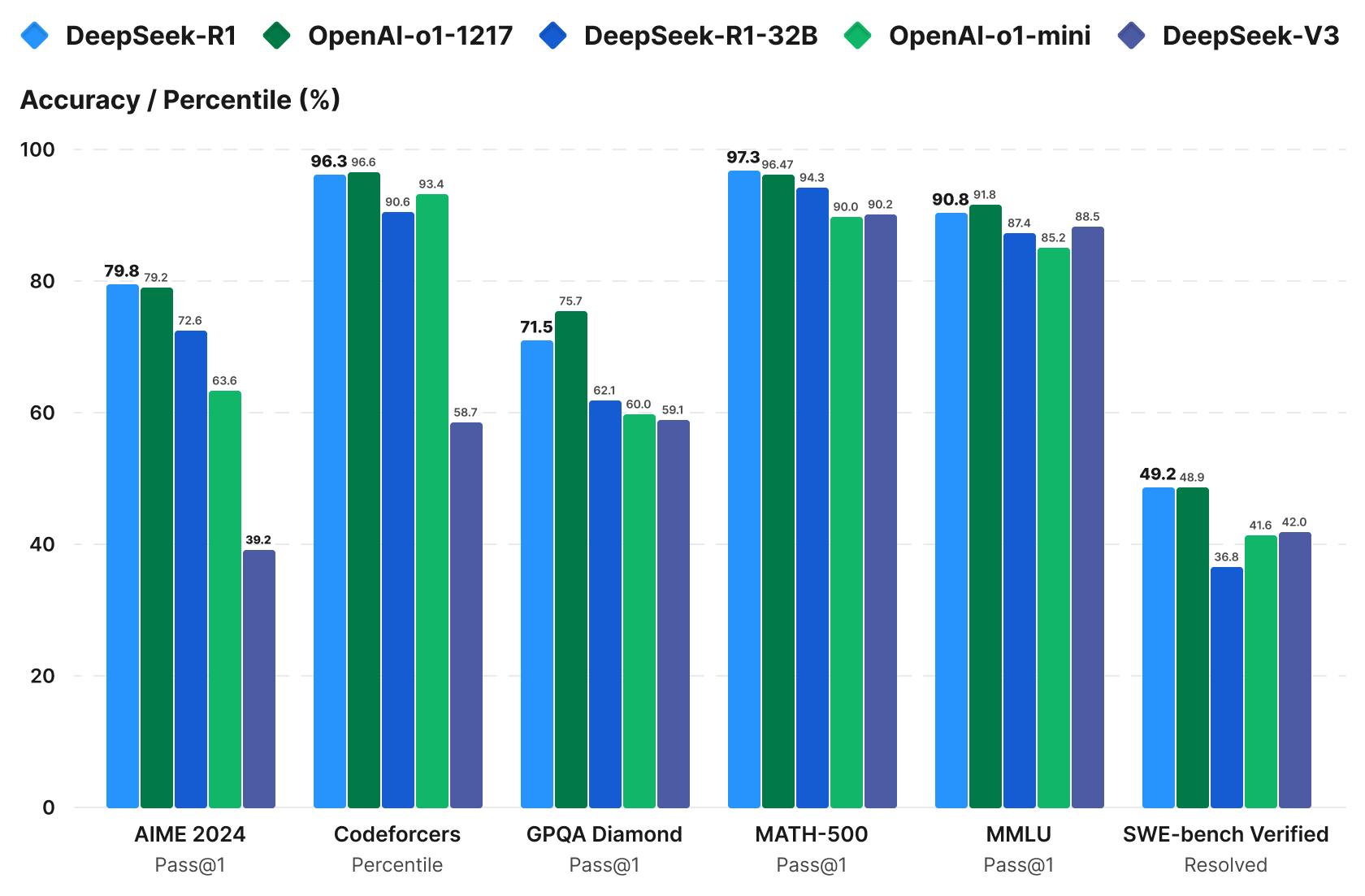
Source: “DeepSeek-R1: Incentivizing Reasoning Capability in LLMs via Reinforcement Learning” by DeepSeek
ETF Data Built for Precision
Trackinsight delivers reliable and comprehensive coverage on 14,000+ ETFs
DeepSeek reported that it attained massive improvements over previous accuracy estimates by "distilling" from other open-source models frameworks, notably Alibaba's Qwen and Meta Platforms' Llama models. The process of "distillation" can roughly be explained thus³: the larger model (like, say, the "base" DeepSeek-R1 model) is less efficient since it processes along more parameters. Generally speaking, the larger the number of parameters, the harder it is to be sustainably accurate unless a lot of computation power is deployed to crunch large volumes of data. So, to improve this, smaller models working with fewer parameters use the computation results of the larger model as a "teacher" or a baseline reference to be more efficient in arriving at a more accurate conclusion. Theoretically, this could become a two-way street between "teacher" and "student": the smaller model's efficiency could possibly be replicated into the next iteration in the larger one, making the next generation of "students" possibly even smaller or more accurate.
In DeepSeek's case, it referenced the open-source work of China-based Alibaba and U.S.-based Meta. In turn, Alibaba's Qwen model itself was a "teacher" to Stanford University's S1 model that also distilled from Google's Gemini Thinking Experimental model⁴ to outperform OpenAI's model on a set of curated questions.
Thus, while media agencies might be construed as hyping the growing capabilities of Chinese AI companies, the fact is that this is less a notch for any specific organization of a particular country. Instead, it's mostly the achievement of the open-source developers' community flourishing all over the world, including in Silicon Valley, Wall Street (to an extent), leading universities and more.
Open-Source Consideration and Whistleblowers
DeepSeek itself, however, isn't open-source in the strictest sense. Instead, they have been mostly "open-weight", i.e. while the algorithm's results can be studied and the algorithm can be used as a base to build on, the training data and code itself are not made available to the public. This in itself, however, was an improvement over other more popular LLM providers. For instance, Sam Altman-led OpenAI — which originally started under the aegis of being a "non-profit" seeking funding for research that would be made available to the world — closed off the public's access to their code's inner workings after the launch of GPT-4⁵.
One month after it published results comparing its latest accuracy results versus OpenAI, DeepSeek announced plans⁶ to share the code repository of five of its "online services", i.e. the likes of chatbots, search aggregators, etc., with the public. Sam Altman went on to say that OpenAI might be on "the wrong side of history"⁷ regarding the open-sourcing of its technologies and admitted that it's likely that the company will progressively maintain less of a lead against the rest of the industry than it did in previous years. Perhaps naturally, he didn't commit right away to revert to being an open-source initiative again, instead arguing without going into significant detail that a "different approach" is need for open-sourcing code.
Another challenge to the idea of "closed-source" corporate giants lies in how LLMs work. LLMs are "trained" to give responses to queries via databases (or "training datasets") created by essentially "scraping" the internet for human-written material. As per former OpenAI researcher-turned-whistleblower Suchir Balaji⁸, this includes everything from pirated book archives and content behind paywalls to user-generated content from platforms like Reddit and copyrighted materials without explicit permission.
OpenAI responded⁹ to the New York Times (which has published Mr. Balaji's account and has also sued both OpenAI and Microsoft for using its content to train its chatbots) by officially stating, “We build our A.I. models using publicly available data, in a manner protected by fair use and related principles, and supported by longstanding and widely accepted legal precedents. We view this principle as fair to creators, necessary for innovators, and critical for US competitiveness.”
Around one month after the exposé was published, Mr. Balaji was found dead in his San Francisco apartment, with the police ruling it as a suicide. Mr. Balaji's parents, both long-standing tech workers, continue to vehemently dispute¹⁰ this verdict.
Advertisement
OpenAI hasn't been the only one accused of violating copyright laws. Proof News — an investigative outlet working with Wired — determined in July last year¹¹ that Apple, Anthropic, Nvidia, and Salesforce used YouTube's Subtitles feature on hundreds of thousands of videos from thousands of YouTube content creators to train their models. As legal challenges mount on America's tech giants over their wholesale usage of human-created data ostensibly for free to build out their "paid services", both Google and OpenAI wrote to the Trump administration earlier this month¹² stating that copyright, privacy, and patents policies “can impede appropriate access to data necessary for training leading models” and that allowing AI companies to access copyrighted content would help the US “avoid forfeiting” its lead in AI to China respectively. Virtually the entirety of the entertainment industry and a large number of individuals stating aggrievement by the usage of their produced work without recompense stand opposed to such a measure.
Market Impact
With the publication of DeepSeek's test results and subsequent actions essentially inching towards widening the world's access to AI-relevant code development coupled with the potential for the massive usage of copyrighted/human-created work creating the looming threat of several billions in expenses by way of copyright fees and settlements on tech giants, both the "broad market" S&P 500 — which counts tech giants as prime movers in its constituent mix — as well the industry-specific Solactive US Artificial Intelligence Index (SOLUAI) have been buffeted by strong headwinds since the 20th of January:
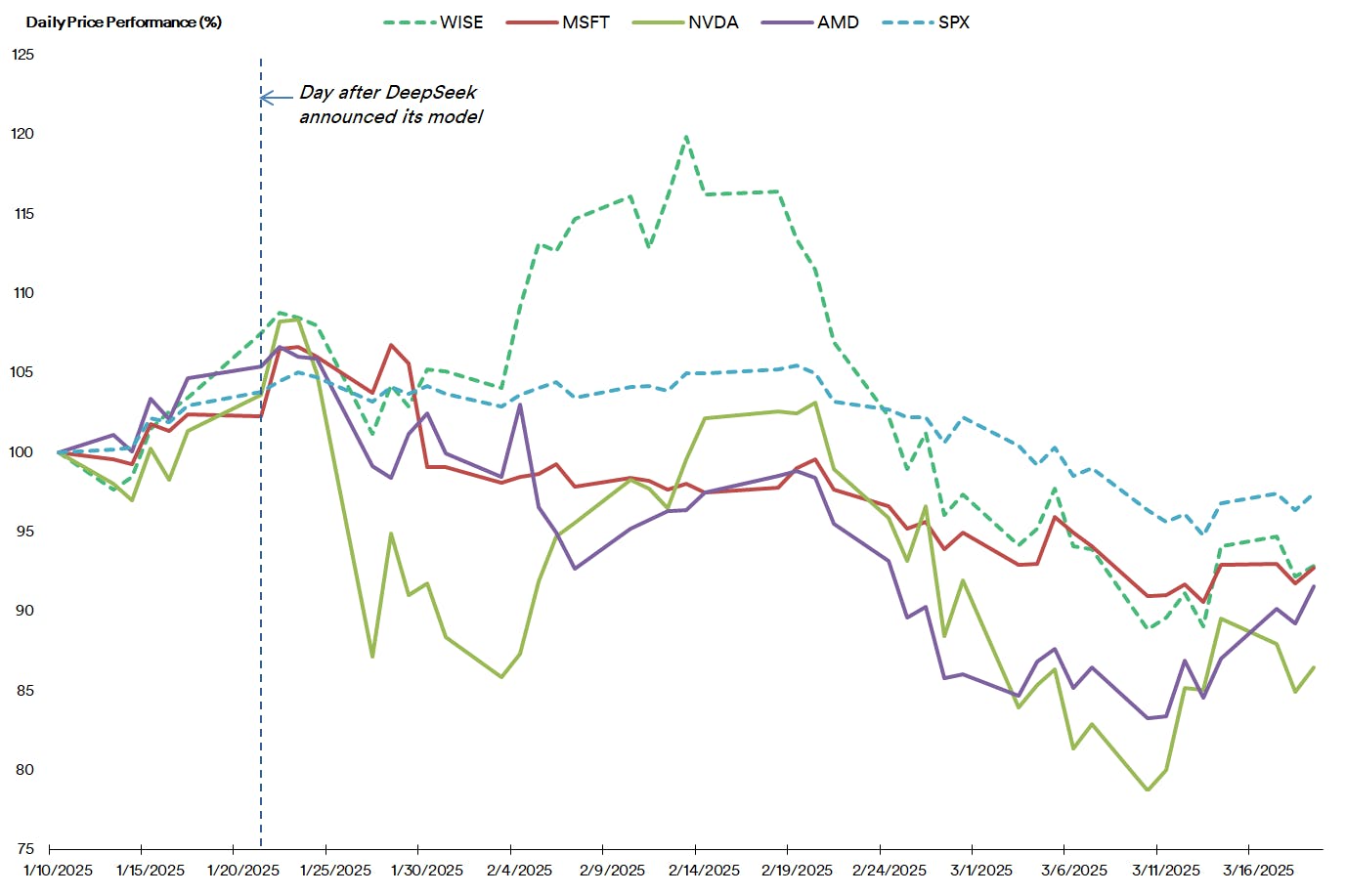
The dampening of the AI sector and the broad market is also evident in the nearly-perfect running correlations in the price performance of chipmakers such as Nvidia and AMD. For the better part of the past ten days, however, the forward outlook of AI stocks and the market received some support from the Federal Reserve as it prepared to chair its latest rate-setting Federal Open Market Committee.
The Committee's decision met consensus market expectations prior to the release of the decision¹³: rates remained unchanged for the present but at least two cuts are projected for later this year as inflationary outlook is set to heighten. As rate cuts roll in, the classical market theory holds that the incentive to hold debt assets lessens, leading to a boost in consumer borrowing/spending, thus imparting a slight tailwind to the market. Adding to this is the Federal Reserve's decision to continue scaling back its “quantitative tightening” program wherein it holds government bonds in a bid to add liquidity to the bond market.
In Conclusion
The "AI as a product" space is fraught with uncertainty from two fronts: on a forward-looking basis, building a product will be increasingly easier as concerted open-source efforts democratize the space. While it's an even bet on whether the Trump administration will amend copyright laws to benefit tech giants, U.S. tech giants face issues related to copyright infringement from all over the world. One such challenge comes from India wherein a large number of publishers¹⁴ (and their U.S.-headquartered partner firms) as well as news agencies have filed a number of copyright infringement cases in the Delhi High Court despite OpenAI's protestations. The concept of "fair dealing" central15 to Indian commercial laws is generally considered more restrictive and less flexible than the U.S.' "fair use" doctrine, with penalties and consequences potentially being much stiffer as well.
With laws differing across jurisdictions and code repositories being increasingly available for research, it's well within the likelihood that a thousand LLMs will bloom across the world (figuratively speaking, of course) and blunt the edge touted by tech players when marketing "AI as a product".
On the other hand, "AI as a service" — wherein tech players will cultivate usage of specific models to achieve specific results on behalf of a specific client or purpose — will be an interesting space to watch. This potential new space will likely have numerous players across the world wherein value propositions will be highly-nuanced and requiring careful analysis for forward outlook estimation.
For professional investors in Europe interested in the ebbs and flows of the Solactive US Artificial Intelligence Index, the Leverage Shares 3x Long Artificial Intelligence (AI) ETP (GPT3) provides magnified exposure during the upside of the index’s trajectory while the -3x Short Artificial Intelligence (AI) ETP (GPTS) does the same for the downside. Leverage Shares also issues a number of leveraged and inverse ETPs in “single names” such as Nvidia, AMD, ASML, TSMC and Super Micro that have witnessed resilient investor interest, given choppy market conditions and tactical opportunities created therein.
Advertisement
Investors with U.S. market access that are interested in broad exposure to the AI sector might want to consider the U.S.-listed Themes Generative Artificial Intelligence ETF (WISE), which tracks the Solactive Generative Artificial Intelligence Index that is currently comprised of 40 companies. For exposure to chipmakers, a variety of U.S.-listed leveraged ETFs are available for consideration: the 2x Long AMD Daily ETF (AMDG), the 2x Long Nvidia Daily ETF (NVDG), the 2x Long ASML Daily ETF (ASMG), the 2x Long TSMC ETF (TSMG) and the 2x Long ARM Daily ETF (ARMG). These “single-ticker” ETFs provide magnified exposure to the respective stocks’ trajectories. However, since there is scope for both magnified gains and losses, these instruments are suited for tactical scenarios.
About Leverage Shares
Leverage Shares is the largest European issuer of single stock ETPs by AUM & trading volume. It is the only provider of physically-backed leveraged ETPs on single stocks, ETFs and commodities.
The opinions expressed in this publication are those of the authors and are subject to change. They do not purport to reflect the opinions or views of Trackinsight or its members. Trackinsight does not guarantee the accuracy, completeness, or reliability of the information provided.
Footnotes:
¹“China’s cheap, open AI model DeepSeek thrills scientists”, Nature, 23 January 2025
² ‘In awe’: scientists impressed by latest ChatGPT model o1”, Nature, 1 October 2024
³ “Deploy DeepSeek-R1 distilled Llama models with Amazon Bedrock Custom Model Import”, AWS Machine Learning Blog, 29 January 2025
⁴ “Alibaba’s Qwen AI models enable low-cost DeepSeek alternatives from Stanford, Berkeley”, South China Morning Post, 10 February 2025
⁵ “OpenAI is getting trolled for its name after refusing to be open about its A.I.”, Fortune, 17 March 2023
⁶ “DeepSeek to open source parts of online services code”, TechCrunch, 21 February 2025
⁷ “Sam Altman: OpenAI has been on the ‘wrong side of history’ concerning open source”, TechCrunch, 31 January 2025
⁸ “Former OpenAI Researcher Says the Company Broke Copyright Law”, New York Times, 23 October 2024
⁹ “We Want To Dig Out The Truth” – Parents Of OpenAI Whistleblower Suchir Balaji”, IndiaCurrents, 28 January 2025
¹⁰ “Apple, Nvidia, Anthropic Used Thousands of Swiped YouTube Videos to Train AI”, Proof News, 16 July 2024
¹¹ “OpenAI and Google ask the government to let them train AI on content they don’t own”, The Verge, 15 March 2025
¹² “Fed holds interest rates steady, still sees two cuts coming this year”, CNBC, 19 March 2025
¹³ “Hearing in Copyright Case Against OpenAI Brought by Indian Publishers Set for March”, TechPolicy.Press, 14 February 2025
¹⁴ “AI and Fair Use: Navigating Legal Challenges in India and the United States”, Institute of Intellectual Property Research and Development, 23 January 2025
More articles


About Trackinsight
Since our founding in 2016, we have been at the forefront of the industry, delivering accessible, comprehensive, and reliable tools to support the evolving needs of investors.
Over the past decade, Trackinsight has expanded its operations across six countries, serving thousands of professional investors. We’ve consistently innovated to provide cutting-edge solutions that meet the changing demands of the ETF market.
In 2024, Kepler Cheuvreux, a leading independent European financial services firm, acquired a majority stake in Trackinsight, becoming the company's principal shareholder.
This strategic partnership solidifies Trackinsight's position as a premier provider of ETF selection and analysis tools, while strengthening Kepler Cheuvreux’s commitment to becoming a leading player in the ETF sector.
Together, we are committed to offering advanced services that empower professional investors, advisors, institutions, and issuers. This new step enables us to deliver even more comprehensive and innovative technological solutions, driving ETF investing to new heights.
More about TrackinsightETF TOOLS
PLATFORM
ETF NEWS & RESEARCH
Privacy policy | Cookie policy | | Terms of use | Imprint