Get your free ETF data sample from our comprehensive offerings. Start your free trial→
Help us improve your experience. Please confirm your investor type:
Don’t Miss a Move in the ETF Market
Sign up and keep track of everything that moved the ETF industry this week. From new launches to regulatory shifts across the Atlantic.

Musk-Trump Clash Jolted Tesla Stock
Tesla stock tumbles as Musk’s feud with Trump fuels political backlash, regulatory risk, and brand erosion.


By Leverage Shares
June 17, 2025
- Leverage Shares
- Tesla
- EV
Advertisement
- Tesla stock plunged 14% on Thursday
- Trump's bill could gut EV subsidies
- Musk’s politics weigh on Tesla’s brand image.
Trump-Musk Feud Rocked Tesla Shares
Tesla Inc. has weathered a multitude of storms since its inception, but its latest headwind may be one of the most damaging yet, an all-out political and personal brawl between CEO Elon Musk and President Donald Trump. What began as a policy disagreement over a controversial federal spending bill has spiralled into a high-stakes feud, sending shockwaves through Wall Street and leaving investors nervous about the electric vehicle (EV) maker’s near-term prospects.
Musk’s short-lived tenure as a “special government employee” advising the Trump administration ended in late May, capping 130 days of a highly publicized partnership. His exit was marked by strong opposition to Trump’s sweeping tax-and-spending proposal, which turned into personal attacks against each other on social media.¹
📊 Share your ETF outlook
From AI infrastructure to active strategies, the ETF landscape is shifting. Share your perspective in the 7th Annual Global ETF Survey and get exclusive early access to the final report.
Last Thursday, Tesla shares dropped 14% in a single day, wiping out around $150 billion in market value. This sharp decline occurred even though there were no major changes to the company’s fundamentals, highlighting how investor concerns were driven largely by political risk.
This dramatic fallout had fractured a once-unprecedented blend of political access and business advantage that Tesla had enjoyed since Trump’s re-election victory in November.
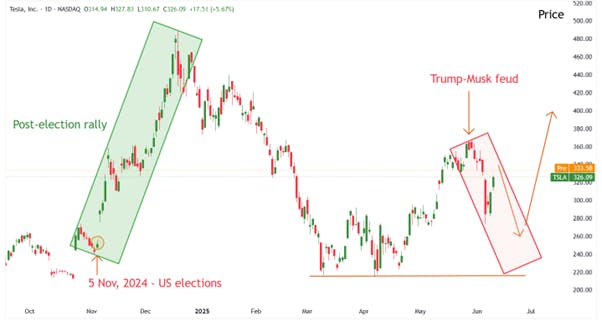
Source: TradingView, Tesla daily price chart as of 11 June 2025
A Political Fallout with Business Consequences
The fallout between Musk and Trump raises the likelihood of increased regulatory scrutiny for the company. Regulatory hurdles, potential investigations, and the rollback of EV tax credits are now plausible threats. Trump threatened to cut off government contracts with Musk’s companies, including SpaceX, which holds billions in federal deals. Investors are now worried that Tesla could face unfavourable treatment from federal agencies, particularly in areas like self-driving technology and electric vehicle subsidies.
There’s concern that the Department of Transportation and the National Highway Traffic Safety Administration could impose stricter rules, potentially mandating technologies Tesla does not currently use, such as lidar systems. Meanwhile, decisions, such as granting tariff exemptions Tesla needs for importing Chinese manufacturing equipment, may no longer find favour in Washington.
Musk’s once-beneficial political alignment with Trump has now become a liability. Hopes for regulatory support and extended tax incentives have been replaced by fears of retaliation and policy headwinds. The loss of potential tax credits and government support could hit Tesla’s profits, given Trump’s proposed budget cuts for EV subsidies.
Tesla’s brand and sales are also at risk. The company has already faced backlash in key markets like Europe and California, where customers are sensitive to political affiliations. The ongoing feud further complicates the company’s position in an already challenging environment marked by falling EV sales and increasing competition.
Tesla Faces Harsh Reality Check Amid Sliding Sales and Stalled Innovation
Even before the feud, Tesla’s fundamentals were under scrutiny. The company reported a 9% year-over-year revenue decline in Q1, with automotive revenue plunging 20% amid fierce competition from Chinese EV giants and a mounting backlash over Musk’s polarizing political stances.²
Advertisement
U.S. deliveries are trending lower this quarter, while Tesla's sales in Europe dropped 49% year-over-year in April, according to the European Automobile Manufacturers’ Association, or ACEA and experienced another double-digit decline in May.³ In China, sales for April and May were approximately 20% lower compared to the same period last year.
Innovation once a hallmark of Tesla appears to have stalled. The company has yet to release a compelling new EV model, while BYD and other Chinese players flood global markets with affordable, high-quality alternatives. Quality for Tesla is an issue, with the company announcing eight voluntary recalls of the Cybertruck in 15 months.⁴
Meanwhile, Tesla’s robotaxi ambitions remain mostly aspirational. Musk recently confirmed a pilot in Austin using a handful of Model Ys with Full Self-Driving (FSD) Unsupervised technology in a tightly geofenced area. But with Alphabet’s Waymo already operating in major cities, Tesla’s advantage in autonomy is eroding.⁵ Similarly, its humanoid robot project suffered a setback with the departure of key executive Milan Kovac.⁶
Brand Damage and Boardroom Pressure
The reputational damage is increasingly tangible. In the U.S. and Europe, Tesla faces protests, vandalism, and boycotts. Anti-Tesla ads labelling the company’s vehicles as “swasticars” have appeared in Times Square and London.⁷ The Vancouver International Auto Show even removed Tesla from its exhibitor list.
Institutional investors and public officials are raising the alarm. New York City Comptroller Brad Lander and Maryland Comptroller Brooke Lierman have publicly criticized Tesla’s board for failing to rein in Musk’s behavior, warning that the company’s governance deficiencies threaten its financial and operational future.
Maryland Comptroller Brooke Lierman also criticized Tesla’s board that it is failing to ensure the company has leadership that prioritizes Tesla’s long-term interests. She emphasized that because Musk is so closely tied to Tesla’s identity, the board must work to ensure the company can thrive independently of any single individual. Musk’s conduct poses an ongoing risk to Tesla’s future, warning that his divisive public image continues to erode the brand, one of the company’s most valuable assets.¹
Valuation Stretched, Fundamentals Weak
Despite the price rebounding this week, Tesla’s shares are down 20% year-to-date and still trade at lofty earnings expectations multiples. Given the weakness in global deliveries and sales in Europe, a re-test of the post-election high of $488.54 might not be seen in the short term.
The evaporation of potential Republican support only worsens Tesla’s outlook. With Musk estranging Republican supporters, there's little remaining support to sustain positive consumer sentiment toward Tesla, potentially leading to a decline in the brand’s public perception.
Advertisement
Despite the turmoil, the selloff might be overdone as Tesla remains strong in AI, robotics, manufacturing, and renewable infrastructure. Musk’s long-term vision on robotaxis, humanoid robots, and vertical integration across energy and mobility may continue to draw investor interest, despite the reality that execution has repeatedly lagged promises, and public patience may be wearing thin.
Conclusion
Elon Musk’s recent public conflict with former President Donald Trump appears to be aimed at drawing widespread attention to broader political and economic issues that Musk deems important, such as the U.S. national debt and fiscal outlook. While this political engagement might generate negative sentiment toward Tesla’s brand in the short-term, it seems to be a deliberate part of Musk’s broader strategy rather than a spontaneous outburst. For those who expected Musk to solely focus on Tesla’s operations, this clash with President Donald Trump reinforces the reality that his business and political interests remain closely intertwined.
Investors should be prepared for heightened volatility in Tesla’s stock if tensions between Musk and political figures continue or intensify. That said, despite the risks associated with Musk’s controversial public persona, the long-term prospects for Tesla remain strong. The company continues to be well-positioned for growth in advanced technological areas like autonomous vehicles, robotics, energy storage, and infrastructure, which are expected to deliver far greater value than the traditional electric vehicle business alone. In light of these opportunities, Tesla maintains a strong position among top automotive innovators in the U.S. market.
About Leverage Shares
Leverage Shares is the largest European issuer of single stock ETPs by AUM & trading volume. It is the only provider of physically-backed leveraged ETPs on single stocks, ETFs and commodities.
The opinions expressed in this publication are those of the authors and are subject to change. They do not purport to reflect the opinions or views of Trackinsight or its members. Trackinsight does not guarantee the accuracy, completeness, or reliability of the information provided.
Footnotes:
² Tesla Q1 2025 Quarterly Update: https://digitalassets.tesla.com/tesla-contents/image/upload/IR/IR/TSLA-Q1-2025-Update.pdf
⁴ CNET: https://www.cnet.com/home/electric-vehicles/every-tesla-cybertruck-recall-thats-happened-so-far/
⁵ CNBC: https://www.cnbc.com/2025/05/20/elon-musk-tesla-robotaxi.html
⁷ Newsroom: https://www.newsweek.com/activists-brand-tesla-vehicles-swasticar-stickers-2023645
More articles


About Trackinsight
Since our founding in 2016, we have been at the forefront of the industry, delivering accessible, comprehensive, and reliable tools to support the evolving needs of investors.
Over the past decade, Trackinsight has expanded its operations across six countries, serving thousands of professional investors. We’ve consistently innovated to provide cutting-edge solutions that meet the changing demands of the ETF market.
In 2024, Kepler Cheuvreux, a leading independent European financial services firm, acquired a majority stake in Trackinsight, becoming the company's principal shareholder.
This strategic partnership solidifies Trackinsight's position as a premier provider of ETF selection and analysis tools, while strengthening Kepler Cheuvreux’s commitment to becoming a leading player in the ETF sector.
Together, we are committed to offering advanced services that empower professional investors, advisors, institutions, and issuers. This new step enables us to deliver even more comprehensive and innovative technological solutions, driving ETF investing to new heights.
More about TrackinsightETF TOOLS
PLATFORM
ETF NEWS & RESEARCH
Privacy policy | Cookie policy | | Terms of use | Imprint