Global ETF Survey 2026: Answer now →
Help us improve your experience. Please confirm your investor type:
Don’t Miss a Move in the ETF Market
Sign up and keep track of everything that moved the ETF industry this week. From new launches to regulatory shifts across the Atlantic.
Nvidia's Q1 Earnings Price Bump Might Not Last. Here’s Why.
Nvidia beats Q1 earnings despite a $4.5B China export ban hit, but slowing growth and insider stock sales hint at turbulence ahead.

By Leverage Shares
May 30, 2025
- Leverage Shares
- Nvidia
- Information Technology
Advertisement
Market-leading chipmaker Nvidia, Inc (ticker: NVDA) walked up to its first quarter (Q1) earnings for its Fiscal Year (FY) 2026 on the 28th of May with a warning that its total revenues will be taking a hit after the U.S. administration continued with a largely-bipartisan effort enacted over the course of the past five years to restrict sales of advanced technology to China by including its "China-specific" H20 chips with immediate effect.
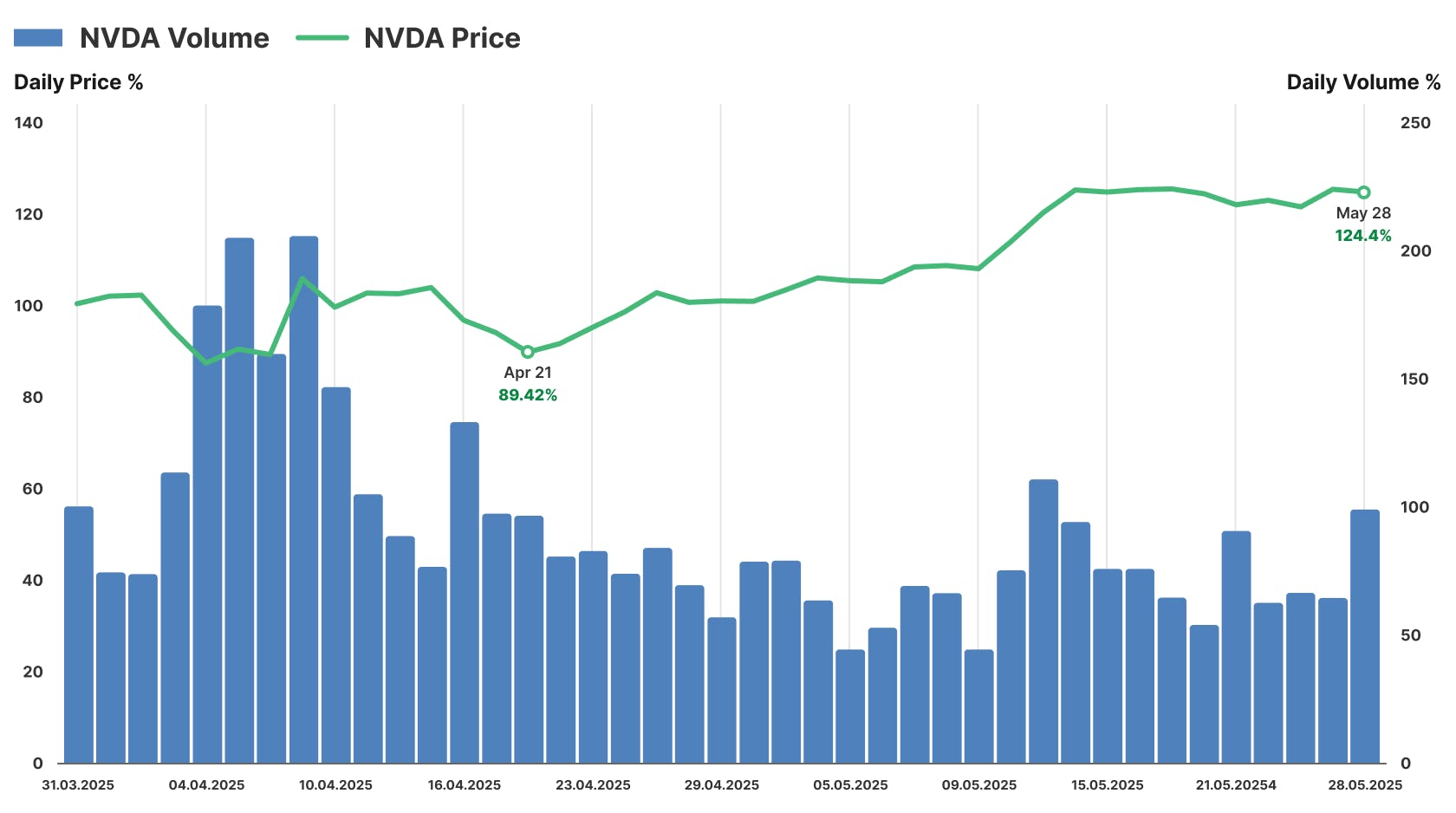
In the fortnight leading up to the Q1 2026 earnings release, the company's stock essentially held steady around the $124 level attained on the 14th of May.
📊 Share your ETF outlook
From AI infrastructure to active strategies, the ETF landscape is shifting. Share your perspective in the 7th Annual Global ETF Survey and get exclusive early access to the final report.
Source: Leverage Shares analysis
Traded volumes shrunk back from the highs seen in early April after President Trump's "Liberation Day" tariffs were announced and followed by tightening controls on technology sales to China. Given the rise seen, traded volumes could be considered cautiously bullish.
By reporting revenue of $44.1 billion for Q1 2026 versus Bloomberg-compiled analyst estimates of $43.3 billion and delivering adjusted earnings per share (EPS) of $0.96 (excluding the "charge" from the loss of H20 chip sales to China) versus an estimate of $0.93, the company is adjudged by analysts as having passed muster.
However, the bottom line is definitely taking a hit in trends.
Trend Analysis
Note: As of at the time of writing, the company hasn't furnished the more-detailed 10K statement submitted to the SEC.
As per the company, a little over 10% of its revenue in Q1 2026 – $4.6 billion – was from H20 sales to China before the export restrictions kicked in and caused a nearly equivalent charge of $4.5 billion.
Nonetheless, early revenue trends seem encouraging – at least at first blush.
Advertisement
Source: Company Information; Leverage Shares analysis
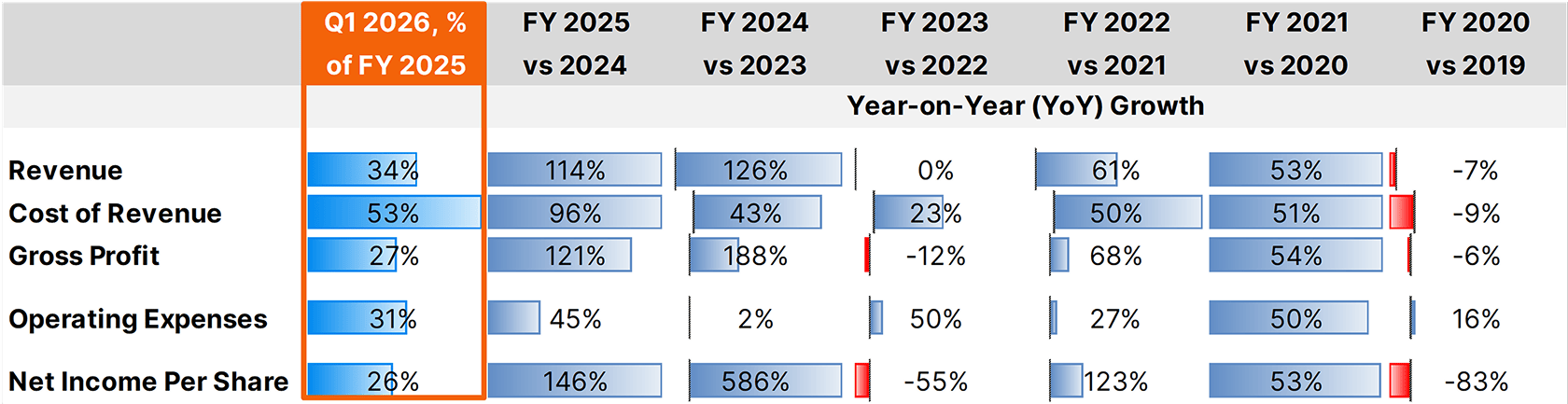
If trends were to continue, the company would have realized a 36% growth in revenue in FY 2026, which is a third of what was achieved in the previous FY. Meanwhile, cost of revenue is already trending to be 112% higher for FY 2026, which is somewhat consistent with what was witnessed in the previous FY. CFO Collette Kress' commentary states that this is due to higher compensation expenses (which would likely be reflected in the Stock-Based Compensation figures that are currently not available) as well development costs for new products (which would have been reflected in R&D costs, also not currently available).
Net Income per share is currently trending to close FY 2026 with a paltry 4% growth, which is a mighty fall from the triple-digit percentage growth seen over the past two FYs.
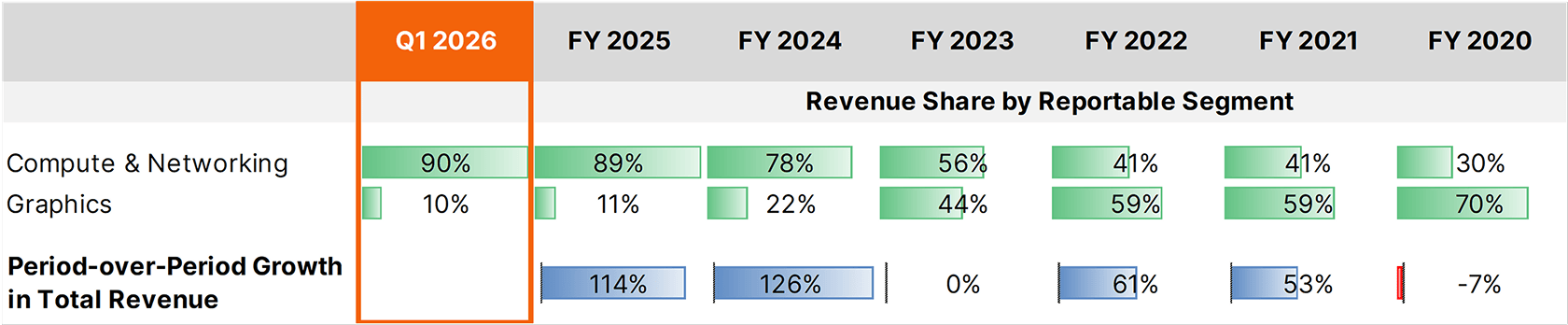
The company's "Compute and Network" segment continues to grow on the back of datacentre demand.
Source: Company Information; Leverage Shares analysis
Graphics cards – once its mainstay that endeared the company's products among gamers all over the world – remains on a decline. Also, the "OEM and Other" revenue category – which encompasses robotics, embedded systems, and AI-powered products for industrial automation – registered a 12% quarter-on-quarter decrease. If this trend continues, the company is essentially set to be mostly (if not nearly wholly) dependent on datacentre demand for its cash flows.
Advertisement
The language of the earnings call heavily emphasized its new achievements on datacentres: the company's Blackwell platform was reported to have set records in AI-driven inference results by delivering up to 30 times higher throughput and Blackwell cloud instances are now reported as being available on Amazon’s AWS, Google Cloud, Microsoft Azure and Oracle Cloud Infrastructure. Also announced were a host of initiatives to build AI factories in Saudi Arabia and infrastructure clusters in Abu Dhabi, plans to work on an AI factory supercomputer in collaboration with Foxconn and the Government of Taiwan, as well as a research center in Japan.
In Conclusion
The company estimates that Q2 2026 revenue will effectively run par with Q1's at $45 billion. Considering the fact that this excludes sales to China, this represents a net 10% increase in global demand, ex-China. In terms of top line trends, this is a net positive despite not being quite as dramatic as those witnessed in prior quarters. Gross margins, on the other hand, shot up 10% to 71% after the loss of China business and raw material obligations piled up. As the company recognizes a further $8 billion charge in Q2 from the loss of access to China, this means that the 71% margin will continue to weigh down earnings. CEO Jensen Huang stated that the $50 billion China market is effectively closed to U.S. industry as a whole and that the company is currently exploring limited ways to compete in it. However, given the highly-focused nature of export restrictions, Nvidia likely won't be able to compete in it for a while.
A lot of the valuation premium that Nvidia's stock exhibited in price ratio terms over its peers in the semiconductor industry came from its massive top- and bottom-line growth as it made inroads in datacenters all around the world (including China). With bottom-line trends likely affected with new product rollouts, inventory reordering and relatively stable demand from the rest of the world, a correction in the valuation premium to the tune of 10-15% is quite likely over the course of Q2 earnings. Management actions, for one, seem to bear out the notion that Nvidia’s high valuations are transient: as per Rule 10b5-1 plans filed with the SEC¹, CEO Jensen Huang sold 6 million shares in 2025 for $713 million and plans to sell another 6 million in 2026 for $800 million by present-day valuations. Similarly, CFO Colette Kress sold 500,000 shares in 2025 for $61.7 million and is set to sell another 500,000. For the first time, Nvidia director Brooke Seawell has filed a plan to sell 1.15 million shares valued at $155 million.
Regardless of CEO Huang's statements about China, the company isn't massively affected at least in the present by the loss of the China market. However, the forward growth outlook in the ticker is a different matter: as growth softens, the sky-high valuation will be tested and perhaps found wanting. There will likely be tactical trading opportunities galore on both the upside as well as the downside for the next three months (if not further). Growth-oriented investors, on the other hand, might have to make do with overall single-digit percentage growth for the duration of FY 2026.
Professional investors in Europe might do well to consider leveraged ETPs to capitalize on the stock’s inevitable turbulence going forward. The +3x Long NVIDIA ETP (NVD3) offers magnified return during the upsides of the stock’s trajectory while the -3X Short NVIDIA ETP (NV3S) does the same during the downside.
Also worthy of consideration is the NVIDIA Options ETP (LSE ticker: NVDI), which seeks to generate monthly income by buying NVIDIA shares, selling up to 5% ‘out-of-the-money’ (OTM) weekly call options on NVIDIA and paying a return on the premia collected.
Footnotes:
¹ “CEO Jensen Huang to Sell $800 Million of Nvidia Stock”, MSN, 29 May 2025
More articles


About Trackinsight
Since our founding in 2016, we have been at the forefront of the industry, delivering accessible, comprehensive, and reliable tools to support the evolving needs of investors.
Over the past decade, Trackinsight has expanded its operations across six countries, serving thousands of professional investors. We’ve consistently innovated to provide cutting-edge solutions that meet the changing demands of the ETF market.
In 2024, Kepler Cheuvreux, a leading independent European financial services firm, acquired a majority stake in Trackinsight, becoming the company's principal shareholder.
This strategic partnership solidifies Trackinsight's position as a premier provider of ETF selection and analysis tools, while strengthening Kepler Cheuvreux’s commitment to becoming a leading player in the ETF sector.
Together, we are committed to offering advanced services that empower professional investors, advisors, institutions, and issuers. This new step enables us to deliver even more comprehensive and innovative technological solutions, driving ETF investing to new heights.
More about TrackinsightETF TOOLS
PLATFORM
ETF NEWS & RESEARCH
Privacy policy | Cookie policy | | Terms of use | Imprint