Trackinsight is part of ETF One, the fully integrated ETF platform of Kepler Cheuvreux. Learn more →
Help us improve your experience. Please confirm your investor type:
The ETF Industry Is Evolving Fast
From AI infrastructure to active strategies, the ETF landscape is shifting. Share your perspective in the 7th Annual Global ETF Survey.
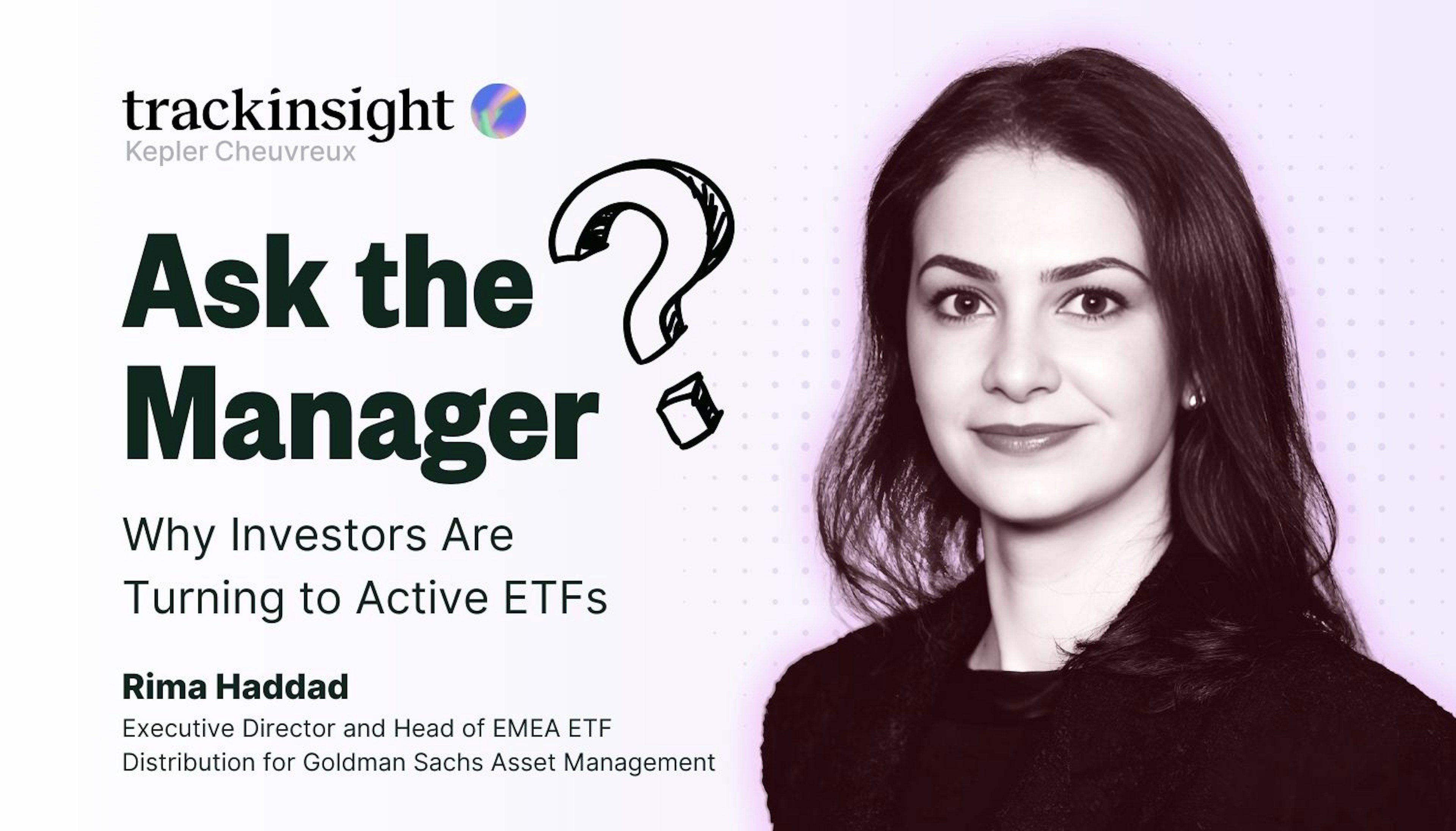
Ask the Manager: Rima Haddad on Why Investors Are Turning to Active ETFs
Why are investors turning to Active ETFs? Goldman Sachs' Rima Haddad breaks down their growing appeal, liquidity advantages, and market impact.

By Trackinsight
March 11, 2025
- Active
- Goldman Sachs
Advertisement
Rima Haddad, Executive Director and Head of EMEA ETF Distribution at Goldman Sachs Asset Management, joins our Ask the Manager series to shed light on the growing demand for Active ETFs, their role in portfolio diversification, and the broader macro outlook for 2025.
Where is the demand for Active ETFs coming from?
ETFs have been around for more than 30 years, and for most of that time, they’ve been largely associated with passive investing and index-tracking funds. But that’s been changing.
📊 Share your ETF outlook
From AI infrastructure to active strategies, the ETF landscape is shifting. Share your perspective in the 7th Annual Global ETF Survey and get exclusive early access to the final report.
Active ETFs first came onto the scene in 2008, and in recent years, we’ve seen a real surge in demand as investors look to combine the benefits of the ETF wrapper—liquidity, diversification, and transparency—with the added advantage of active management and the potential for alpha generation.
While passive ETFs still make up the majority of total assets, we’re seeing a strong shift toward active strategies. More investors are recognizing the value of an actively managed approach within an ETF structure, and as new products continue to hit the market, that demand is only growing.
Just look at 2024—active ETFs expanded nearly five times faster than passive ETFs. And there are a few key reasons behind that:
Firstly, investors, particularly those focused on fixed income, are increasingly looking for active solutions. From a macro perspective, fixed income has moved from an era of accommodative policy, low borrowing costs, and low volatility to a market environment where policy is likely to remain structurally tighter, with elevated borrowing costs, and heightened volatility risks.
Due to these structural shifts, there is growing demand among fixed income investors for managers with deep research capabilities, robust investment frameworks and with multi-faceted risk management capabilities to manage downside risk.
Secondary, active ETFs are becoming the preferred delivery mechanism to gain exposure to these active opportunities and alongside their benefits, are the perfect bridge. They combine the best of both worlds: the transparency, liquidity, and cost efficiency, with the flexibility and alpha potential of active management.
This is particularly valuable within fixed income, where market fragmentation and macro divergence require the precision of active strategies. In such a market, passive strategies - in particular passive ETFs - are increasingly viewed as tools for liquidity management or gaining temporary exposure, while active strategies are becoming indispensable for navigating complexity and tailoring to specific objectives.
Lastly, as new products enter the market, investors are increasingly using ETFs not only as a means of market entry, but the active variety are being seen as solutions to various client objectives and tools for portfolio implementation and construction.
Advertisement
We believe research expertise, portfolio construction, and robust risk management can combine to deliver on client objectives, whether the focus is on income generation, diversification or aligning portfolios with sustainability goals.
How do Active Fixed Income ETFs offer portfolio diversification over traditional passive strategies?
One of the biggest challenges with passive fixed income ETFs is that their indices don’t always represent the full market. Take the Bloomberg US Aggregate Index, for example—it excludes nearly half of the fixed income opportunity set, leaving out key asset classes like high-yield corporates and non-agency mortgage-backed securities. That means passive strategies may not provide the broad market beta that many investors assume they do.
Given that the global fixed income market is worth over $140 trillion and spans millions of securities across different types, maturities, and credit ratings, we believe active investing is a natural fit for fixed income. By combining active management with the ETF structure, investors get an added layer of diversification and flexibility to navigate shifting market conditions.
Unlike traditional passive strategies, active ETFs allow managers to adjust sector composition, duration exposure, and security selection in response to evolving trends. They also benefit from deep fundamental research, helping to identify issuers positioned for both cyclical and structural shifts. This ability to dynamically allocate and select securities isn’t just about potential alpha—it’s also a key tool for managing risk.
Take investment-grade credit, for instance. We see a favorable macro backdrop and strong credit fundamentals, so we focus on sectors with growth potential and a stable customer base. We’re also constructive on BBB-rated bonds in the U.S., even with tighter spreads, because we expect fallen angel activity to remain limited. Another area we find compelling is the front-end of the corporate credit curve. However, some passive indices exclude bonds with maturities under three years, which limits their ability to generate alpha.
Ultimately, this flexibility is what sets active ETFs apart. They help mitigate risks and capture opportunities that a static, index-based strategy might miss.
In what ways do Active Fixed Income ETFs offer liquidity advantages over traditional bond investments?
ETFs have several built-in features that give them a liquidity edge over traditional bond investments. First, because ETFs trade on an exchange, they offer intra-day trading flexibility, whereas traditional bonds are traded over the counter with limited windows. This ability to trade throughout the day provides investors with much easier access to liquidity.
Another key advantage is transparency. ETFs disclose their holdings daily, which helps with price discovery, even during volatile or illiquid market conditions. That’s a big plus compared to the bond market, where pricing can sometimes be opaque.
Advertisement
Then there’s the in-kind creation and redemption mechanism, which is a major differentiator. This process allows authorized participants to facilitate large block trades without being directly impacted by the availability of the underlying bonds in the secondary market. In other words, it helps maintain liquidity regardless of how much trading is happening in the ETF itself.
This was especially evident during the COVID-19 crisis. While cash bond trading deteriorated, ETF trading surged across all asset classes—particularly in Fixed Income. Investors relied on ETFs to gain bond market exposure, especially in less liquid markets like high yield.
Ultimately, ETFs provide a more efficient way to maintain liquidity, manage market stress, and offer investors a practical alternative to traditional bonds.
What are the main considerations for investors when using Active ETFs?
Active ETFs are reshaping how investors approach the fixed income market, offering a combination of dynamic management, security selection, and the tradability, liquidity, and cost-effectiveness of ETFs. One crucial aspect is evaluating the issuer’s investment process to ensure it is robust and well-structured.
As demand for Active ETFs continues to grow, we are committed to expanding our offering by leveraging our deep research capabilities and providing solutions that blend the benefits of active management with the efficiency of an ETF structure.
With over $3.1 trillion in assets under management, our goal is to lead in this space, delivering products that help clients achieve their investment objectives.
What's your Macro Outlook for 2025
Our central bank expectation for 2025 is a continued global expansion, further easing of inflation and broadening central bank rate cuts. However, US policy shifts add a new layer of uncertainty to the outlook.
With incoming policy announcements, particularly across trade, fiscal, and immigration, we remain focused on fundamentals such as labor market conditions, which inform consumer spending, and the health of private sector balance sheets, which continue to support income potential across various fixed income sectors.
Each G10 economy starts 2025 with lower inflation compared to the start of 2024. Consequently, we expect every G10 central bank, except the Bank of Japan (BoJ), to deliver rate cuts in 2025.
About Rima Haddad
Rima is an Executive Director and head of EMEA ETF Distribution for Goldman Sachs Asset Management in London. She has over 20 years’ industry experience with over 16 years working in dedicated ETF distribution roles at leading firms. Prior to joining Goldman Sachs, she led the UK Institutional coverage for State Street’s SPDR ETF business, and was previously at ETF Securities where she held various roles as Head of the UK, Switzerland and Middle East. Rima graduated from King’s College London with a First Class BSc. Honours degree in Business Management.
Please be advised that the views shared in this Q&A represent the expert's perspective and should not be considered financial advice. This information is provided for educational purposes only. Always consult with a registered financial professional before making any investment decisions.
More articles


About Trackinsight
Since our founding in 2016, we have been at the forefront of the industry, delivering accessible, comprehensive, and reliable tools to support the evolving needs of investors.
Over the past decade, Trackinsight has expanded its operations across six countries, serving thousands of professional investors. We’ve consistently innovated to provide cutting-edge solutions that meet the changing demands of the ETF market.
In 2024, Kepler Cheuvreux, a leading independent European financial services firm, acquired a majority stake in Trackinsight, becoming the company's principal shareholder.
This strategic partnership solidifies Trackinsight's position as a premier provider of ETF selection and analysis tools, while strengthening Kepler Cheuvreux’s commitment to becoming a leading player in the ETF sector.
Together, we are committed to offering advanced services that empower professional investors, advisors, institutions, and issuers. This new step enables us to deliver even more comprehensive and innovative technological solutions, driving ETF investing to new heights.
More about TrackinsightETF TOOLS
PLATFORM
ETF NEWS & RESEARCH
Privacy policy | Cookie policy | | Terms of use | Imprint