Global ETF Survey 2026: Answer now →
Help us improve your experience. Please confirm your investor type:
The Ultimate ETF Comparison Tool - Try Now!
Analyze up to 5 ETFs side-by-side and gain instant insights on performance, fees, holdings, and more to make data-driven investment decisions.
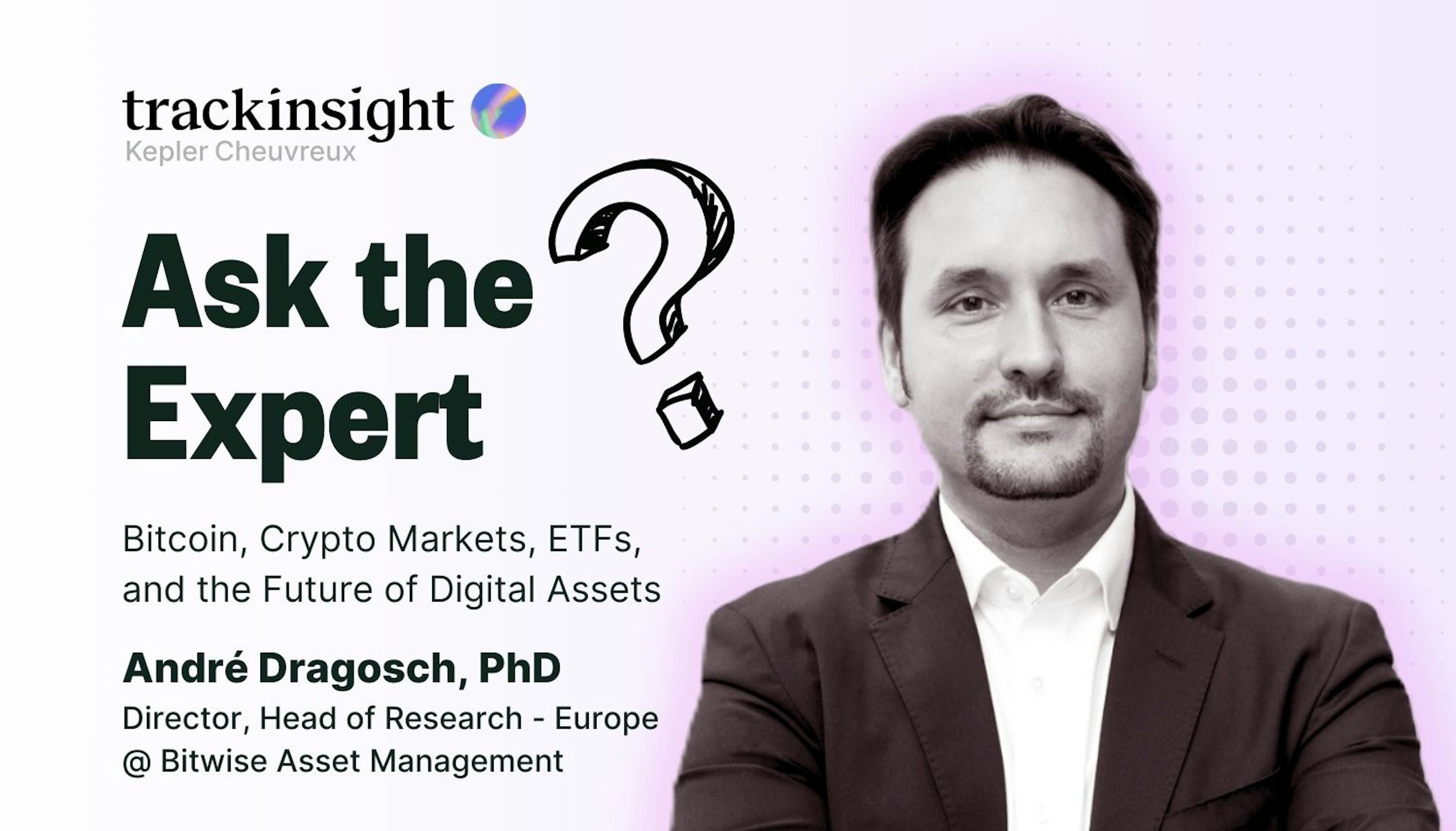
Ask the Expert: André Dragosch on Bitcoin, Crypto Markets, ETFs, and the Future of Digital Assets
From Bitcoin’s future to crypto regulation—André Dragosch, PhD, answers the biggest questions in digital assets.

By Trackinsight
March 4, 2025
- Bitcoin
- Cryptocurrencies
Advertisement
André Dragosch, PhD, Director, Head of Research - Europe at Bitwise Asset Management, joins our "Ask the Expert" series to answer some of the most pressing questions on Bitcoin, blockchain technology, and the evolving crypto landscape.
I can make a POW blockchain, so surely that can replace Bitcoin
There have been many copies of Bitcoin (BTC) but many have failed to gain significant network participation and market cap compared to the original blockchain launched in 2009. This has several reasons:
📊 Share your ETF outlook
From AI infrastructure to active strategies, the ETF landscape is shifting. Share your perspective in the 7th Annual Global ETF Survey and get exclusive early access to the final report.
- First-mover-advantage: Bitcoin has been the very first of its kind and has therefore had more time to establish brand recognition and attract capital and developers.
- Although Bitcoin’s source code can be copied, the size of the network and security can’t. At the time of writing, the Bitcoin network operates with a hash rate of approximately 861.05 exahashes per second (EH/s). An exahash represents one quintillion (10^18) hash computations per second. In comparison, the world's most efficient supercomputer, "Henri," achieves a peak performance of 3,579.13 teraflops per second. A teraflop equates to one trillion (10^12) floating-point operations per second. This indicates that the decentralized Bitcoin network processes hash computations at a rate equivalent to approximately 240,656 of the most advanced supercomputers operating at their maximum capacity. The network's decentralization is further evidenced by over 21,370 active full nodes worldwide. This extensive distribution, coupled with the substantial computational power securing the network, is unparalleled and cannot be easily replicated. Hard forks of the original Bitcoin, such as Bitcoin Cash (BCH) and Bitcoin Satoshi Vision (BSV), do not approach the computational strength of Bitcoin (BTC).
How can you prove Bitcoin will be here in 1000 years, if you can’t then surely gold is better
You can’t say for sure, but you can say that Bitcoin will most likely survive for at least another 16 years due to the so-called “Lindy Effect”. The Lindy Effect states that the future lifespan of a business is proportional to its previous time of survival.
In general, the longer Bitcoin survives, the higher the probability for survival in the future.
Besides, the age of an established asset is no guarantee that it won’t be technologically disrupted at some point in the future. Mankind used to ride horses for thousands of years before the automobile was invented which made horses obsolete as transportation technology.
Mankind used to use candles for thousands of years before electric light bulbs were introduced that made candles obsolete as light technology. Since Bitcoin is technologically superior to gold, we expect that Bitcoin will eventually disrupt gold as well despite its shorter track record and make gold obsolete as monetary technology.
With quantum computing I’ll be able to steal your bitcoin so how can it be an investable asset or store of value?
This appears to be unlikely for several reasons: First, Bitcoin miners are usually the first users of the most cutting-edge technology in Bitcoin mining. So, it is quite likely that they will also be the first to adopt quantum computing miners to have a technological advantage in terms of hashing efficiency.
In other words, the Bitcoin mining network will become more secure, not less because of quantum computing. Moreover, there are already quantum-resistant wallet addresses available on the Bitcoin blockchain. At some point most of the users will probably switch to these new addresses.
Do you think the record flows into US spot Bitcoin ETFs from 2024 will continue in 2025?
Yes, our base case is that net inflows into US spot Bitcoin ETFs in 2025 will at least match those of 2024 and most-likely even slightly surpass those record inflows. There are 3 key reasons for this:
- Year one is typically the slowest year for ETFs.
- Major wirehouses are just starting to come online in the US.
- Investors are laddering up-3% is the new 1%-based on our latest survey of financial advisors in the US.
What impact do ETF flows have on the crypto market right now?
ETF flows, especially for Bitcoin, have played an increasingly important role for the performance. Based on our statistical analysis, the performance variation in Bitcoin explained by changes in global ETP fund flows has been steadily increasing and has now reached around 50%. In other words, approximately half of Bitcoin’s performance could be explained by flows into global Bitcoin ETPs over the past 6 months.
Macro factors have also played a large role in shaping these flows such as global growth expectations that tend to cycle with overall cross asset risk appetite.
Advertisement
What will be the impact of the FCA allowing retail to access crypto assets, for the UK and Europe?
Although institutional ownership of cryptoassets has been growing strongly, we think that the global crypto ETP market still remains mostly retail dominated. For instance, the most recent 13F filings in the US have revealed that non-institutional investors still account for around 75% of AuM ownership in spot Bitcoin ETFs.
Therefore, any approval of retail access to crypto ETPs in the UK could have a sizeable impact on the market. We generally advocate for an easy retail access because ETPs are regulated financial instruments and therefore safer than some dubious crypto service providers online. In general, we believe that retail access to crypto ETPs in the UK could foster retail investor protection.
With all the growth from traditional industries and on chain activity on Ethereum, why is the price flagging?
We think that Ethereum generally suffers from “middle child syndrome” right now – it is not as scalable as Solana (SOL) and at the same time not as secure and established as Bitcoin (BTC). This makes Ethereum a relatively unattractive cryptoasset for retail investors. That being said, we continue to see very high dominance in emerging themes like real-world asset (RWA) tokenization and stablecoin issuances which primarily happen on Ethereum.
The reason is that especially institutional investors and companies prefer the security of established smart contract platforms like Ethereum relative to Solana or others. We believe that both of these themes will be a major driver of on-chain activity on Ethereum over the coming months and could lead to a renewed outperformance.
What's the impact of investing in crypto?
There are several studies that emphasize the favorable impact of adding cryptoassets to a multiasset portfolio. A small allocation of cryptoassets (ideally around 3%) in a multiasset portfolio can significantly enhance risk-adjusted returns (Sharpe Ratio).
Does it destroy a portfolio's risk profile?
Small allocations of cryptoassets into multiasset portfolios don’t significantly change neither the portfolio volatility nor the max drawdown of the portfolio. The relatively high volatility of cryptoassets can generally be harnessed and turned into an advantage by doing a higher frequency of rebalancings.
Our quantitative studies imply that monthly portfolio rebalancings with small single digit portfolio allocations to cryptoassets tend to maximise portfolio risk-adjusted returns without significantly changing the risk profile.
What do you think about Michael Saylor's strategy over the long term? What are the risks?
Michael Saylor’s Bitcoin treasury strategy has so far turned out to be reasonable as evidenced by the strong outperformance of Strategy Inc.’s (MSTR) stock price vis-à-vis other peers. MSTR has already been included in the NASDAQ 100 index and is likely to be included in the S&P 500 index as well due to its strong outperformance.
Advertisement
The establishment of a Bitcoin standard generally makes sense on account of the fact that idle cash reserves held in fiat currencies like the Dollar or the Euro are subject to inflation and therefore lose purchasing power over time. This is suboptimal for the company’s shareholders. Although volatile in the short term, Bitcoin has demonstrated to be a very good hedge against a loss in purchasing power over the medium- to long term.
Other corporations that have also adopted a Bitcoin standard like Meta Planet in Japan have been the best performing stock in their respective equity market which also speaks volumes in terms of shareholder perception of this corporate policy.
In a Dec. 17 video, BlackRock explained that Bitcoin has a fixed supply of 21 million, adding that the “hard-coded rule controls supply, purchasing power and helps avoid the potential misuse of printing more and more currency.” Still, it added a disclaimer that read: “There is no guarantee that bitcoin’s 21 million supply cap will not be changed". What do you think about that?
Although it is theoretically possible to change the hard limit of 21 million coins via a consensus of the network, this appears to be very unlikely, even in the long term. The reason is that even slight changes to the algorithm such as an increase in the block size limit from 1 MB to 8 MB were not able to gather a consensus in the past for various reasons which, in this case, has resulted in the fork of Bitcoin Cash (BCH) in 2017.
This fork hasn’t gathered a significant number of participants or market cap relative to Bitcoin (BTC) either. This historical example highlights that even the most minor changes to algorithm are almost impossible to implement within the community which is why major changes like changing the maximum supply are very unlikely.
About André Dragosch, PhD
André Dragosch has been working for more than 10 years in the German financial industry, mostly in portfolio management and investment research. He also holds a PhD in financial history from the University of Southampton, UK. He has been a private crypto asset investor since 2014 and has been gaining institutional crypto asset experience since 2018.
Please be advised that the views shared in this Q&A represent the expert's perspective and should not be considered financial advice. This information is provided for educational purposes only. Always consult with a registered financial professional before making any investment decisions.
More articles


About Trackinsight
Since our founding in 2016, we have been at the forefront of the industry, delivering accessible, comprehensive, and reliable tools to support the evolving needs of investors.
Over the past decade, Trackinsight has expanded its operations across six countries, serving thousands of professional investors. We’ve consistently innovated to provide cutting-edge solutions that meet the changing demands of the ETF market.
In 2024, Kepler Cheuvreux, a leading independent European financial services firm, acquired a majority stake in Trackinsight, becoming the company's principal shareholder.
This strategic partnership solidifies Trackinsight's position as a premier provider of ETF selection and analysis tools, while strengthening Kepler Cheuvreux’s commitment to becoming a leading player in the ETF sector.
Together, we are committed to offering advanced services that empower professional investors, advisors, institutions, and issuers. This new step enables us to deliver even more comprehensive and innovative technological solutions, driving ETF investing to new heights.
More about TrackinsightETF TOOLS
PLATFORM
ETF NEWS & RESEARCH
Privacy policy | Cookie policy | | Terms of use | Imprint