Global ETF Survey 2026: Answer now →
Help us improve your experience. Please confirm your investor type:
The Ultimate ETF Comparison Tool - Try Now!
Analyze up to 5 ETFs side-by-side and gain instant insights on performance, fees, holdings, and more to make data-driven investment decisions.
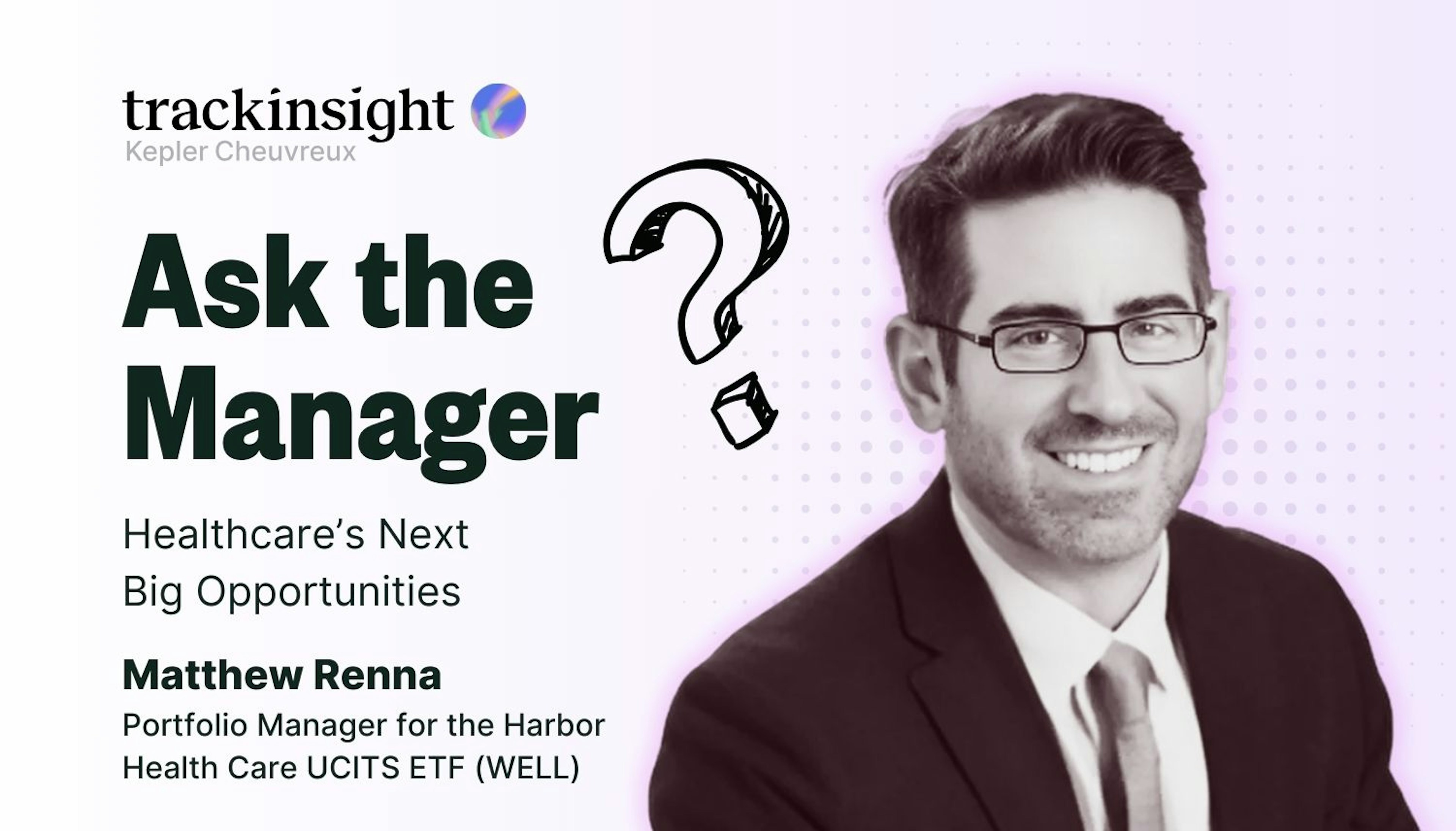
Ask the Manager: Matthew Renna on Healthcare’s Next Big Opportunities
Matthew Renna, Portfolio Manager for the Harbor Health Care UCITS ETF (WELL), breaks down how AI, policy shifts, and an aging population are reshaping healthcare investing.

By Trackinsight
March 7, 2025
- Healthcare
- AI
Advertisement
Matthew Renna, Portfolio Manager for the Harbor Health Care UCITS ETF (WELL), joins "Ask the Manager" to break down key healthcare investment themes—from AI’s role in drug discovery to policy shifts under a new administration.
He shares insights on aging demographics, biotech opportunities, and why healthcare is primed for a rebound in 2025.
📊 Share your ETF outlook
From AI infrastructure to active strategies, the ETF landscape is shifting. Share your perspective in the 7th Annual Global ETF Survey and get exclusive early access to the final report.
AI and digital health are transforming the sector. What impact do you see these technologies having on healthcare investment?
AI has tremendous potential in healthcare, but it is early. We are most excited about the prospects of making drug discovery more efficient. A lot of time and capital is wasted in drug development and the hit rate is painfully low.
If AI can streamline the process, lower the failure rate and improve efficiency, that is of significant value to the biopharma complex and a win for society. We are also bullish on the prospects of AI in radiology and diagnostics. It has been challenging to find a free-standing vehicle to play this theme, but many of our larger cap companies are incorporating this into their business.
With Donald Trump returning to the White House, how do you see his administration’s policies affecting the healthcare sector? Are there specific areas—such as drug pricing, regulation, or insurance—that investors should be watching closely?
Generally speaking, we think a Republican administration is more friendly to healthcare than not. However, there are various puts and takes to consider in the current administration and environment.
First, the FTC under Biden was particularly onerous for M&A – a key tenant of the biopharma investment case. We would expect a more lenient, business friendly FTC to facility much more M&A going forward, and do not think it is an accident that we saw the first >$5B transaction shortly after the election.
We are cautiously optimistic on the FDA, with reduced red tape/more efficiency and a pro industry leader offset by potential layoffs and staffing shortages. From a policy perspective, we are not expecting material incremental changes and believe many pockets of healthcare will do better under the current administration, namely biopharma and Medicare Advantage.
With global populations aging, how do you see this trend shaping investment opportunities in healthcare?
As has been the case for many years, the secular tailwinds in healthcare with an aging population are fairly robust. The challenge is how do you manage the rising needs of a larger population in a cost-effective manner. Across the ecosystem, companies who are additive to the solution of healthcare spend are most attractive – namely products, technologies, services that add value to all stakeholders and reduce long-term burden on the system.
Do you see more opportunities in large established pharmaceutical companies or in smaller, innovative biotech firms?
Without question, we see more inefficiency from a value perspective further down market cap and are finding some very compelling investment ideas.
With that said, we are in a market that favors the lower risk, more established companies and smid biotech remains challenged from a sentiment perspective – stubbornly high interest rates are not helping.
Nonetheless, this is the heart of the innovation cycle, and we believe companies who have truly innovative and differentiated assets will be recognized by investors or consolidated by their larger counterparts.
Many investors view healthcare as defensive, but others see it as a high-growth sector. How should investors think about its role in a broader portfolio?
The beauty of the healthcare ecosystem is that it offers both defensiveness and high growth, depending on the subsector and security.
We take a balanced, barbell approach, incorporating both GARPY secular winners that should act defensive in a tough macro backdrop, as well as high growth innovative names in med tech and biotech.
On a relative basis, we think healthcare is one of the most attractive areas of the market for 2025+, and we suspect fund flows and rotation will benefit the sector going forward.
What are the biggest risks facing healthcare investors today?
Healthcare has been relatively unattractive for growth investors chasing some of the hottest areas of the market since the peak of the pandemic. It has essentially been an ATM to fuel the pursuit of cyclical winners and the crowded Mag 7/AI trade.
Entering 2025, healthcare as a percentage of the S&P 500 was at a 10-year low. To say healthcare is due for a run is an understatement, but I would say the biggest headwind is continued momentum and enthusiasm for tech and associated fund flows.
Second to this is the perpetually higher interest rates that have been a significant headwind to biotech fund flows.
What makes healthcare particularly suited to an active investment approach rather than a passive one?
Healthcare is an incredibly treacherous and inefficient landscape – it lends itself perfectly to active management. Take biotech for instance – you can have a company trading at a negative EV for years, and suddenly it is a $10B market cap – that is something that would never be captured in passive investing.
Advertisement
Furthermore, the proliferation of specialist levered market neutral funds has created unprecedented volatility in daily/weekly and even quarterly trading patterns – having a dedicated team of active managers can help capitalize on the inefficiency that results in this sort of group think/short term investing.
About Matthew Renna
Mr. Renna joined Westfield in 2013 as a member of the Investment Committee covering the Healthcare sector. Prior to joining Westfield, he was with Vinik Asset Management as a Healthcare Portfolio Manager. His professional experience also includes Director, SMID Growth Equity team at BlackRock, inc., Senior Equity Analyst at RA Capital Management and Director, Healthcare/Biotechnology at Soleil Securities Corporation, Neponset Equity Research. Matthew began his career in the Healthcare industry at Merck & Co., before entering equity research as a Senior Research Associate covering Specialty Pharmaceuticals at Leerink Swann LLC. Mr. Renna began his investment career in 2004.
Please note this article is for information purposes only and does not in any way constitute investment advice. It is essential that you seek advice from a registered financial professional prior to making any investment decision.
More articles


About Trackinsight
Since our founding in 2016, we have been at the forefront of the industry, delivering accessible, comprehensive, and reliable tools to support the evolving needs of investors.
Over the past decade, Trackinsight has expanded its operations across six countries, serving thousands of professional investors. We’ve consistently innovated to provide cutting-edge solutions that meet the changing demands of the ETF market.
In 2024, Kepler Cheuvreux, a leading independent European financial services firm, acquired a majority stake in Trackinsight, becoming the company's principal shareholder.
This strategic partnership solidifies Trackinsight's position as a premier provider of ETF selection and analysis tools, while strengthening Kepler Cheuvreux’s commitment to becoming a leading player in the ETF sector.
Together, we are committed to offering advanced services that empower professional investors, advisors, institutions, and issuers. This new step enables us to deliver even more comprehensive and innovative technological solutions, driving ETF investing to new heights.
More about TrackinsightETF TOOLS
PLATFORM
ETF NEWS & RESEARCH
Privacy policy | Cookie policy | | Terms of use | Imprint