Global ETF Survey 2026: Answer now →
Help us improve your experience. Please confirm your investor type:
The Ultimate ETF Comparison Tool - Try Now!
Analyze up to 5 ETFs side-by-side and gain instant insights on performance, fees, holdings, and more to make data-driven investment decisions.
USA Versus the World: The Case for Splitting up ETF Allocations
Here's why pairing a U.S. equity ETF with an international equity ETF can help investors achieve more targeted exposure and better diversification.

By Amundi ETF
December 13, 2024
- Amundi
- World ex-US
- United States
When crafting an investment portfolio, it's tempting to look at the stellar performance of U.S. equities over the past decade and consider a 100% allocation to U.S. markets. However, a broader historical perspective suggests a different strategy could be effective.
Consider the period from 1999 to 2009, often referred to as the "lost decade" for U.S. equities. In this era, the dot-com bubble burst and the 2008 financial crisis hit, leading to a virtually flat performance of the U.S. market on a real return basis.
📊 Share your ETF outlook
From AI infrastructure to active strategies, the ETF landscape is shifting. Share your perspective in the 7th Annual Global ETF Survey and get exclusive early access to the final report.
In contrast, global developed markets, represented by the MSCI EAFE Index—an index of equities in Europe, Australasia, and the Far East—performed notably better during the same period¹.
Given the abundance of cost-efficient ETFs today that offer exposure to nearly all investable markets worldwide, there's no compelling reason to forego the benefits of international diversification².
Let's explore why splitting your ETF allocations between U.S. and global equities not only provides more targeted exposure but also enhances diversification³.
A tale of two indexes
The MSCI World Index is often seen as the go-to benchmark for global equity exposure, but it may not be as diversified as one might assume. A closer look reveals that the US accounts for 71% of the index's weight⁴.
This heavy concentration is due to the index being market cap-weighted, meaning the largest companies, predominantly found in the U.S., heavily influence it. As a result, significant markets like Japan, the UK, France, and Canada are comparatively underrepresented.
For investors aiming to achieve a more balanced global exposure, particularly enhancing their stake in non-U.S. markets, relying on the MSCI World Index alone might not suffice. A more effective solution could be to split your approach.
One potential way to do so could be to consider the MSCI World ex-USA Index, which, as the name suggests, excludes U.S. equities. In this index, European equities take the forefront, constituting about 51% of its weight⁵. This approach allows for a more pronounced exposure to international markets, addressing the imbalance created by the dominant U.S. presence in the global index.
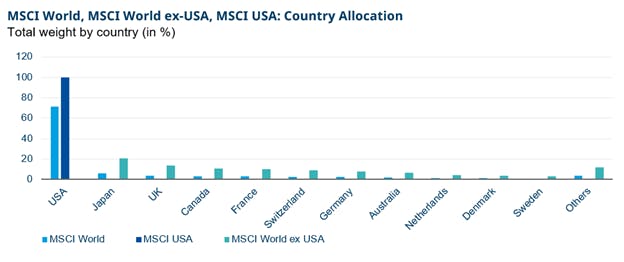
Source: Bloomberg, MSCI, Amundi. Data as at 30/08/2024. Past performance is not a reliable indicator of future performance.
Free float, full float, and GDP
One important aspect of many global indices, including MSCI World, is that they are weighted by free float market capitalization.
Free float market cap refers to the total value of the publicly available shares of a company. This method excludes shares held by insiders, governments, or other restricted holdings that are not available for public trading.
However, if we shift the perspective to weighting countries in an index based on their share of the global Gross Domestic Product (GDP)—the total value of goods and services produced by a country—the picture changes significantly.
For instance, while the U.S. dominates the MSCI World Index due to its large free float market cap, it only accounts for about 32% of global GDP⁶.
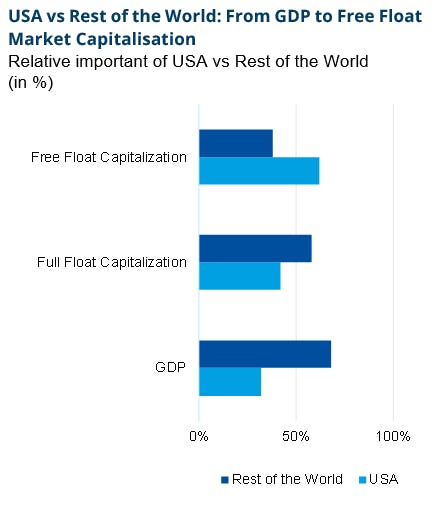
Source: MSCI, Amundi, “Rest of the World” stands for MSCI ACWI IMI (including Large, Mid and Small Caps). Data as at 30/08/2024. Past performance is not a reliable indicator of future performance.
This discrepancy raises a critical question: Is it logical to allocate to a stock merely based on its share price multiplied by the number of shares available for trading? This approach could result in investors being underweight on the non-US 68% of the global economy as measured by GDP.
This method might ignore potentially valuable investment opportunities in markets that are significant contributors to global economic output but are underrepresented in market cap-weighted indices due to smaller free float or less market liquidity.
Sector concentration
Finally, the overweight to U.S. equities within the MSCI World Index leads to significant sector concentration, with Information Technology accounting for about 25%⁷ due to the dominance of heavyweight stocks like Apple, Nvidia, and Microsoft. This sector bias reflects the tech-driven growth narrative prevalent in the U.S. market.
In contrast, the MSCI World ex-USA Index offers a more diversified sectoral breakdown. Financials emerge as the largest sector, followed by industrials, consumer discretionary, and consumer staples, with technology representing only 8.93%.
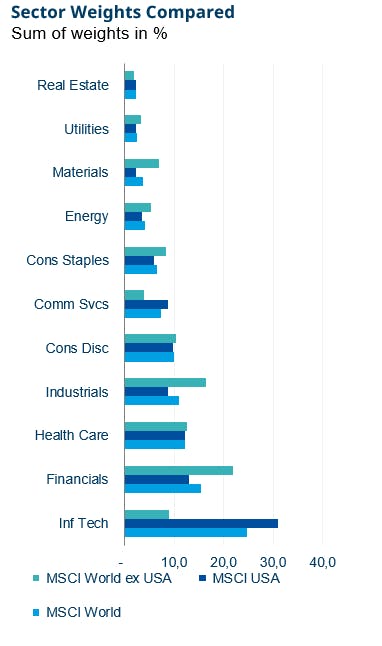
Source: Bloomberg, MSCI, Amundi. Data as at 30/08/2024. Past performance is not a reliable indicator of future performance.
This variation highlights different economic focuses and strengths across global markets, where other sectors besides technology play more significant roles.
The complementary nature of U.S. and ex-U.S. market exposures in terms of sectors and cyclicality could also be crucial. The heavy tech exposure in the U.S. often results in higher market valuations due to growth expectations in the tech sector.
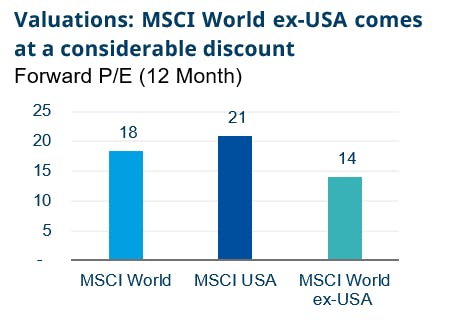
Source: Bloomberg, Amundi. Past performance is not a reliable indicator of future performance. Best consensus estimates as at 05/09/2024.
In comparison, the MSCI World ex-USA Index tends to have more reasonable valuations and a higher dividend yield, making it an attractive option for investors seeking cheaper developed market stocks and a way to offset the higher valuations and lower yields often found in U.S. markets.
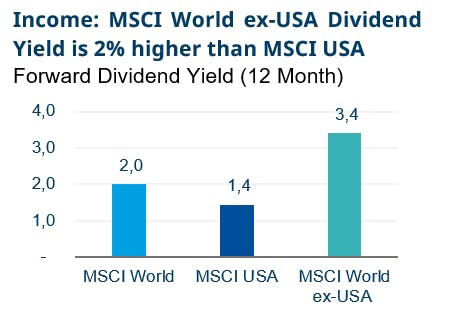
Source: Bloomberg, Amundi. Past performance is not a reliable indicator of future performance. Best consensus estimates as at 05/09/2024.
Putting it into play
Regardless of your views on U.S. versus ex-U.S. markets, the flexibility of ETFs allows you to tailor your portfolio precisely to your preferences.
For those aiming for a balanced approach, one effective strategy is to maintain a 50/50 split between U.S. and international equities, rebalancing annually. This method capitalizes on the principle of buying low and selling high, potentially smoothing out volatility and enhancing returns over the long term.
For the U.S. side, the Amundi MSCI USA UCITS ETF offers exposure to the large and mid-cap segments of the U.S. market. It encompasses 601 constituents, representing about 85% of the free float-adjusted market capitalization in the U.S.⁸, with a low management fee* of 0.03%.
For a global exposure, the Amundi MSCI World Ex USA UCITS ETF covers equity markets in 22 developed countries outside the U.S.⁹, with a management fee* of 0.15%.
Combining these two ETFs not only ensures exposure to nearly the entire global equity market (excluding emerging countries) but also achieves this at a cost-effective rate. The weighted average management fee for these ETFs at a 50/50 allocation sits at just 0.09%.
Please note this article is for information purposes only and does not in any way constitute investment advice. It is essential that you seek advice from a registered financial professional prior to making any investment decision.
*Management fees refer to the management fees and other administrative or operating costs of the fund. For more information about all the costs of investing in the fund, please refer to its Key Information Document (KID). Transaction cost and commissions may occur when trading ETF.
Please note this article is for information purposes only and does not in any way constitute investment advice. It is essential that you seek advice from a registered financial professional prior to making any investment decision.
¹ Past performance is not a reliable indicator of future performance.
² Diversification does not guarantee a profit or protect against a loss..
³ Diversification does not guarantee a profit or protect against a loss.
⁴ Source: Bloomberg, MSCI, Amundi. Data as at 30/08/2024. Past performance is not a reliable indicator of future performance.
⁵ Source: Bloomberg, MSCI, Amundi. Data as at 30/08/2024. Past performance is not a reliable indicator of future performance.
⁶ Source: MSCI, Amundi, “Rest of the World” stands for MSCI ACWI IMI (including Large, Mid and Small Caps). Data as at 30/08/2024. Past performance is not a reliable indicator of future performance.
⁷ Source: Bloomberg, MSCI, Amundi. Data as at 30/08/2024.
⁸ Source: Bloomberg, MSCI, Amundi. Data as at 30/08/2024.
⁹ Source: Bloomberg, MSCI, Amundi. Data as at 30/08/2024.
Please note this article is for information purposes only and does not in any way constitute investment advice. It is essential that you seek advice from a registered financial professional prior to making any investment decision.
Knowing your risk
It is important for potential investors to evaluate the risks described below and in the fund’s Key Investor Document (“KID”) and prospectus available on our website www.amundietf.com.
CAPITAL AT RISK - ETFs are tracking instruments. Their risk profile is similar to a direct investment in the underlying index. Investors’ capital is fully at risk and investors may not get back the amount originally invested.
UNDERLYING RISK - The underlying index of an ETF may be complex and volatile. For example, ETFs exposed to Emerging Markets carry a greater risk of potential loss than investment in Developed Markets as they are exposed to a wide range of unpredictable Emerging Market risks.
REPLICATION RISK - The fund’s objectives might not be reached due to unexpected events on the underlying markets which will impact the index calculation and the efficient fund replication.
COUNTERPARTY RISK - Investors are exposed to risks resulting from the use of an OTC swap (over-the-counter) or securities lending with the respective counterparty(-ies). Counterparty(-ies) are credit institution(s) whose name(s) can be found on the fund’s website amundietf.com. In line with the UCITS guidelines, the exposure to the counterparty cannot exceed 10% of the total assets of the fund.
CURRENCY RISK – An ETF may be exposed to currency risk if the ETF is denominated in a currency different to that of the underlying index securities it is tracking. This means that exchange rate fluctuations could have a negative or positive effect on returns.
LIQUIDITY RISK – There is a risk associated with the markets to which the ETF is exposed. The price and the value of investments are linked to the liquidity risk of the underlying index components. Investments can go up or down. In addition, on the secondary market liquidity is provided by registered market makers on the respective stock exchange where the ETF is listed. On exchange, liquidity may be limited as a result of a suspension in the underlying market represented by the underlying index tracked by the ETF; a failure in the systems of one of the relevant stock exchanges, or other market-maker systems; or an abnormal trading situation or event.
VOLATILITY RISK – The ETF is exposed to changes in the volatility patterns of the underlying index relevant markets. The ETF value can change rapidly and unpredictably, and potentially move in a large magnitude, up or down.
CONCENTRATION RISK – Thematic ETFs select stocks or bonds for their portfolio from the original benchmark index. Where selection rules are extensive, it can lead to a more concentrated portfolio where risk is spread over fewer stocks than the original benchmark.
IMPORTANT INFORMATION
This information is not for distribution and does not constitute an offer to sell or the solicitation of any offer to buy any securities or services in the United States or in any of its territories or possessions subject to its jurisdiction to or for the benefit of any U.S. Person (as defined in the prospectus of the Funds or in the legal mentions section on www.amundi.com and www.amundietf.com. The Funds have not been registered in the United States under the Investment Company Act of 1940 and units/shares of the Funds are not registered in the United States under the Securities Act of 1933.
This document is of a commercial nature. The funds described in this document (the “Funds”) may not be available to all investors and may not be registered for public distribution with the relevant authorities in all countries. It is each investor’s responsibility to ascertain that they are authorised to subscribe, or invest into this product. Prior to investing in the product, investors should seek independent financial, tax, accounting and legal advice.
This is a promotional and non-contractual information which should not be regarded as an investment advice or an investment recommendation, a solicitation of an investment, an offer or a purchase, from Amundi Asset Management (“Amundi”) nor any of its subsidiaries.
The Funds are Amundi UCITS ETFs and Amundi ETF designates the ETF business of Amundi.
Amundi UCITS ETFs are passively-managed index-tracking funds.
Before any subscriptions, the potential investor must read the offering documents (KID and prospectus) of the Funds.
Investment in a fund carries a substantial degree of risk (i.e. risks are detailed in the KID and prospectus). Past Performance does not predict future returns. Investment return and the principal value of an investment in funds or other investment product may go up or down and may result in the loss of the amount originally invested. All investors should seek professional advice prior to any investment decision, in order to determine the risks associated with the investment and its suitability.
It is the investor’s responsibility to make sure his/her investment is in compliance with the applicable laws she/he depends on, and to check if this investment is matching his/her investment objective with his/her patrimonial situation (including tax aspects).
Please note that the management companies of the Funds may de-notify arrangements made for marketing as regards units/shares of the Fund in a Member State of the EU or the UK in respect of which it has made a notification.
A summary of information about investors’ rights and collective redress mechanisms can be found in English on the regulatory page at https://about.amundi.com/Metanav-Footer/Footer/Quick-Links/Legal-documentation with respect to Amundi ETFs.
This document was not reviewed, stamped or approved by any financial authority.
This document is not intended for and no reliance can be placed on this document by persons falling outside of these categories in the below mentioned jurisdictions. In jurisdictions other than those specified below, this document is for the sole use of the professional clients and intermediaries to whom it is addressed. It is not to be distributed to the public or to other third parties and the use of the information provided by anyone other than the addressee is not authorised.
This material is based on sources that Amundi and/or any of her subsidiaries consider to be reliable at the time of publication. Data, opinions and analysis may be changed without notice. Amundi and/or any of her subsidiaries accept no liability whatsoever, whether direct or indirect, that may arise from the use of information contained in this material. Amundi and/or any of her subsidiaries can in no way be held responsible for any decision or investment made on the basis of information contained in this material.
Updated composition of the product’s investment portfolio is available on www.amundietf.com. Units of a specific UCITS ETF managed by an asset manager and purchased on the secondary market cannot usually be sold directly back to the asset manager itself. Investors must buy and sell units on a secondary market with the assistance of an intermediary (e.g. a stockbroker) and may incur fees for doing so. In addition, investors may pay more than the current net asset value when buying units and may receive less than the current net asset value when selling them.
Indices and the related trademarks used in this document are the intellectual property of index sponsors and/or its licensors. The indices are used under license from index sponsors. The Funds based on the indices are in no way sponsored, endorsed, sold or promoted by index sponsors and/or its licensors and neither index sponsors nor its licensors shall have any liability with respect thereto. The indices referred to herein (the “Index” or the “Indices”) are neither sponsored, approved or sold by Amundi nor any of its subsidiaries. Neither Amundi nor any of its subsidiaries shall assume any responsibility in this respect.
In EEA Member States, the content of this document is approved by Amundi for use with Professional Clients (as defined in EU Directive 2004/39/EC) only and shall not be distributed to the public.
Information reputed exact as of end November 2024.
Reproduction prohibited without the written consent of Amundi.
More articles


About Trackinsight
Since our founding in 2016, we have been at the forefront of the industry, delivering accessible, comprehensive, and reliable tools to support the evolving needs of investors.
Over the past decade, Trackinsight has expanded its operations across six countries, serving thousands of professional investors. We’ve consistently innovated to provide cutting-edge solutions that meet the changing demands of the ETF market.
In 2024, Kepler Cheuvreux, a leading independent European financial services firm, acquired a majority stake in Trackinsight, becoming the company's principal shareholder.
This strategic partnership solidifies Trackinsight's position as a premier provider of ETF selection and analysis tools, while strengthening Kepler Cheuvreux’s commitment to becoming a leading player in the ETF sector.
Together, we are committed to offering advanced services that empower professional investors, advisors, institutions, and issuers. This new step enables us to deliver even more comprehensive and innovative technological solutions, driving ETF investing to new heights.
More about TrackinsightETF TOOLS
PLATFORM
ETF NEWS & RESEARCH
Privacy policy | Cookie policy | | Terms of use | Imprint