Global ETF Survey 2026: Answer now →
Help us improve your experience. Please confirm your investor type:
The Ultimate ETF Comparison Tool - Try Now!
Analyze up to 5 ETFs side-by-side and gain instant insights on performance, fees, holdings, and more to make data-driven investment decisions.
ESG: a seismic shift towards a sustainable future, accelerated by the climate emergency
The momentous shift towards sustainability investing is one of the most revolutionary investment developments of our time, driving massive change in the ETF industry and beyond.

By Amundi ETF
0
- Amundi
Advertisement
It is already well documented that the momentous shift towards sustainability investing is one of the most revolutionary investment developments of our time, driving massive change in the ETF industry and beyond. It is already well documented that the COVID-19 crisis has given an additional boost to the trends in ESG adoption already in place before the pandemic outbreak. In 2021 flows to European ESG ETFs reached €84 billion compared to €44 billion in 2020 and a meager €16 billion in 2019. This trend is expected to further accelerate as investors increasingly embrace sustainable investment strategies.
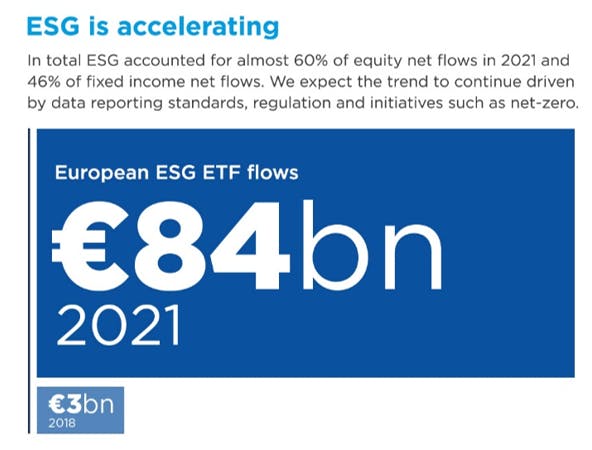
Rising ESG demand comes with increasing initiatives in terms of data reporting standards, regulation and coalition pushes such as the net-zero coalition. These trends will help to reveal areas of inefficiency by filling the gaps of data availability and lead to adjustments in market prices, as they start to incorporate these new pieces of information, therefore generating a positive feedback loop.
ETF Data Built for Precision
Trackinsight delivers reliable and comprehensive coverage on 14,000+ ETFs
As witnessed with the recent net-zero emissions initiative, ESG investing comes in many forms but is ultimately driven by powerful narratives emerging from both the markets and wider society. Issues such as social inequality will be key themes to be tackled by governments in the economic recovery phase.
For ETF investors looking to contribute to a more sustainable future, advances in sustainable mobility and the rise of green bonds offer potential opportunities.
The green future of mobility
Plans to cut greenhouse gas emissions include the planning of an incremental phase-out of new fossil fuel vehicles over the coming decade in various countries. As an example, the infrastructure plan unveiled by the Biden administration set a new national goal that 50% of new car sales by 2030 should be electric vehicles. It offers tax incentives to support the switch along with a $7.5 billion plan to expand the implementation of charging station networks.
Mobility plays a central role in our society and in the context of climate change, sustainable mobility will become increasingly important in the years ahead. Overall, various governments’ initiatives and support on the transition towards greener transport solutions will reshape mobility as we currently know it. The ongoing push certainly favours sales of electric vehicles and should be positive not only for automakers, but also other industries involved in the electric vehicle value chain.
Invest in a cleaner future with green bonds
The green bond market is small compared to the overall bond market. However, it is fast-growing, and supported by fundamental drivers – such as the emergence of strong sovereign green bond issuers enacting new policies on climate and green recovery plans. Global green bond issuance rose strongly in 2021 with cumulative issuance reaching almost $1.5 trillion at year-end versus $860 billion at the end of 2020. With an increasing number of corporates committing to net zero and other emissions reduction targets, nearly 70% of green bond issuance came from large corporates.
Many sovereigns issued their first green bonds in 2021. The EU’s €12 billion inaugural issue in early October 2021 was the largest single issuance on record. Looking ahead, the EU is firmly on course to become the biggest global green bond issuer, with over €250 billion of issuance expected over the next five years. This represents about 30% of the funds allocated to the EU’s €800 billion ‘NextGenerationEU’ recovery fund launched in the wake of the pandemic.
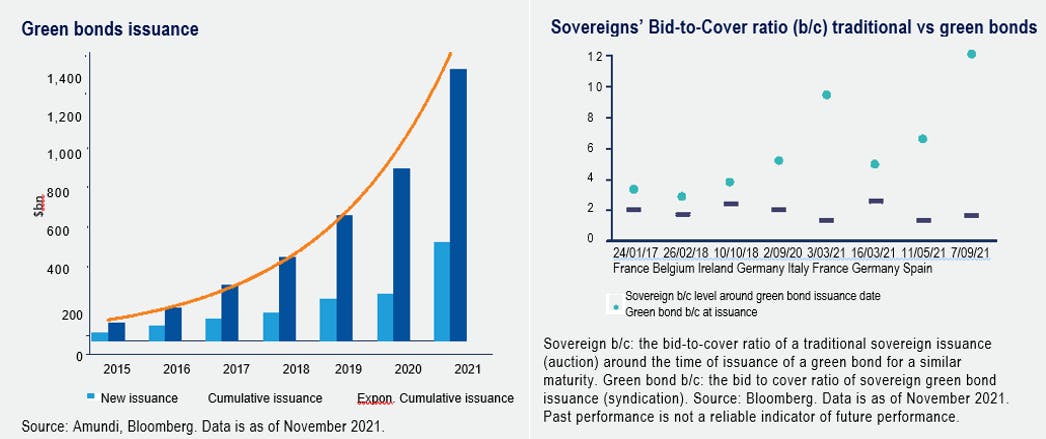
Overall, this market segment is benefiting from strong investor demand for green assets, and policymakers and companies aligning with the Paris Agreement’s goals to hit carbon emission-reduction targets. Looking ahead, the performance of green bonds should remain more supported compared to their vanilla equivalents.
Advertisement
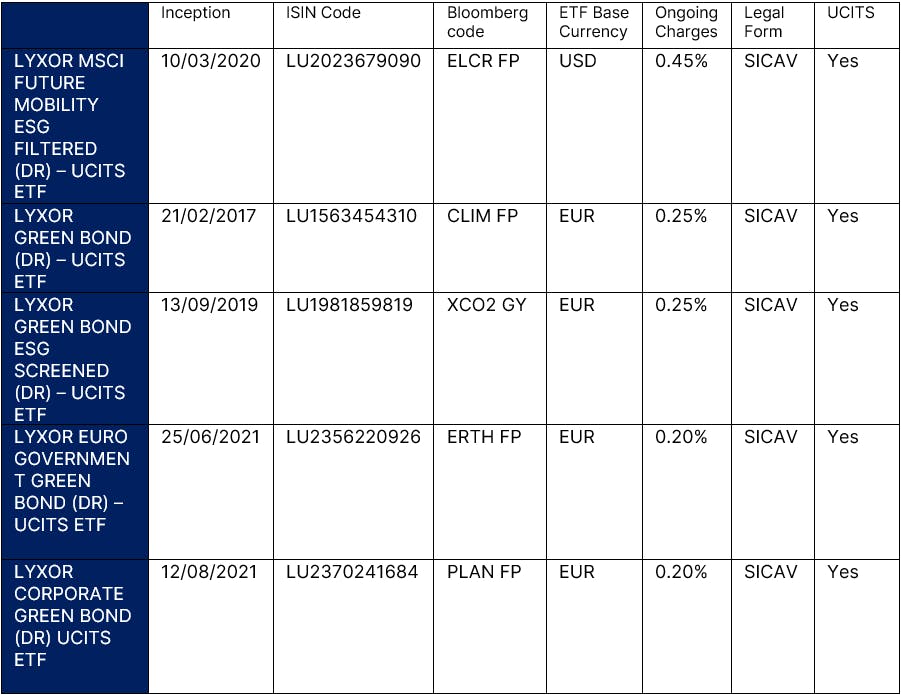
Amundi is committed to meeting the growing need for responsible investment solutions, underpinned by the belief that ETFs have a key role to play in democratising ESG investing and redirecting capital for good. Sustainable ETFs empower all investors to have an impact in a way that suits their needs and their goals. Amundi now offers investors an expanded range of over 80 ESG ETFs, spanning both equity and fixed income.
Our range of solutions to address the future of mobility and green bonds:
To learn more about ESG and climate investing with Amundi ETF, please visit: https://www.amundietf.co.uk/professional/Investing-in-ETF/Responsible-Investing
Amundi ETF, Indexing and Smart Beta is one of Amundi’s strategic business areas. With over 30 years of expertise in index solutions replication and development, Amundi is the European leader in ETFs[1] and a partner of choice in passive management, recognised for its flexibility, innovation and competitiveness. The platform is also known for its ability to develop Smart Beta and Factor Investing solutions. Responsible investment is a key strength and focus of the platform, not only for open funds but also for custom ESG and climate solutions. The business line manages over €282 billion of assets[2].
[1] Source: ETFGI, based on the combined assets of Amundi ETF and Lyxor ETF as at 30 September 2021
[2] Amundi pro-forma data as of 30/09/2021
Advertisement
For professional clients only.
KNOWING YOUR RISK
It is important for potential investors to evaluate the risks described below and in the fund’s Key Investor Information Document (“KIID”) and prospectus available on our websites www.amundietf.com or www.lyxoretf.com (as the case may be).
CAPITAL AT RISK - ETFs are tracking instruments. Their risk profile is similar to a direct investment in the underlying index. Investors’ capital is fully at risk and investors may not get back the amount originally invested.
UNDERLYING RISK - The underlying index of an ETF may be complex and volatile. For example, ETFs exposed to Emerging Markets carry a greater risk of potential loss than investment in Developed Markets as they are exposed to a wide range of unpredictable Emerging Market risks.
REPLICATION RISK - The fund’s objectives might not be reached due to unexpected events on the underlying markets which will impact the index calculation and the efficient fund replication.
COUNTERPARTY RISK - Investors are exposed to risks resulting from the use of an OTC swap (over-the-counter) or securities lending with the respective counterparty(-ies). Counterparty(-ies) are credit institution(s) whose name(s) can be found on the fund’s website amundietf.com or lyxoretf.com. In line with the UCITS guidelines, the exposure to the counterparty cannot exceed 10% of the total assets of the fund.]
CURRENCY RISK – An ETF may be exposed to currency risk if the ETF is denominated in a currency different to that of the underlying index securities it is tracking. This means that exchange rate fluctuations could have a negative or positive effect on returns.
LIQUIDITY RISK – There is a risk associated with the markets to which the ETF is exposed. The price and the value of investments are linked to the liquidity risk of the underlying index components. Investments can go up or down. In addition, on the secondary market liquidity is provided by registered market makers on the respective stock exchange where the ETF is listed. On exchange, liquidity may be limited as a result of a suspension in the underlying market represented by the underlying index tracked by the ETF; a failure in the systems of one of the relevant stock exchanges, or other market-maker systems; or an abnormal trading situation or event.
VOLATILITY RISK – The ETF is exposed to changes in the volatility patterns of the underlying index relevant markets. The ETF value can change rapidly and unpredictably, and potentially move in a large magnitude, up or down.
CONCENTRATION RISK – Thematic ETFs select stocks or bonds for their portfolio from the original benchmark index. Where selection rules are extensive, it can lead to a more concentrated portfolio where risk is spread over fewer stocks than the original benchmark.
IMPORTANT INFORMATION
This material is solely for the attention of professional and eligible counterparties, as defined in Directive MIF 2014/65/UE of the European Parliament acting solely and exclusively on their own account. It is not directed at retail clients. In Switzerland, it is solely for the attention of qualified investors within the meaning of Article 10 paragraph 3 a), b), c) and d) of the Federal Act on Collective Investment Scheme of June 23, 2006.
This information is not for distribution and does not constitute an offer to sell or the solicitation of any offer to buy any securities or services in the United States or in any of its territories or possessions subject to its jurisdiction to or for the benefit of any U.S. Person (as defined in the prospectus of the Funds or in the legal mentions section on www.amundi.com, www.amundietf.com and www.lyxoretf.com). The Funds have not been registered in the United States under the Investment Company Act of 1940 and units/shares of the Funds are not registered in the United States under the Securities Act of 1933.
This document is of a commercial nature. The Funds described in this document may not be available to all investors and may not be registered for public distribution with the relevant authorities in all countries. It is each investor’s responsibility to ascertain that they are authorised to subscribe, or invest into this product. Prior to investing in the product, investors should seek independent financial, tax, accounting and legal advice.
This is a promotional and non-contractual information which should not be regarded as an investment advice or an investment recommendation, a solicitation of an investment, an offer or a purchase, from Amundi Asset Management (“Amundi”) nor any of her subsidiaries, nor Lyxor International Asset Management (“Lyxor”) and Lyxor Asset Management UK LLP (“Lyxor UK”).
The Funds are respectively Amundi UCITS ETFs (“Amundi ETF”) and Lyxor UCITS ETFs (“Lyxor ETF”). Amundi ETF designates the ETF business of Amundi and includes the funds under both Amundi ETF and Lyxor ETF denomination.
The Funds are French or Luxemburg open ended mutual investment funds respectively approved by the French Autorité des Marchés Financiers or by the Luxemburg Commission de Surveillance du Secteur Financier, and authorized for marketing of their units or shares in various European countries (the Marketing Countries) pursuant to the article 93 of the 2009/65/EC Directive. The Funds can be sub-funds of the following umbrella structures:
For Amundi ETF: Amundi Index Solutions, Luxemburg SICAV, RCS B206810, located 5, allée Scheffer, L-2520, managed by Amundi Luxembourg S.A.
For Lyxor ETF:
- Multi Units France, French SICAV, RCS 441 298 163, located 91-93, boulevard Pasteur, 75015 Paris, France, managed by Lyxor International Asset Management
- Multi Units Luxembourg, RCS B115129 and Lyxor Index Fund, RCS B117500, both Luxemburg SICAV located 28-32, place de la Gare, L-1616 Luxemburg, and managed by Lyxor International Asset Management
- Lyxor SICAV, Luxemburg SICAV, RCS B140772, located 5, allée Scheffer, L-2520 Luxemburg, managed by Lyxor Funds Solutions
Before any subscriptions, the potential investor must read the offering documents (KIID and prospectus) of the Funds. The prospectus in French for French UCITS ETFs and in English for Luxemburg UCITS ETFs, and the KIID in the local languages of the Marketing Countries are available free of charge on www.amundi.com, www.amundietf.com and www.lyxoretf.com or upon request to client-services-etf@lyxor.com. They are also available from the headquarters of the Amundi Index Solutions SICAV, or the headquarters of Lyxor International Asset Management (as the management company of Multi Units Luxembourg, Multi Units France and Lyxor Index Fund) or of Lyxor Funds Solutions (as the management company of Lyxor SICAV).
Investment in a fund carries a substantial degree of risk (i.e. risks are detailed in the KIID and prospectus). Past Performance does not predict future returns. Investment return and the principal value of an investment in funds or other investment product may go up or down and may result in the loss of the amount originally invested. All investors should seek professional advice prior to any investment decision, in order to determine the risks associated with the investment and its suitability.
It is the investor’s responsibility to make sure his/her investment is in compliance with the applicable laws she/he depends on, and to check if this investment is matching his/her investment objective with his/her patrimonial situation (including tax aspects).
Please note that the management company may de-notify arrangements made for marketing as regards units/shares of the Fund in a Member State of the EU in respect of which it has made a notification.
A summary of information about investors’ rights and collective redress mechanisms can be found in English on the regulatory page at https://about.amundi.com/Metanav-Footer/Footer/Quick-Links/Legal-documentation with respect to Amundi ETFs, and, at https://www.lyxor.com/en/investors-rights-2021-en with respect to Lyxor ETFs.
This document was not reviewed, stamped or approved by any financial authority.
This document is not intended for and no reliance can be placed on this document by persons falling outside of these categories in the below mentioned jurisdictions. In jurisdictions other than those specified below, this document is for the sole use of the professional clients and intermediaries to whom it is addressed. It is not to be distributed to the public or to other third parties and the use of the information provided by anyone other than the addressee is not authorised.
This material is based on sources that Amundi for Amundi ETF, and Lyxor and Lyxor UK for Lyxor ETF consider to be reliable at the time of publication. Data, opinions and analysis may be changed without notice. Amundi, Lyxor and Lyxor UK accept no liability whatsoever, whether direct or indirect, that may arise from the use of information contained in this material. Amundi or Lyxor can in no way be held responsible for any decision or investment made on the basis of information contained in this material.
Updated composition of the product’s investment portfolio is available on www.amundietf.com or www.lyxoretf.com. Units of a specific UCITS ETF managed by an asset manager and purchased on the secondary market cannot usually be sold directly back to the asset manager itself. Investors must buy and sell units on a secondary market with the assistance of an intermediary (e.g. a stockbroker) and may incur fees for doing so. In addition, investors may pay more than the current net asset value when buying units and may receive less than the current net asset value when selling them.
Indices and the related trademarks used in this document are the intellectual property of index sponsors and/or its licensors. The indices are used under license from index sponsors. The Funds based on the indices are in no way sponsored, endorsed, sold or promoted by index sponsors and/or its licensors and neither index sponsors nor its licensors shall have any liability with respect thereto. The indices referred to herein (the “Index”) are neither sponsored, approved or sold by Amundi nor Lyxor nor Lyxor Funds Solutions. Neither Amundi nor Lyxor nor Lyxor Funds Solutions shall assume any responsibility in this respect.
In EEA Member States, the content of this document is approved by Amundi and Lyxor for use with Professional Clients (as defined in EU Directive 2004/39/EC) only and shall not be distributed to the public.
Information reputed exact as of 8 February 2022.
Reproduction prohibited without the written consent of Amundi.
More articles


About Trackinsight
Since our founding in 2016, we have been at the forefront of the industry, delivering accessible, comprehensive, and reliable tools to support the evolving needs of investors.
Over the past decade, Trackinsight has expanded its operations across six countries, serving thousands of professional investors. We’ve consistently innovated to provide cutting-edge solutions that meet the changing demands of the ETF market.
In 2024, Kepler Cheuvreux, a leading independent European financial services firm, acquired a majority stake in Trackinsight, becoming the company's principal shareholder.
This strategic partnership solidifies Trackinsight's position as a premier provider of ETF selection and analysis tools, while strengthening Kepler Cheuvreux’s commitment to becoming a leading player in the ETF sector.
Together, we are committed to offering advanced services that empower professional investors, advisors, institutions, and issuers. This new step enables us to deliver even more comprehensive and innovative technological solutions, driving ETF investing to new heights.
More about TrackinsightETF TOOLS
PLATFORM
ETF NEWS & RESEARCH
Privacy policy | Cookie policy | | Terms of use | Imprint