Global ETF Survey 2026: Answer now →
Help us improve your experience. Please confirm your investor type:
Don’t Miss a Move in the ETF Market
Sign up and keep track of everything that moved the ETF industry this week. From new launches to regulatory shifts across the Atlantic.

S&P 500 Plunges as Recession Fears and Yield Curve Inversion Rattle Markets
The S&P 500 drops sharply as recession fears rise, the yield curve inverts, and trade tensions escalate.


By Leverage Shares
March 18, 2025
- Leverage Shares
- S&P 500
- US Large Cap
Advertisement
- Stock market plunges on U.S. recession fears
- Yield curve inverts pointing to a potential downturn
Global Growth Fears Resurface Amid Weak U.S. Data and Trade Tensions
Concerns over global economic growth have re-emerged, rattling financial markets as weak U.S. economic data and escalating trade tensions weigh on consumer confidence and business activity. The resilience of the U.S. economy has provided some reassurance, yet recent indicators suggest that the outlook is far from stable, raising fears of potential recession.
The latest disruption comes from U.S. President Donald Trump’s announcement of new 25% tariffs on Mexico and Canada, which have further exacerbated concerns over economic slowdown. Markets are reflecting this change in sentiment, with U.S. stock indices retreating from their February highs. Meanwhile, U.S. Treasury yields have dropped significantly, signalling investors' growing expectation of imminent interest rate cuts.
📊 Share your ETF outlook
From AI infrastructure to active strategies, the ETF landscape is shifting. Share your perspective in the 7th Annual Global ETF Survey and get exclusive early access to the final report.
Confidence Takes a Hit as Market Conditions Deteriorate
Key economic indicators paint a concerning picture. Investor confidence, a key pillar of economic stability, has been shaken by deteriorating U.S. consumer and business sentiment. U.S. consumer confidence in January saw its steepest drop in more than three and years, while retail sales fell at the fastest pace in nearly two years. Additionally, manufacturing activity showed significant declines in both new orders and employment.
Despite these troubling signs, we remain cautious but not entirely pessimistic. While a slowdown is likely in the next few quarters, we do not foresee an outright recession. However, the uncertainty surrounding U.S. policy is weighing heavily on consumer sentiment.
The Atlanta Fed’s GDPNow model, which recently revised its estimate for annualized growth this quarter from +2.3% to -2.8% in just a week, highlighting the sudden change in economic expectations.
The Trade War’s Growing Impact on Global Markets
Trump has implemented a 25% tariff on all steel and aluminium imports, along with additional 25% tariffs on certain imports from Mexico and Canada, with some exemptions. Additionally, a 20% levy has been imposed on Chinese goods.
The U.S. trade wars has moved focus from inflation concerns to economic growth risks. The situation is further complicated by China's response to heightened U.S. tariffs, with Beijing imposing additional levies of 10%-15% on select U.S. imports.
The American Chamber of Commerce to the EU warned on Monday that a potential trade war between the U.S. and Europe could put at risk transatlantic business valued at $9.5 trillion per year.
Mounting Pressure for Interest Rate Cuts
The repercussions of these economic and trade developments are being felt in currency markets, with the Canadian dollar and Mexican peso briefly hitting one-month lows. Surprisingly, even the U.S. dollar, which has typically benefited from trade tensions has weakened as growth concerns take centre stage.
The Federal Reserve now faces growing pressure to cut interest rates to counter the economic slowdown. The combination of slowing growth and persistent inflation could create a stagflation-like scenario, forcing the central bank to continue easing monetary policy.
Advertisement
Market expectations for rate cuts have changed dramatically. Traders are now pricing in 75 basis points of U.S. rate cuts by the end of the year, a sharp contrast to mid-January, when only one cut was anticipated. The bond market is increasingly signalling concerns about an economic slowdown and possibly a recession, with 10-year U.S. Treasury yields hovering around 4,30%, marking their steepest monthly decline since late 2023.
Investors and Businesses Brace for Uncertainty
Even if U.S. economic data shows signs of improvement in the coming months, the overall outlook remains clouded. The ongoing trade war, policy uncertainty, and poor investor sentiment warrant a cautious approach toward equities.
Consumer discretionary stocks, which are often seen as a barometer of economic health were the worst-performing sector in the U.S. last month, reflecting growing concerns about household spending power. Given that consumers have been the main driver of this bull market, the jobs market will be closely watched for clues on whether the labour market remains resilient or if cracks are beginning to show.
Yield Curve Inversions and Recession Warnings
A clear warning sign of economic trouble is emerging in the U.S. Treasury yield curve, where key segments are flashing warning signs. The spread between two-year and five-year notes recently turned negative, a phenomenon that has historically preceded major economic contractions. This part of the yield curve is particularly significant, as previous sustained inversions have preceded major economic downturns and sharp declines in the stock market.
Another concerning indicator is that benchmark 10-year Treasury yields dropped below the federal funds rate last week, a development that has historically signalled that monetary policy may be behind the curve.
The yield curve can invert for multiple reasons, but it frequently signals unease about Federal Reserve policy when long-term bond yields drop more sharply than short-term ones. This happens because longer-term yields are influenced by economic growth prospects, whereas short-term yields are shaped by expectations for Fed interest rate moves. An inversion indicates that investors worry the central bank may maintain high rates for too long, which could hinder economic expansion.
Jobs Data Becomes Critical for Fed Policy
As recession concerns grow, the Federal Reserve is likely to place greater emphasis on labour market data in its policy decisions. While job growth has slowed, layoffs have remained relatively subdued at least for now. However, this could change abruptly, and the March jobs report will be particularly critical as It will reflect the impact of recent layoffs, including those from Elon Musk’s Department of Government Enterprises (DOGE).
Technical Analysis
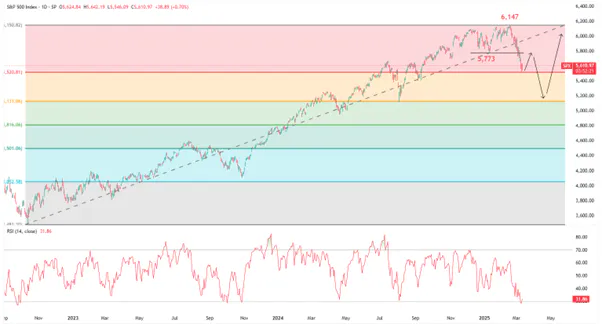
Markets have recently experienced heightened volatility due to fears of rising inflation, potential stagflation, and escalating global trade tensions fuelled by U.S. protectionist policies. The S&P 500 has entered correction territory, dropping more than 10% from its February 19 peak of 6,147, signalling a loss of momentum early in the second Trump administration. Investor sentiment has been shaken by unpredictable policy moves, including sudden tariff changes and federal job cuts, adding to market uncertainty.
Advertisement
Market corrections, defined as declines from 10% up to 20%, are a natural part of financial cycles, typically lasting from three weeks up to several months. However, concerns over a potential recession have intensified after U.S. Treasury Secretary Scott Bessent stated there were "no guarantees" the U.S. economy would avoid one this year. This uncertainty follows President Trump's recent refusal to rule out a recession.
Despite ongoing trade concerns, the S&P 500 rebounded on Friday after Senate Democrats allowed a stopgap funding bill to pass, reducing fears of a government shutdown. However, the Trump administration’s tariff policies continue to pressure investors, with speculation that new “reciprocal” tariffs could target countries like Vietnam, India, and Indonesia, further impacting global trade stability. The uncertainty surrounding additional levies remains a key driver of market fluctuations.
Given the current macroeconomic backdrop, volatility is likely to remain elevated in the months ahead. A potential rebound from here is likely to be short-lived with risk increasing toward another leg lower before the market can stage a stronger rebound and take the S&P 500 to new highs.
Professional traders looking for magnified exposure to the S&P 500 index may consider Leverage Shares +5x Long S&P 500 or -5x Short S&P 500 ETPs.
About Leverage Shares
Leverage Shares is the largest European issuer of single stock ETPs by AUM & trading volume. It is the only provider of physically-backed leveraged ETPs on single stocks, ETFs and commodities.
The opinions expressed in this publication are those of the authors and are subject to change. They do not purport to reflect the opinions or views of Trackinsight or its members. Trackinsight does not guarantee the accuracy, completeness, or reliability of the information provided.
More articles


About Trackinsight
Since our founding in 2016, we have been at the forefront of the industry, delivering accessible, comprehensive, and reliable tools to support the evolving needs of investors.
Over the past decade, Trackinsight has expanded its operations across six countries, serving thousands of professional investors. We’ve consistently innovated to provide cutting-edge solutions that meet the changing demands of the ETF market.
In 2024, Kepler Cheuvreux, a leading independent European financial services firm, acquired a majority stake in Trackinsight, becoming the company's principal shareholder.
This strategic partnership solidifies Trackinsight's position as a premier provider of ETF selection and analysis tools, while strengthening Kepler Cheuvreux’s commitment to becoming a leading player in the ETF sector.
Together, we are committed to offering advanced services that empower professional investors, advisors, institutions, and issuers. This new step enables us to deliver even more comprehensive and innovative technological solutions, driving ETF investing to new heights.
More about TrackinsightETF TOOLS
PLATFORM
ETF NEWS & RESEARCH
Privacy policy | Cookie policy | | Terms of use | Imprint