Get your free ETF data sample from our comprehensive offerings. Start your free trial→
Help us improve your experience. Please confirm your investor type:
The ETF Industry Is Evolving Fast
From AI infrastructure to active strategies, the ETF landscape is shifting. Share your perspective in the 7th Annual Global ETF Survey.
Solar ETFs: Zero-Carbon Investing Solution
Solar ETFs are opening gates to ESG investors with a mission to improve our environment by investing in solar energy.

By Rony Abboud
April 1, 2022
- Energy
Advertisement
Solar is the most abundant energy resource on earth (Source: U.S. DOE) and yet it only accounts for a fraction of global electricity generation. With Climate change endangering the health of the planet, the species, and ecosystems, the push for clean energy has never been stronger. Increased adoption of solar technologies could potentially help address global power insecurity and minimize the adverse environmental impacts of fossil fuel consumption. In this article, we look at ways to get exposure to solar-related companies, a green theme with positive long-term prospects, and a gateway for ESG investors to contribute to the betterment of our environment.
How does solar work?
Solar technologies convert sunlight into electrical energy either through photovoltaic (PV) panels or through mirrors that concentrate solar radiation. This energy can be used to generate electricity or be stored in batteries or thermal storage.
📊 Share your ETF outlook
From AI infrastructure to active strategies, the ETF landscape is shifting. Share your perspective in the 7th Annual Global ETF Survey and get exclusive early access to the final report.
In 2020, Solar PV accounted for 3.1% of global electricity generation (Source: iea.org), and it remains the third-largest renewable electricity technology behind hydropower and onshore wind after overtaking bioenergy in 2019. You can learn more about Solar Power here.
Who are the leaders in solar energy?
Nations have been wary about the climate change threats and have been engaging in funding projects and creating policies that boost the share of solar power in the energy mix. Visualcapitalist.com and IRENA have created an infographic (see below) that maps solar power capacity by country in 2021. This includes both solar photovoltaic (PV) and concentrated solar power capacity.
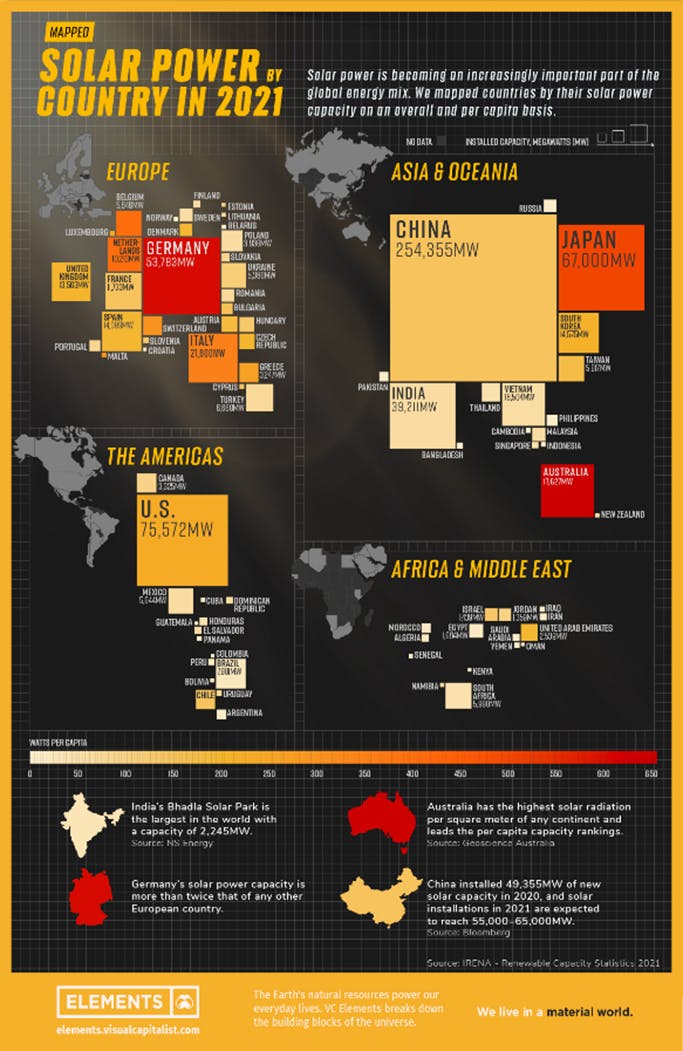
In terms of total installed capacity, China leads the way with over 35% of global capacity. The United States comes second with 10% and Japan third with 9.4%. China is also the world's number one producer of polysilicon, a key component in silicon-based photovoltaic (PV) panels with a 66% market share. They are also responsible for more than three-quarters of produced solar cells, along with 72% of the world's PV panels (visualcapitalist.com).
The investment case for solar
The amount of sunlight that strikes the earth's surface in an hour and a half is enough to handle the entire world's energy consumption for a full year (Source: energy.gov). This fact alone shows the sheer size of the global opportunity to power our planet with a clean and abundant source of energy. It doesn't stop here: below are some key points for investors to consider about solar energy:
A future trillion-dollar market?
The global market for solar energy could reach $200bn by 2026, four times the market size in 2019. (Source: Facts & Factors, 2021).
Solar spending will be huge!
Solar energy has impressive growth potential with an estimate of $3.4 trillion of solar spending through 2040 (Source: Bloomberg New Energy Finance). Solar PV will generate 25% of all electricity consumed globally by 2050 (Source: BNEF).
The cost of solar energy has dropped dramatically
Solar energy’s levelized cost has already plunged by 83% since 2010 (Source: Lazard) due to dramatic technological advances and economies of scale. It will plunge by another 71% by 2050 (Source: BNEF), which would make it the cheapest source of electricity by far. Solar energy has already reached grid-parity in many areas of the world where its low cost now beats that of coal and nuclear power plants.
A key tool to fend off climate change
The energy transition is a major factor in the rise of renewables, but the growth of solar energy is partly due to how cheap it has become over time. Solar energy is one of the very few long-term solutions for the world's zero-carbon energy needs with free fuel (sunlight) and zero CO2/pollution emissions. Solar energy is also a scalable solution that provides wholesale electricity for utilities as well as distributed retail electricity for businesses and homeowners.
Advertisement
Finding Solar Stocks
According to Marketscreener.com, there are 55 stocks (market cap > $50 million) involved in photovoltaic and thermal solar systems and equipment. Some of the most notable solar companies include:
- Enphase Energy (USA, ENPH)
- SolarEdge Technologies Inc. (Israel, SEDG)
- First Solar Inc. (USA, FSLR)
- Sunrun Inc. (USA, RUN)
- Xinyi Solar Holdings Ltd. (China, 968 HK)
- Daqo New Energy Corp. (China, DQ)
- JinkoSolar Holding Co Ltd ADR (China, JKS)
- Sunnova Energy International Inc. (USA, NOVA)
- West Holdings Corp. (Japan, 1407.T)
- SMA Solar Technology AG (Germany, S92)
- Solaria Energia y Medio Ambien (Spain, SLR)
- Canadian Solar Inc. (Canada, CSIQ)
- Encavis AG (Germany, ECV)
- Tesla (USA, TSLA)
With so many options available, it would be an onerous task to find a clear winner to invest in, not to mention the risks involved in investing in a high-growth industry. A different and relatively safer approach is to invest in a basket of solar stocks. This could be achievable through Exchange-Traded Funds (ETFs). A solar ETF can provide diversification across geography, technology, and value chain – allowing investors to own the global solar theme in one trade.
Investing in Solar ETFs
Solar Exchange-traded funds invest in stocks of companies involved in providing goods and services exclusively to the solar energy industry, including:
- Solar power production
- Inclusion of solar power technology as a part of energy systems
- Development/manufacturing of solar-powered generators, engines, and batteries
- Development of other technologies related to the utilization of solar as an energy source.
The first Solar ETF to hit the market was the Invesco Solar ETF (TAN). TAN was launched on April 15th, 2008, and became a popular product among clean energy enthusiasts. As demand peaked for Clean Energy ETFs during the pandemic, other ETF issuers launched new Solar ETFs to cater to a growing audience of Thematic ESG investors. As of today, there are 5 Solar ETFs, 2 domiciled in the United States, and 3 in Europe.
In 2021, Solar ETFs received $280 million from investors. So far this year, investors have added $57 million in hopes that governments ramp up their investments in clean energy to end their reliance on fossil fuels.
Investing in Solar ETFs in America
The two Solar ETFs domiciled in the United States are:
- Invesco Solar ETF (TAN): $2,750 million AUM
- Global X Solar ETF (RAYS): $10 million AUM
TAN is the oldest and largest pure solar play ETF, with over $2.75 billion in assets under management.
TAN seeks to track the MAC Global Solar Energy Index and invests at least 90% of its total assets in the securities, American depositary receipts (ADRs), and global depositary receipts (GDRs) engaged in the solar industry.
Advertisement
As of March 28th, 2022, information technology has the highest sector allocation (60%), followed by utilities (23%), industrials (12.5%), financials (2.6%), and materials (2.34%). In terms of country allocation, the United States has the largest weight (46%), followed by China (24%), Spain (5.61%), Israel (4.16%), and Taiwan (4.11%).
The top 10 holdings account for 57% of the portfolio, with Enphase Energy Inc (11.17%), SolarEdge Technologies Inc. (10.12%), First Solar Inc (6.60%), Xinyi Solar Holdings Ltd (5.67%), and GCL-Poly Energy Holdings Ltd (5.53%), sitting as the top-weighted names.
TAN has a total expense ratio of 0.66% and trades primarily on the NYSE Arca. After losing -33% between October 31st, 2021, and January 31st, 2022, TAN's share price is on track to register its second straight monthly gain after a +9.15% bump in February.
Investing in Solar ETFs in Europe
The three Solar ETFs available for trade in Europe are:
- Invesco Solar Energy UCITS ETF (SOLR): $26.6 million AUM
- HANetf Solar Energy UCITS ETF (TANP): $9.7 million AUM
- Global X Solar UCITS ETF (RAYZ): $1.9 million AUM
Investing in Solar ETFs in Europe is possible through Invesco Solar Energy UCITS ETF (SOLR), Global X Solar UCITS ETF (RAYZ), and HANetf Solar Energy UCITS ETF (TANP). SOLR is TAN's European doppelganger and tracks the same index, thereby providing similar exposure. Meanwhile, RAYZ and TANN aim to track the Solactive Solar v2 Index and the EQM Global Solar Energy Index respectively.
TANP is Europe’s first ETF to offer pure-play exposure to the rapidly growing global solar industry – launched on June 1st, 2021. As of February 28th, 2022, the United States holds the highest weight in country allocation (30%), followed by China (24.4%), Taiwan (11.2%), Germany (8.15%), and Japan (5.77%).
The fund's top 10 names account for 31% of the portfolio and include SolarEdge Technologies Inc (3.45%), West Holdings Corp. (3.42%), Enphase Energy Inc (3.20%), Daqo New Energy Corp (3.11%), and Canadian Solar Inc (3.08%).
TANN has a total expense ratio of 0.69% and trades on multiple European exchanges such as the London Stock Exchange (TANN LN, USD or TANP LN, GBP), Euronext Paris (TANN FP, EUR), SIX Swiss Exchange (TANN SW, CHF), Borsa Italiana (TANN IM, EUR), and Deutsche Boerse (TANN GY, EUR).
FIND AND COMPARE OVER 8,000 ETFS WITH OUR FREE TOOLS:
INTERESTED IN SEEING LISTS OF TOP-PERFORMING ETFS? CHECK OUT OUR NEW INVESTING GUIDES:
- Investing in Gold ETFs
- Investing in Silver ETFs
- Investing in Commodity ETFs
- Investing in Oil ETFs
- Investing in ESG ETFs
More articles


About Trackinsight
Since our founding in 2016, we have been at the forefront of the industry, delivering accessible, comprehensive, and reliable tools to support the evolving needs of investors.
Over the past decade, Trackinsight has expanded its operations across six countries, serving thousands of professional investors. We’ve consistently innovated to provide cutting-edge solutions that meet the changing demands of the ETF market.
In 2024, Kepler Cheuvreux, a leading independent European financial services firm, acquired a majority stake in Trackinsight, becoming the company's principal shareholder.
This strategic partnership solidifies Trackinsight's position as a premier provider of ETF selection and analysis tools, while strengthening Kepler Cheuvreux’s commitment to becoming a leading player in the ETF sector.
Together, we are committed to offering advanced services that empower professional investors, advisors, institutions, and issuers. This new step enables us to deliver even more comprehensive and innovative technological solutions, driving ETF investing to new heights.
More about TrackinsightETF TOOLS
PLATFORM
ETF NEWS & RESEARCH
Privacy policy | Cookie policy | | Terms of use | Imprint