Trackinsight is part of ETF One, the fully integrated ETF platform of Kepler Cheuvreux. Learn more →
Help us improve your experience. Please confirm your investor type:
Don’t Miss a Move in the ETF Market
Sign up and keep track of everything that moved the ETF industry this week. From new launches to regulatory shifts across the Atlantic.

Preferred shares: A tax-efficient alternative to corporate bonds?
Fixed-income investors can consider substituting corporate bonds for preferred shares to enhance tax-efficiency.


By Tony Dong
November 24, 2022
- Tax
Advertisement
Investment-grade (BBB rated or higher) corporate bonds have long been a mainstay in the fixed income portion of retail portfolios. For those seeing enhanced income potential, an allocation to corporate bonds can provide higher yields without incurring too much credit risk.
Another benefit of corporate bonds is the ability to seek higher yields without incurring excessive interest rate risk. With Treasury bonds, investors seeking higher yields must go up the maturity ladder, holding longer duration bonds which leaves them susceptible to rate hikes.
📊 Share your ETF outlook
From AI infrastructure to active strategies, the ETF landscape is shifting. Share your perspective in the 7th Annual Global ETF Survey and get exclusive early access to the final report.
With corporate bonds, investors can hold shorter-maturity issues and still get a relatively decent yield. Of course, there is no free lunch, as with this higher yield comes greater market risk. When markets crash, corporate bonds tend to tumble as well.
Another shortcoming of corporate bonds is their poor tax-efficiency. In ETF form, their interest payments are taxed at the ordinary income rate, capped at 39.6%. This is much higher than the qualified dividends rate, which is anywhere from 15-20%. Here's how substituting preferred shares can help.
What are preferred shares?
Preferred shares are hybrid securities issued by corporations with bond and stock like characteristics. Like stocks, preferred shares are classified as equities and can trade on an exchange. Like bonds, they possess a par value, pay out a fixed income stream, and are sensitive to interest rate changes.
However, unlike stocks, preferred shares have a higher ranking in the company's capital structure. In the event of insolvency or liquidation, preferred shareholders are paid out before common shareholders, but after bondholders. Unlike common shares, they usually also lack voting rights.
Compared to bonds, preferred shares can miss dividend payments without an adverse impact on the company's credit rating. Some preferred shares are cumulative, meaning that if a dividend is missed, they accrue in arrears and no dividends can be paid out to common shareholders until it is reinstated.
The performance of preferred shares has been described as "having stock-like volatility, but bond-like returns," and that's a pretty apt assessment. For instance, the iShares Preferred & Income Securities ETF (PFF) has returned an annualized 4.17% since 2008, but with a high standard deviation of 16.78%. Here's how it stacks up compared to the iShares Broad USD Investment Grade Corporate Bond ETF (USIG):
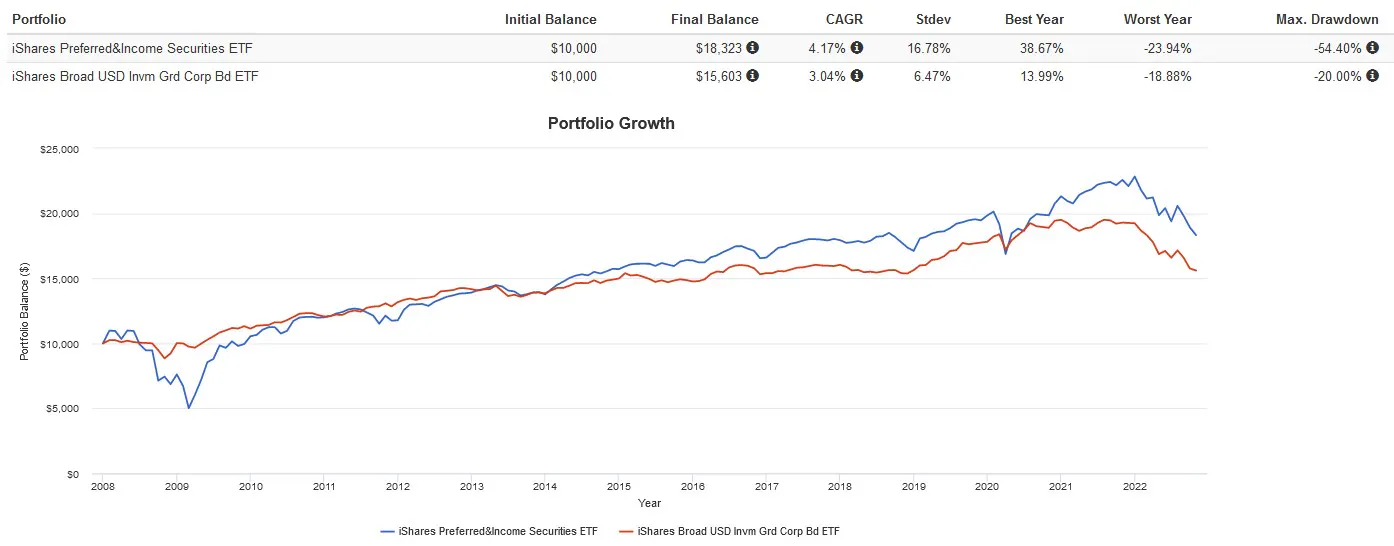
The overall returns of preferred shares are very similar to corporate bonds, albeit with much higher volatility. Notice the deep drawdowns during both the 2008 and 2020 crashes compared to corporate bonds. This is symptomatic of their higher degree of market risk.
Why substitute preferred shares?
Still, in a taxable account preferred shares can be a useful substitute for corporate bonds. As a diversifier for a portfolio, preferred shares have two important characteristics, namely:
Advertisement
- A positive long-term expected return from the dividend payments and possible capital appreciation.
- Sufficiently high volatility while possessing sufficient low correlation with equities.
The combination of these two characteristics makes preferred shares a reasonable addition to diversify a portfolio, in small allocations.
The biggest reason to consider substituting preferred shares in lieu of corporate bonds is tax-efficiency. Most preferred shares ETFs generate qualified dividends, which are taxed anywhere from 0-20% depending on your income bracket. As noted earlier, interest income for corporate bonds is taxed at the ordinary income rate, which can be as high as 39.6%.
A possible strategy could be combining preferred shares with U.S. Treasury bond ETFs, which are also taxed more favorably than corporate bonds. This way, investors can obtain better yields from the preferred shares, while ensuring a decent overall credit quality for their fixed income holding.
The following ETFs offer exposure to preferred shares. Clicking on them will take you to a page where you can view their strategy, holdings, and expense ratios.
More articles


About Trackinsight
Since our founding in 2016, we have been at the forefront of the industry, delivering accessible, comprehensive, and reliable tools to support the evolving needs of investors.
Over the past decade, Trackinsight has expanded its operations across six countries, serving thousands of professional investors. We’ve consistently innovated to provide cutting-edge solutions that meet the changing demands of the ETF market.
In 2024, Kepler Cheuvreux, a leading independent European financial services firm, acquired a majority stake in Trackinsight, becoming the company's principal shareholder.
This strategic partnership solidifies Trackinsight's position as a premier provider of ETF selection and analysis tools, while strengthening Kepler Cheuvreux’s commitment to becoming a leading player in the ETF sector.
Together, we are committed to offering advanced services that empower professional investors, advisors, institutions, and issuers. This new step enables us to deliver even more comprehensive and innovative technological solutions, driving ETF investing to new heights.
More about TrackinsightETF TOOLS
PLATFORM
ETF NEWS & RESEARCH
Privacy policy | Cookie policy | | Terms of use | Imprint