All you need to get started with ETF selection and analysis. Create your account now →
Help us improve your experience. Please confirm your investor type:
The ETF Industry Is Evolving Fast
From AI infrastructure to active strategies, the ETF landscape is shifting. Share your perspective in the 7th Annual Global ETF Survey.

Negative-Yield Bonds: The End of an Era
Global negative-yielding debt has essentially been wiped out as of January 2023, as the Bank of Japan made an unexpected policy shift in December, marking the end of close to a decade of sub-zero yields.


By Daniel Chivu
March 1, 2023
Advertisement
A negative-yielding bond is a bond that has a yield of less than 0%. This means that an investor will receive less in interest payments and principal over the life of the bond than they paid for it originally.
Negative yields can occur in situations where there is a high demand for safe, low-risk investments, as well as a low supply of such investments. During times of economic uncertainty, or deflation, investors may be willing to accept a negative yield on their bonds, as a way of preserving capital. In these scenarios, investors crowd into low-yield bonds and drive the prices up, as a way of locking in smaller losses than they would otherwise.
In the case of economic hardships, negative-yield bonds act as a cap on the amount that will be lost, as compared to other asset classes which could potentially lose even more value.
In the second scenario, where deflation is prevalent, already low-yielding bond prices increase as a result of Central Bank policies that lower interest rates, dropping the corresponding yields to negative, despite having started in positive territory.
This occurred during the beginning phases of the COVID-19 pandemic when central banks worldwide dropped interest rates to zero in response to the shutting down of their economies. The prices of low-yield bonds shot up as inflation plummeted to negative levels, and investors rushed to the relative safety of fixed income.
Which countries issue negative-yielding debt?
Negative-yield bonds have been issued by governments and companies in various countries around the world, including Japan, Germany, Switzerland and the Netherlands. It is difficult to determine the exact date of the first negative-yield bond, as the yields can become negative due to a variety of factors, including changes in market conditions and interest rates. However, most negative-yield bonds were issued at relatively low yields, and were very susceptible to an eventual flip to the negative, in the right market conditions.
ETF Data Built for Precision
Trackinsight delivers reliable and comprehensive coverage on 14,000+ ETFs
Although negative-yield bonds have been around since at least 2015, there was certainly a pick-up in pace starting in mid-2018, when most central banks were worried about the persisting low inflation, and were doing everything to stimulate it through low interest rates.
The pandemic proved to be the catalyst for a resurgence in negative yields, which surged to a high of USD $18 trillion by the end of 2020:
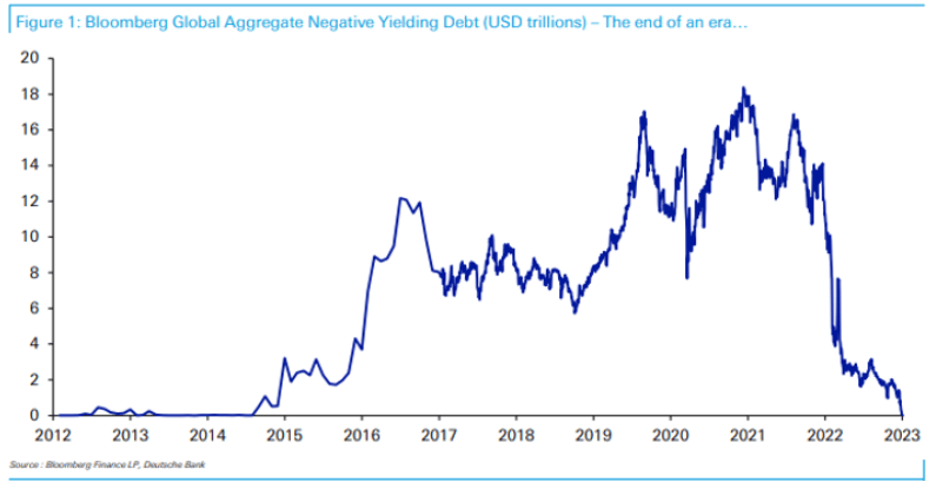
As global equity markets rallied throughout 2021, investors fled from the safety of bonds to the frothy stock markets, and so we saw the beginning of a steep decline in the value of negative-yielding debt. It is uncertain whether bond investors foresaw the eventual interest rate hiking cycle and wanted to liquidate their negative yield positions or were simply looking to get a piece of the action in the white-hot stock market. Regardless, the end result was a collapse in negative yield bond values, finalized by the 2022 rate hike cycle.
A surprising policy shift
The bank of Japan’s recent policy shift in December of 2022, marked the end of the negative era, when they relaxed the policy around their interest rates, and allowed yields to rise up to 0.5%. Until recently, Japan has been an outlier, resisting global pressures to hike rates even as the FED, ECB, and other Central Banks have shown determination to reign in runaway inflation.
Being the world’s largest creditor, with close to $3.2T in foreign assets of which 1/3 is USD Debt, the world was reminded of how integral Japan is to global financial markets when the BoJ adjusted its views on bond purchases, which were keeping interest rates close to 0. But as global rates have diverged, the value of the Japanese Yen has fallen as a result of investors fleeing for better returns in other jurisdictions.
Prior to mid-December, the expectation was that no changes would be made to its current policies until March, and the sudden shift caught everyone off guard. As a result, global markets plunged, the Yen surged more than 3%, and bond yields shot up, ending the negative yield policy era.
What this means for global bond investors
When a bastion of ultra-low rates decides to suddenly shift its policy, a clear message is sent out to investors: yields will stay higher.
What is curious, however, is that Japanese bond values reacted contrary to what we would expect in a rate hike. Whereas most Western government and corporate bonds have been losing their value with interest rates moving higher, the UBS – Bloomberg Japan Treasury 1-3 Year Bond ETF has surprisingly begun trending upward since the announcement in December. A possible explanation could be that Japanese government bonds are now suddenly worth holding since they will be providing a positive yield.
Beyond the direct effects on Japanese bonds, this shift in policy also served as a signal. A signal that unless inflation somehow collapses to pre-pandemic levels, we should expect to see higher yields for longer, on a global scale.
*IMPORTANT: The views and opinions expressed herein are the views and opinions of the author and do not necessarily reflect those of Trackinsight. Past performance is not indicative of future results. Investors should undertake their own due diligence and carefully evaluate companies before investing. ADVICE FROM A FINANCIAL PROFESSIONAL IS STRONGLY ADVISED.
More articles


About Trackinsight
Since our founding in 2016, we have been at the forefront of the industry, delivering accessible, comprehensive, and reliable tools to support the evolving needs of investors.
Over the past decade, Trackinsight has expanded its operations across six countries, serving thousands of professional investors. We’ve consistently innovated to provide cutting-edge solutions that meet the changing demands of the ETF market.
In 2024, Kepler Cheuvreux, a leading independent European financial services firm, acquired a majority stake in Trackinsight, becoming the company's principal shareholder.
This strategic partnership solidifies Trackinsight's position as a premier provider of ETF selection and analysis tools, while strengthening Kepler Cheuvreux’s commitment to becoming a leading player in the ETF sector.
Together, we are committed to offering advanced services that empower professional investors, advisors, institutions, and issuers. This new step enables us to deliver even more comprehensive and innovative technological solutions, driving ETF investing to new heights.
More about TrackinsightETF TOOLS
PLATFORM
ETF NEWS & RESEARCH
Privacy policy | Cookie policy | | Terms of use | Imprint