Trackinsight Enterprise, a unified platform for institutional ETF research, analytics, and compliance, is now live. Explore Trackinsight Enterprise →
Help us improve your experience. Please confirm your investor type:
The ETF Industry Is Evolving Fast
From AI infrastructure to active strategies, the ETF landscape is shifting. Share your perspective in the 7th Annual Global ETF Survey.

Investing in Energy Funds: Crisis Turned to Opportunity

By Daniel Chivu
January 27, 2023
- Energy
Advertisement
After close to a decade of underperformance, Energy stocks had a resurgence in 2022 on fears of supply concerns due to geopolitical events. Although energy prices have come down from their peaks, they are still well above production costs, leaving Energy companies flush with cash, and raising dividend payments to shareholders.
The question on investors’ minds is whether the energy resurgence in 2022 is simply an outlier in ten years worth of underperformance, or whether this is the start of a multi-year trend that will see energy indexes reach all-time highs.Investing in energy stocks or funds often carries a negative connotation due to their association with climate change or environmental disasters throughout the decades.For this reason, many ESG-conscious investors or fund managers often steer away from including traditional oil and gas investments within their funds.
📊 Share your ETF outlook
From AI infrastructure to active strategies, the ETF landscape is shifting. Share your perspective in the 7th Annual Global ETF Survey and get exclusive early access to the final report.
Offsetting carbon footprints
Investing in energy should not be synonymous with supporting environmental damage.Although history points to environmental accidents or relaxed emission regulations that have undoubtedly contributed to high CO2 levels in the atmosphere, this should not be the case going forward.
In fact, many oil and gas companies are investing heavily in carbon capture technology and actively looking to reduce their carbon footprint, as the need for greener energy production becomes more and more pronounced. Traditional energy companies have started making massive investments in alternative energy sources whether that be hydrogen, solar, or biofuels. Similarly, many companies have pledged vast sums of money over the next decade to invest in carbon capture projects, or have publicly announced plans to completely decarbonize over the next three decades.
Although these are long-term initiatives, it signals a clear shift towards environmental responsibility which should at the very least begin to garner more support from investors who would have otherwise shunned investments in this sector.
We can take the Pathways Alliance as an example, currently made up of six major Canadian Oil and Gas producers, who have pledged to reach a NetZero carbon footprint by 2050, while at the same time working to maintain energy security not just in Canada but the world as a whole. And they are far from the only companies undertaking this endeavor. American energy giants such as ConocoPhillips, Chevron and ExxonMobil have either made similar pledges to reach Net Zero by 2050 or are actively investing in a diverse portfolio of renewable assets including wind and solar energy or biofuels.
Likewise, European companies (who understand the need for energy security better than anyone perhaps), have made similar declarations with producers such as BP Oil or Total Energies (a French multinational energy company), also pledging Net Zero by 2050 and actively looking to diversify their assets to include green alternatives.
Demand outlook for energy
But when all is said and done, the main purpose of investing is to generate a preferred rate of return. So while green initiatives certainly support the brand image of these producers, the question is whether the industry will remain profitable in the future.
Energy funds and shareholders have benefited from the surge in energy prices in 2022, and despite little to no investment in additional production companies have been able to generate record profits for their shareholders. The iShares S&P 500 Energy Sector UCITS ETF was up 54% and 64% over 2021 and 2022 respectively, with an already strong start to 2023.
Advertisement
Being a commodity, the price of oil is heavily dictated by the laws of supply and demand, a basic tenant of economics. And so, by this logic, we can look at the projections of supply and demand of hydrocarbons over the next 5 to 10 years and attempt to figure out whether the ‘emperor has any clothes’.
As per the International Energy Association’s latest report in October 2022, oil demand (in millions of barrels/ day) is set to increase until at least 2030 under the currently proposed policies, represented by the blue line:
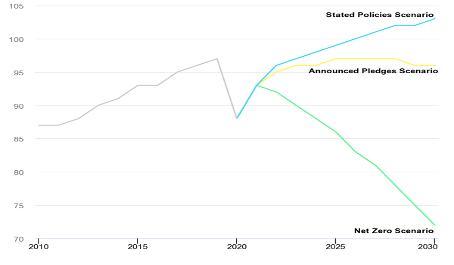
Clearly, as per the IEA’s own projections, demand is stated to increase under the two most likely scenarios.
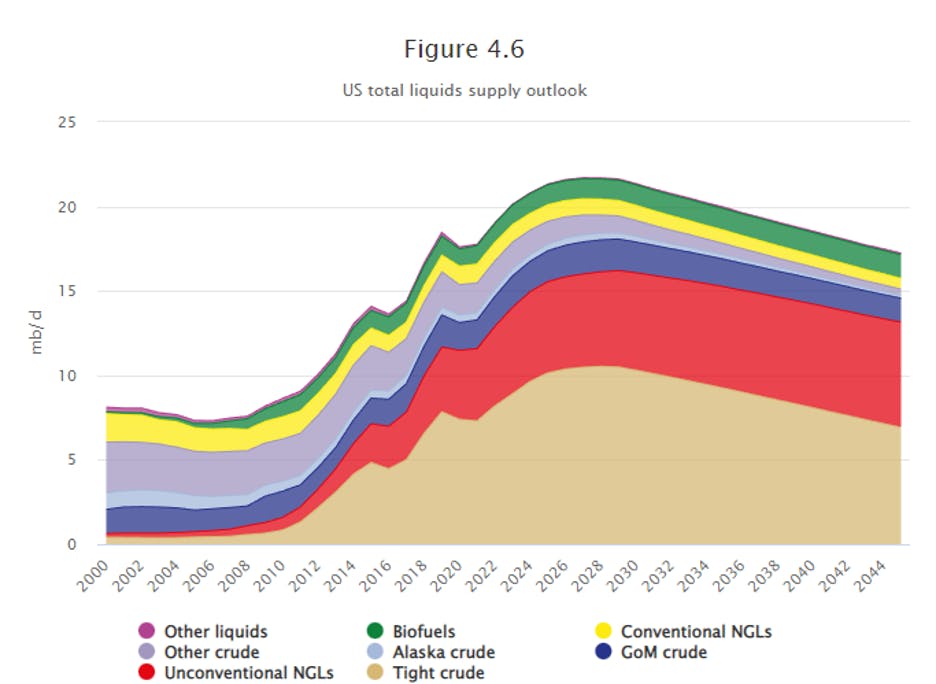
But what about supply? If supply outstrips demand, oil prices would trend downwards over this same period of time, and reduce any benefit received by companies operating in the industry. This is a little harder to figure out, as oil-producing nations are split between OPEC and non-OPEC countries, but two graphs should be able to paint a clear picture.
In the figure below, we see the U.S liquid production outlook over the next 20 years:
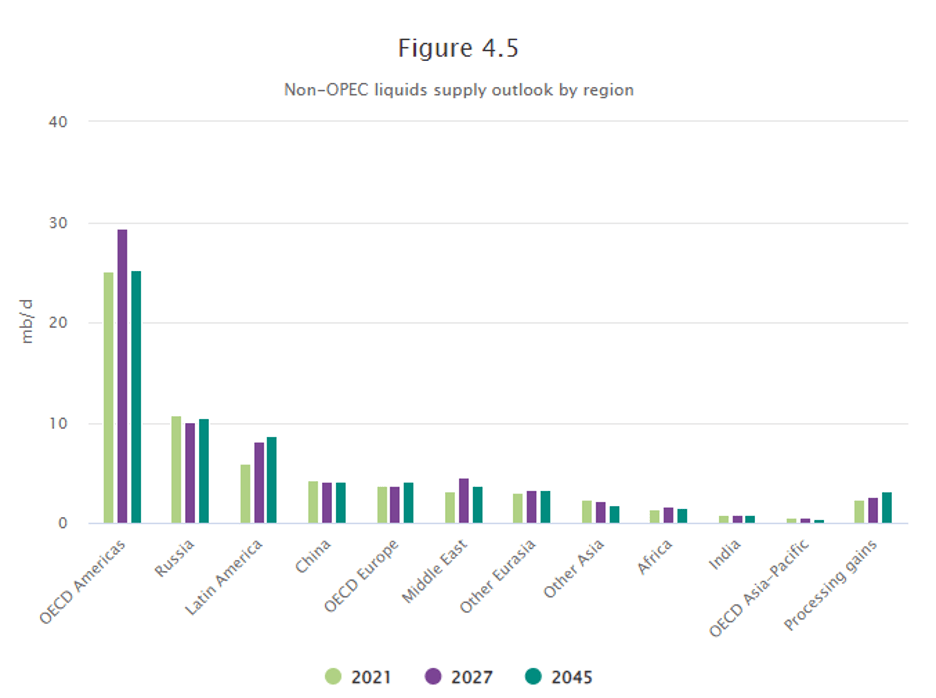
For an even better view, we can look at the production outlooks over multiple geographic regions:
For more details on the outlooks, readers can access the information throw OPEC’s own website.
A clear trend develops based on the outlooks provided by what is, undoubtedly, the most important organization in the world when it comes to energy prices and production. Over the next 10 years, demand for liquid hydrocarbons is expected to increase by at least 15%, while production in the U.S. and in other oil-exporting countries seems poised to remain flat or to experience only modest growth.
Getting exposure to energy funds
Though the analysis above is somewhat simplistic in that it doesn’t include renewable resources in the equation, the clear trend of higher demand and stagnating supply for the next decade should make investors think twice about not having exposure.
Advertisement
European investors, especially, whose countries are currently grappling with high energy costs at the moment, should know all too well what these trends mean for the future, and consider a healthy allocation to the Energy sector in their long-term portfolios.
Energy has historically been quite a volatile sector so a long-term outlook should be considered, along with geographical diversification in the fund allocations. ETFs focusing on global oil and energy producers would probably be the best bet, as they are able to avoid the risks of any one country taking advantage of supply and demand dynamics (I’m looking at you Canada).
The SPDR MSCI Europe Energy UCITS ETF (STN) provides investors with a healthy exposure to energy producers in Europe. It focuses primarily on UK assets (>52%), with roughly 20% allocated to French producers. The ETF has an expense ratio of 0.18% which is definitely on the higher end, however, it does aim to provide exposure to a less liquid market and so it is a warranted cost.
For investors who are looking to add some North American exposure, the iShares Oil & Gas Exploration & Production UCITS ETF (SPOG) could provide this opportunity, while still remaining geographically diversified. The fund primarily invests in U.S. and Canadian energy producers, however, it also provides exposure to Japanese, Israeli, and Australian producers. For this reason, it commands a hefty expense ratio of 0.55%.
It is important to note that both of these above options do not currently have distributions of income, electing to reinvest any dividends provided by the underlying holdings into additional shares. Investors get the benefit of the dividends through an increase in the Net Asset Value (NAV) of the fund rather than through income, which could be tax advantageous depending on the jurisdiction.
Please note this article is for information purposes only and does not in any way constitute investment advice. It is essential that you seek advice from a registered financial professional prior to making any investment decision.
More articles


About Trackinsight
Since our founding in 2016, we have been at the forefront of the industry, delivering accessible, comprehensive, and reliable tools to support the evolving needs of investors.
Over the past decade, Trackinsight has expanded its operations across six countries, serving thousands of professional investors. We’ve consistently innovated to provide cutting-edge solutions that meet the changing demands of the ETF market.
In 2024, Kepler Cheuvreux, a leading independent European financial services firm, acquired a majority stake in Trackinsight, becoming the company's principal shareholder.
This strategic partnership solidifies Trackinsight's position as a premier provider of ETF selection and analysis tools, while strengthening Kepler Cheuvreux’s commitment to becoming a leading player in the ETF sector.
Together, we are committed to offering advanced services that empower professional investors, advisors, institutions, and issuers. This new step enables us to deliver even more comprehensive and innovative technological solutions, driving ETF investing to new heights.
More about TrackinsightETF TOOLS
PLATFORM
ETF NEWS & RESEARCH
Privacy policy | Cookie policy | | Terms of use | Imprint