Trackinsight Enterprise, a unified platform for institutional ETF research, analytics, and compliance, is now live. Explore Trackinsight Enterprise →
Help us improve your experience. Please confirm your investor type:
The ETF Industry Is Evolving Fast
From AI infrastructure to active strategies, the ETF landscape is shifting. Share your perspective in the 7th Annual Global ETF Survey.
Meme stocks hack the FTSE Russell indices rebalancing
FTSE Russell, one of the largest index providers, will rebalance its indices at the end of the month. What’s different this time? Meme stocks like GameStop, AMC and Nokia are here to spice things up.

By Pierre Laget
June 16, 2021
- FTSE Russell
- IWN
- Small Cap
Advertisement
Indexes are like recipes – they tell investment managers and ETF providers what ingredients (stocks or bonds) to include, and how much of each that they should use. However, the price of stocks and bonds can change over time, companies can merge or go bankrupt and new companies may come to market that need to be added to the index.
Index rebalancing is a way of readjusting the amount of each ingredient to take into account the changes that have occurred in the market.
📊 Share your ETF outlook
From AI infrastructure to active strategies, the ETF landscape is shifting. Share your perspective in the 7th Annual Global ETF Survey and get exclusive early access to the final report.
Confused? Here’s a quick example: Let’s say you are an index provider who is calculating an Electric Vehicle index. You may have familiar names like Tesla, Volkswagen in the index. But if Toyota launches a range of electric cars, you would need to add Toyota to the index to ensure you are capturing the full opportunity in the electric vehicles market. This addition would occur during a rebalance.
During a rebalance, portfolio managers need to sell certain assets and buy others. While this may sound simple, the process can be tricky under unusual conditions. In our case, GameStop’s year-to-date performance, a 1,000% increase in price, is a good example of an unusual condition. We review what the meme stocks rally means for indices and for ETFs tracking those indices.
(Re)balance in chaos
For most people, June marks the end of Spring. For FTSE Russell, it’s the period of its annual rebalancing. At the market close on the 25th, the global index provider will publish the new universe for its range of U.S. equities indices. The actual rebalancing will take place on the 28th June.
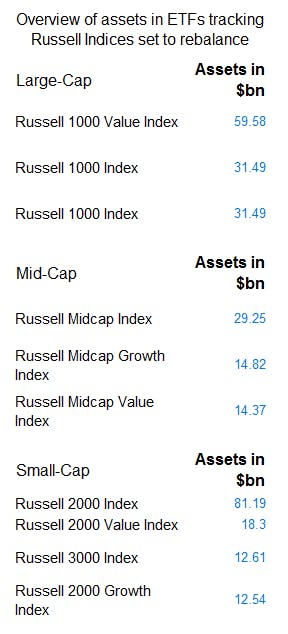
As of the 31st of May, there are $390bn of assets invested in ETFs tracking a FTSE Russell index set to rebalance at the end of the month. More specifically $113bn of them are linked to the Russell 2000 index and its different versions.
This time is a lot different. The market has rebounded sharply after the March 2020 sell off. Social communities such as r/wallstreetbets have driven huge speculation around a few stocks called “meme stocks”. The ETF industry was fast to react and quickly launched products for this crowd. VanEck listed their BUZZ ETF last March. More recently, the FOMO ETF, listed last month, and the SFY ETF all tried to catch the trend.
But it turns out a totally different kind of ETFs end up owning the most “meme stocks” as their unusual surge shake the world of traditional indices.
Meme stocks outgrow the Russell 2000
Following the r/wallstreetbets rally, many indices have been impacted by the social media frenzy over stocks like GameStop, AMC or Nokia. More particularly, all eyes are on two Russell indices: the Russell 2000 and Russell 1000. The Russell 2000 is the reference benchmark for U.S. small cap stocks. The Russell 1000 is its equivalent for U.S. large-cap stocks. Currently the Russell 2000 holds a significant amount of “meme” stocks. As of the 11th of June, its top 5 holdings are all favorites of the social media trading communities.
Advertisement
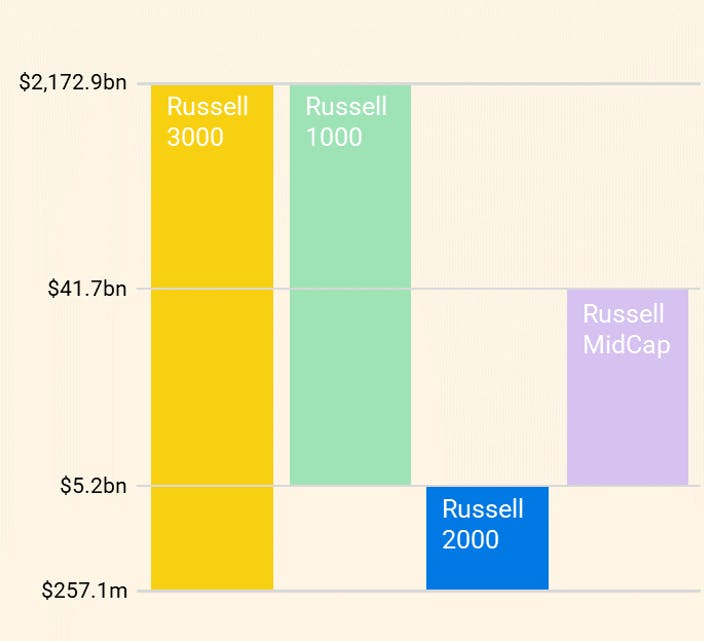
How did those buzz stocks make it to such a reference index? It is simply a story of numbers. If a stock reaches a certain size of market capitalization, it will get included in the index on rebalancing date. And that is what is going to happen to the Russell 1000 now following the jaw-dropping rally of some “meme stocks” like GameStop.
The video game retailer is expected to leave the Russell 2000 for the Russell 1000 on the June rebalancing. With a market value of more than $11bn as of the 7th May, it is well above the minimum market cap required to enter the big league of Russell 1000 - $5.2bn.
Not all “meme stocks” will have the same fate though. AMC, currently part of the Russell 2000, should not enter the Russell 1000 at the next rebalancing. Indeed, the stock’s largest gain happened after the threshold date for index inclusion. If the movie theater chain market cap stands at $30bn as of the 16th of June, on the 7th of May it was only around $4.9bn, not enough to enter the large-cap index.
What does it mean for ETF investors?
The surge in price of those “meme stocks” has distorted many ETFs holdings. Investors in Russell 2000 have significant exposure to those stocks, and the craze is now knocking at Russell 1000’s door.
To understand the problem better, it is important to remind that ETFs are recognized throughout the globe for their diversification power. When you buy a share of an ETF, you immediately own a portion of thousands of stocks through the ETF. This allows investors to avoid risk specific to a single stock. Even if some thematic ETFs might have substantial concentration risk, ETFs are used to get exposure to a segment not to a single asset.
A Russell 2000 ETF should provide a diversified exposure to thousands of U.S. small cap stocks. The swell in “meme stocks” prices meant they also started to represent greater proportions in those investors’ portfolios than can be expected. The meteoric rise pushed by social media is now fueling fears of over-valuation and the bubble popping. Investors in the Russell 2000 might consider GameStop leaving the index as good news – they effectively bought low and sold high. The same can’t be said about the Russell 1000 though.
Beyond capturing a gain, another benefit of the index rebalance for investors in Russell 2000 ETFs will be to keep their portfolios diversified. Diversification can be measured with the HH index (or HHI in short). It gives the effective number of stocks that drives the ETF performance. A higher effective number of stocks signals a more diversified fund.
Most indices have a lower effective number of stocks than the number of stocks in their portfolios. This is due to the way that stocks are weighted – some stocks are present but at such low weights that their impact on return is negligible.
Advertisement
Even though the Russell 2000 index has “2000” in its name, the effective number of stocks usually hovers around 850. But during the first Reddit stocks rally in January, the metric dropped significantly to 770. This shows meme stocks had a negative impact on the index diversification.

Investors in the Russell 1000 shouldn’t be too worried to see speculative stocks entering their portfolio either. Even though the Russell 1000 allows stocks of over $5bn to enter the benchmark, stocks will need to reach a market cap of roughly $390bn to get a weight of just 0.50% in the index. That’s the current size of Walmart for comparison.
To get there, GameStop would have to multiply its market cap by 24 times or reach a price of 54,000 per share. By entering into a larger-cap index, meme stocks will have a significantly lower impact on the Russell 1000 than what they had on in the Russell 2000.
Avoid the market mania and cut through the noise to find the right ETF with our new ETF screener.
More articles


About Trackinsight
Since our founding in 2016, we have been at the forefront of the industry, delivering accessible, comprehensive, and reliable tools to support the evolving needs of investors.
Over the past decade, Trackinsight has expanded its operations across six countries, serving thousands of professional investors. We’ve consistently innovated to provide cutting-edge solutions that meet the changing demands of the ETF market.
In 2024, Kepler Cheuvreux, a leading independent European financial services firm, acquired a majority stake in Trackinsight, becoming the company's principal shareholder.
This strategic partnership solidifies Trackinsight's position as a premier provider of ETF selection and analysis tools, while strengthening Kepler Cheuvreux’s commitment to becoming a leading player in the ETF sector.
Together, we are committed to offering advanced services that empower professional investors, advisors, institutions, and issuers. This new step enables us to deliver even more comprehensive and innovative technological solutions, driving ETF investing to new heights.
More about TrackinsightETF TOOLS
PLATFORM
ETF NEWS & RESEARCH
Privacy policy | Cookie policy | | Terms of use | Imprint