Get your free ETF data sample from our comprehensive offerings. Start your free trial→
Help us improve your experience. Please confirm your investor type:
The Ultimate ETF Comparison Tool - Try Now!
Analyze up to 5 ETFs side-by-side and gain instant insights on performance, fees, holdings, and more to make data-driven investment decisions.
Markets Factor Out US Election Outcome (So Far)
With the U.S. election approaching, market volatility looms as economic policies and tech-driven trends dominate investor focus.

By Leverage Shares
October 29, 2024
- Leverage Shares
- United States
Advertisement
A key event in November is, of course, the U.S. Presidential election, where former President Trump squares off against the ostensibly incumbent Vice President Kamala Harris. As of now, the consensus among polls indicates that Vice-President Harris might be on course to win the popular vote.
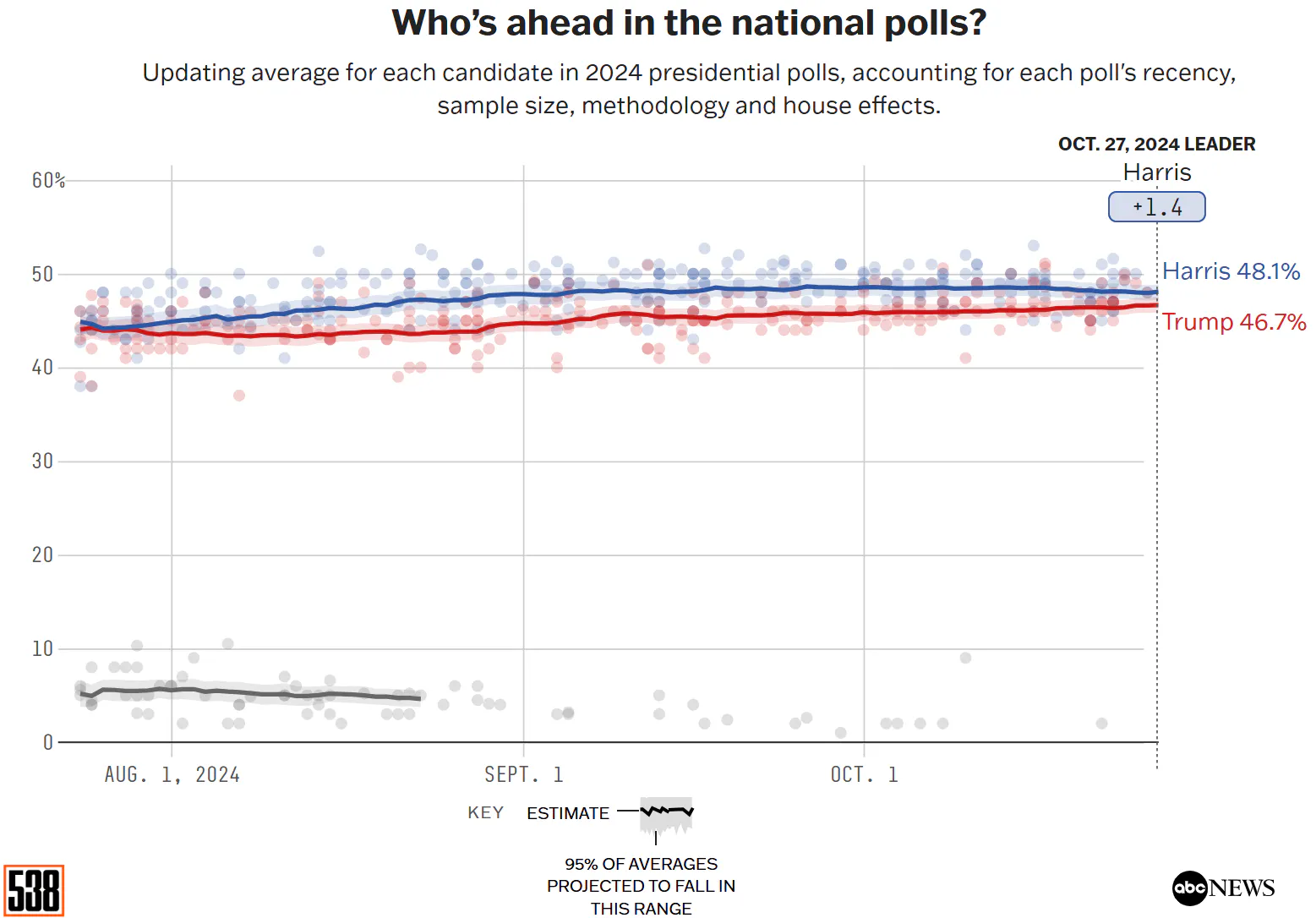
But the election is also predicated on the Electoral College as represented by vote share within each state as per a myriad of rules. Given that both candidates' utterances on economic policy have been radically different, this creates the likelihood that there should be “election volatility”.
📊 Share your ETF outlook
From AI infrastructure to active strategies, the ETF landscape is shifting. Share your perspective in the 7th Annual Global ETF Survey and get exclusive early access to the final report.
However, as it turns out, market volatility might be driven by other factors so far.
Year So Far: Far from Secular Growth
Since the Global Financial Crisis (“GFC”), tech's dominance over market trajectory has accelerated. For a sense of the impact that tech valuation, the trajectories of “sub-indices” S&P 500 Energy Sector Index, S&P 500 Financial Services Index and the S&P 500 Index Minus Information Technology, Communication Services, Amazon and Tesla (essentially “S&P 500 Ex-Tech”) can be considered versus that of the S&P 500 and the Equally-Weighted S&P 500 (which holds a constant and equal proportion of all constituents of the index).
The trends that emerge are seemingly messy.
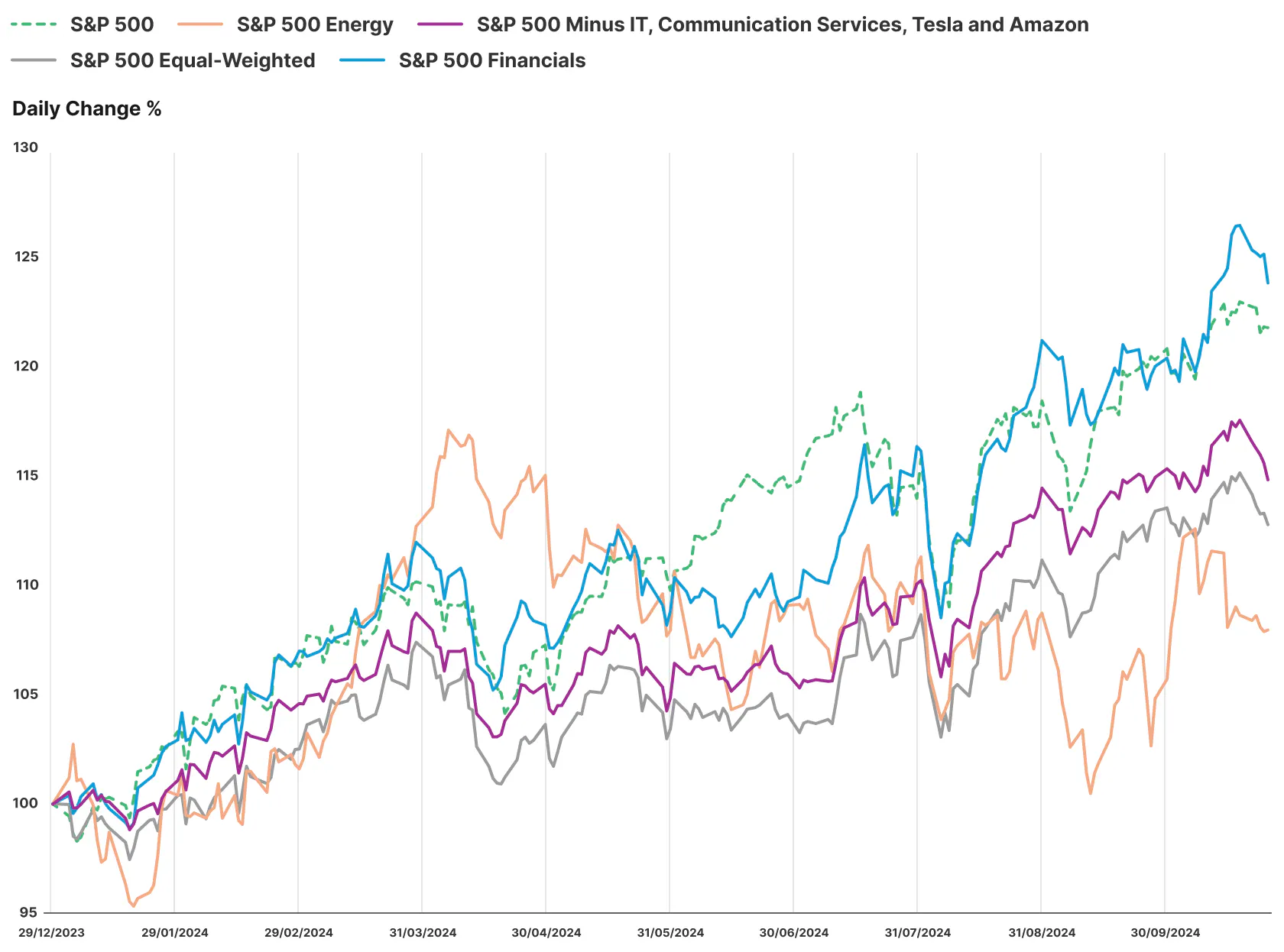
The pairing of energy and financials as “safe harbour” investment choices in times of economic uncertainty on a forward-looking basis is a near-classical theme: regardless of economic uncertainty, energy must be available to the citizenry while banks must process savings and credit cards, support the restructuring of companies, sell debt to the open market, advise on investments and so forth. Thus, when other sectors fade in conviction, these two tend to be resilient and even show growth.
The Equally-Weighted Index shows a net 8% underperformance relative to the broad market, strongly suggesting that market growth is not secular. In fact, at around 13% gains in the YTD, it could be argued that the index's growth would be nil-to-negative if adjusted for actual inflation. The “S&P 500 Minus Tech and Tesla” sub-index fares a little better at 15%, thereby suggesting that some opportunistic buying in specific high-value under-pressure sectors has been underway at certain periods, particularly at lows. Nil-to-negative growth implication should be suggestive of a depressed forward outlook, thereby setting in the advent of the classic “financials and energy” surge. This pairing hasn't quite happened.
While ongoing tensions in the Middle East and the Russo-Ukrainian conflict were potential tailwind factors for sending crude oil prices surging (which did happen until April), WTI Crude Oil's Front Month prices are currently hovering and holding steady around the $70-75 price range, i.e., the same range as at the start of the year. With access to additional exploration activities potentially hobbled for U.S. and European companies in areas of geopolitical tension, however, conviction in this sector seems to be largely returning to a holding -to-bearish pattern.
However, the U.S. financials sector has been booming. As of the 23rd, Financials outpace the S&P 500 by about 4%, with several periods of outright outperformance in the YTD. Conviction, in particular, has been strengthening since Q2 2024. Financial institutions, however, don't tend to have a lot of speculation imputed; they tend to be “value” investments that swiftly adjust their costs to economic conditions. The bulk of the speculation — and market capitalization — in the broad markets is derived from “Big Tech,” which empirically has developed a rather interesting market conviction trend with the financial sector.
Big Tech versus Big Banks?
Within the index, the financial sector is dwarfed in market capitalization by Big Tech, which is (in turn) dominated by the “Magnificent Seven” — a group consisting of Apple (AAPL), Microsoft (MSFT), Alphabet (GOOG and GOOGL), Amazon (AMZN), NVIDIA (NVDA), Tesla (TSLA) and Meta Platforms (META). To estimate the relationship of market convictions, the Roundhill Magnificent Seven ETF (MAGS) — a fairly popular instrument that offers equal weight exposure to the “Magnificent Seven” with periodic rebalancing — is compared to the S&P 500 Financials sub-index.
Advertisement
To contextualize the play of market convictions, in the image below the S&P VIX Index (VIX) tracking S&P 500 options, is overlaid on the net performance of these two instruments.
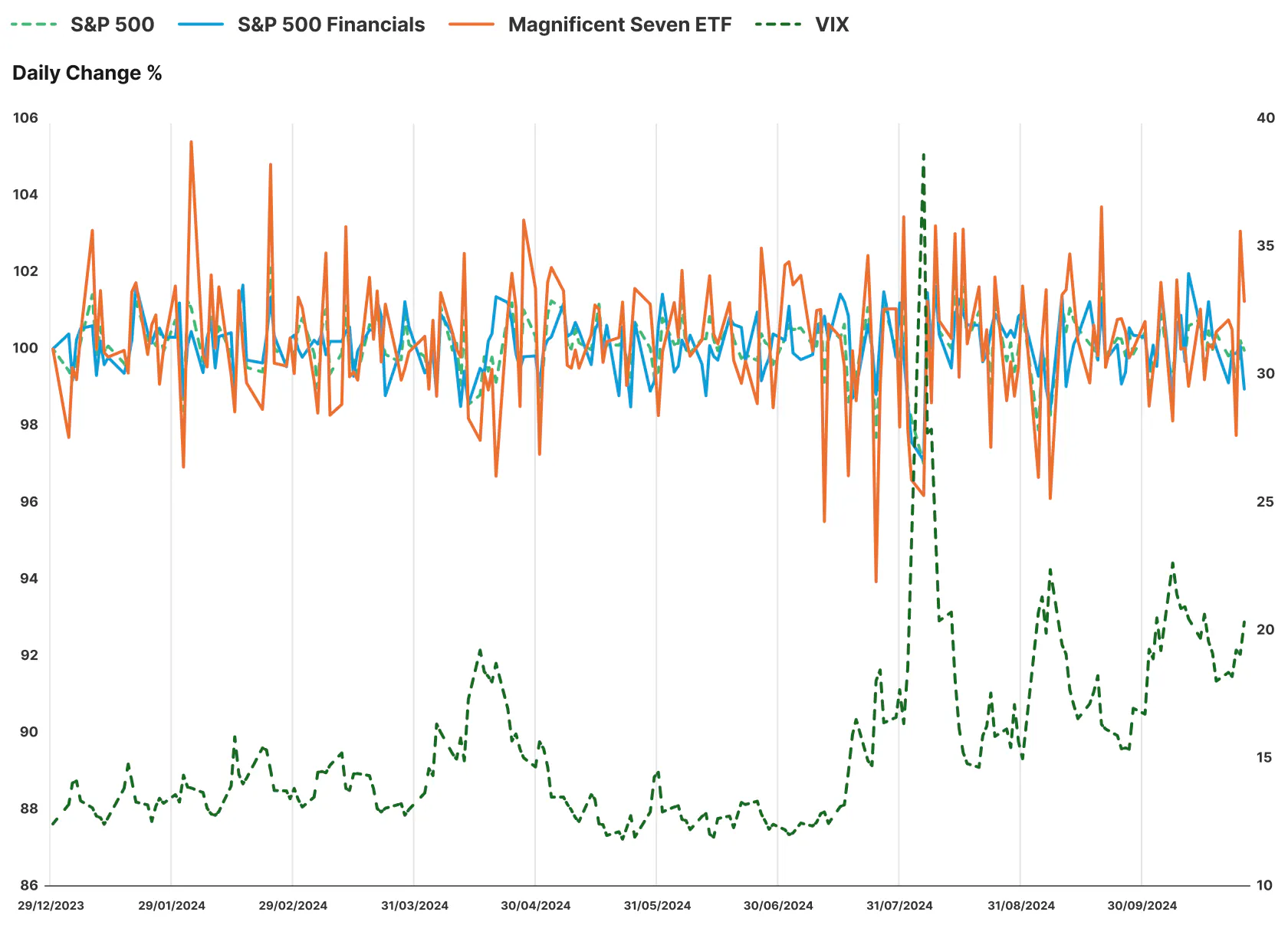
Note: The VIX has not been restated into daily performance.
Until the final month of Q3, the Financials Index and the Magnificent Seven ETF tended to rise and fall in tandem more often than not. Afterward, there's an overall sense of a “regime shift” in net tactical/opportunistic market participant behaviour: nearly every time the Magnificent Seven slumped, the Financials spiked (and vice versa). Furthermore, nearly every sharp spike of the VIX precipitated a fall in conviction for the Magnificent Seven, both before and after the “regime shift.” After the “regime shift,” every sharp spike essentially meant a quick retreat into the Financials for an early buy-in into “safe harbour.” The repetitiveness of this action implies that there is no consensus on when the safe harbour will rise in valuation.
A massive spike in volatility was apparent when the Bank of Japan raised interest rates for the first time, effectively throttling the “Yen carry trade.” This is a long-standing mechanism wherein many prominent participants enable the borrowing of Japanese yen at near-zero interest rates, converting it into currencies with higher rates such as the U.S. dollar, and then investing in American bonds and equities. The equity trades were mostly in highly liquid stocks with substantial momentum in valuation, such as (of course) the Magnificent Seven and sundry tech stocks.
After the Yen Carry Trade Shakeup
One month after the throttling of the “Yen carry trade” paradigm that had fueled years of momentum-building, an interesting trend to emerge is the near-equalling of momentum between the Equally-Weighted S&P 500 and the “S&P 500 Minus Tech and Tesla,” which continues to the present day.
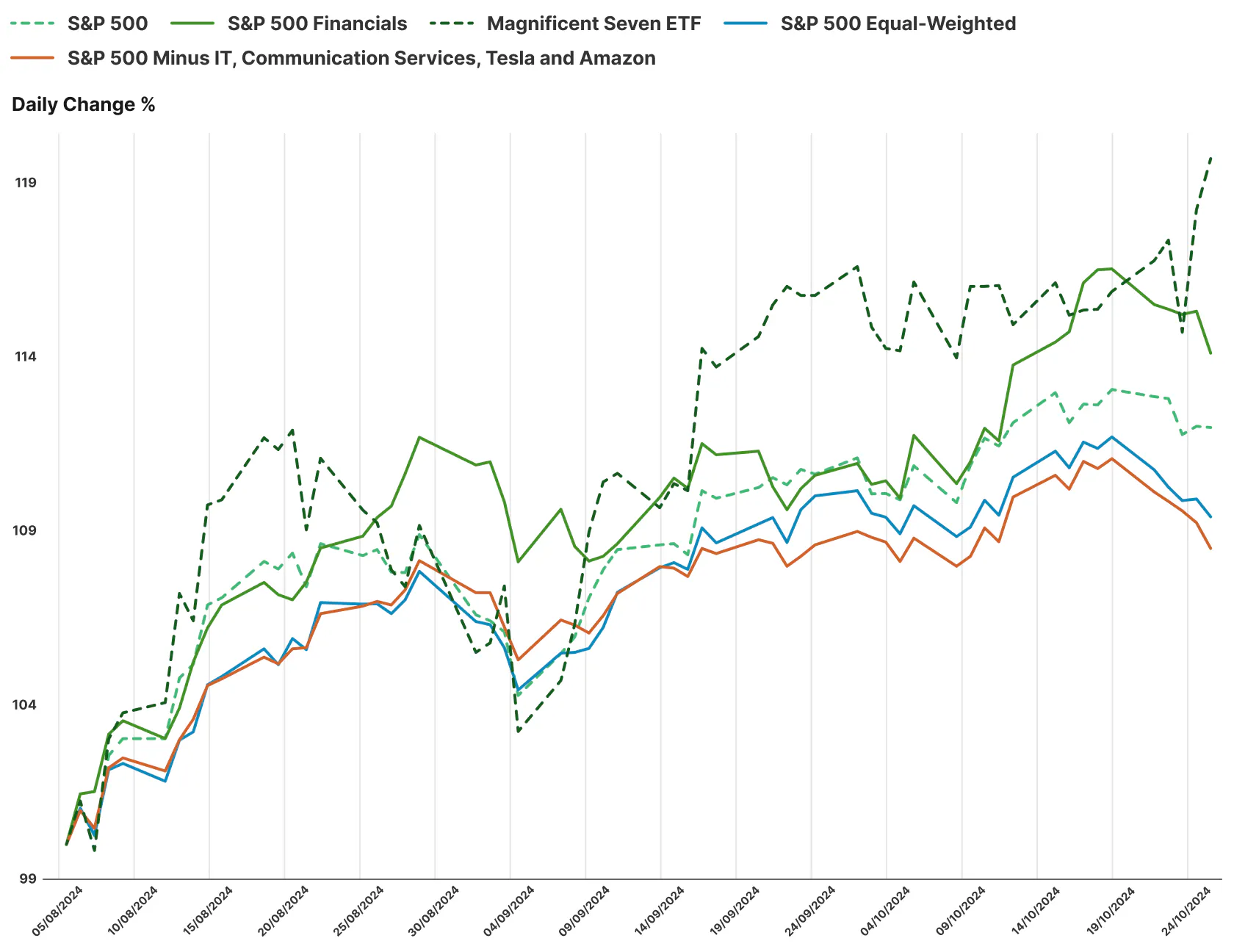
The see-saw between Financials and the Magnificent Seven continued in that period. Financials began to resonate with the “Minus Tech and Tesla” and the “Equal Weight” until circa the 10th of October, when the U.S. Consumer Price Index “slowed less than expected,” implying that the forward outlook continues to be uncertain. Uncertainty implies an increasing desirability of a safe harbour, which led to a quick rise in conviction, along with expectations that the strength of earnings for banks can be expected to grow.
One month after the throttling of the “Yen Carry trade” rolled in Q3 earnings season, with overall expectations of it being a positive season in line with seasonality. With the S&P 500 and the Equally Weighted now running largely in tandem, volatility dominantly resided within Tech and adjacent stocks.
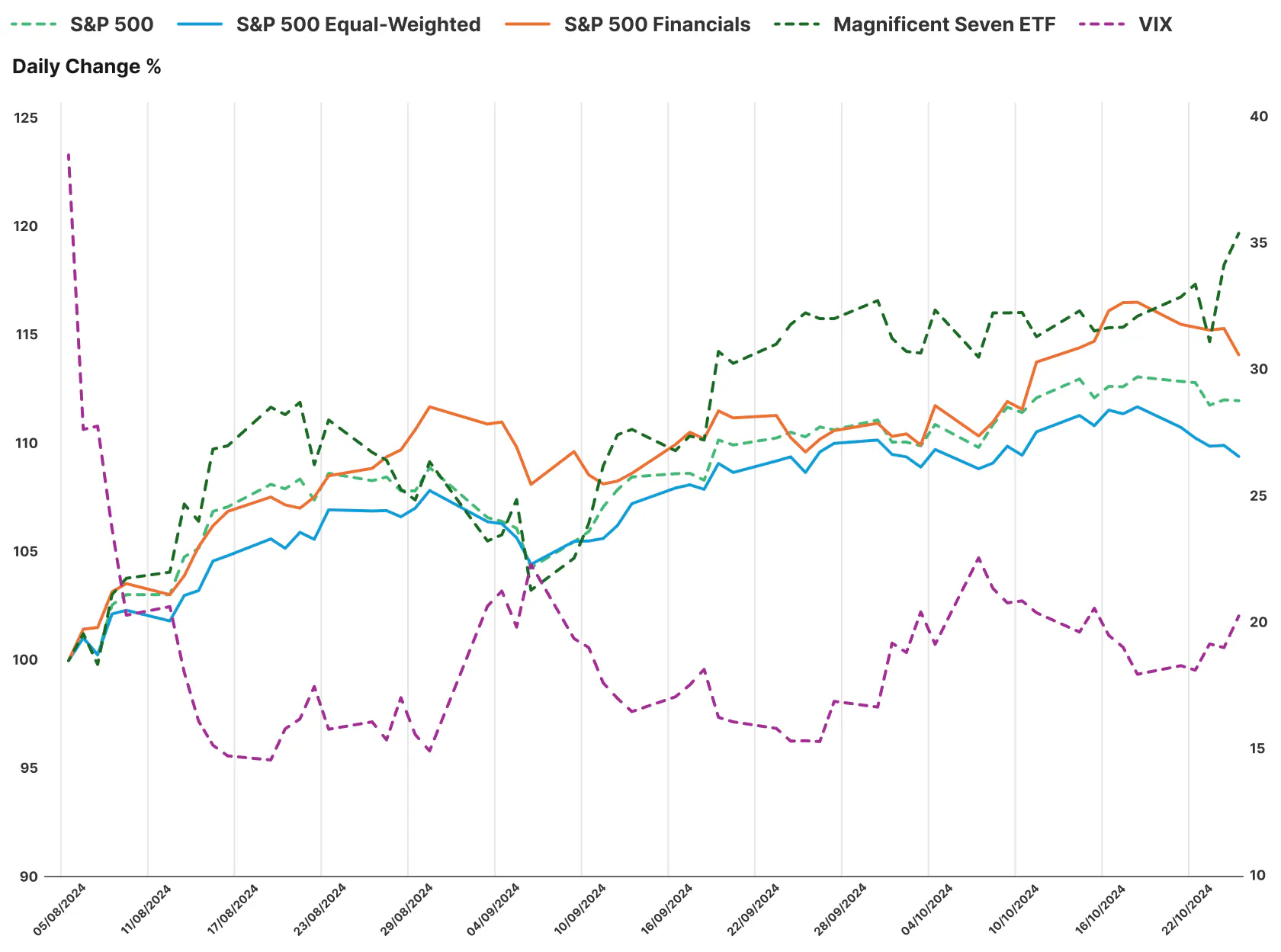
After the CPI report, the market trailed off, with Tech and Financials leading momentum again. The effect of the VIX readings currently are being clouded by the froth of Q3 earnings season but can be expected to renew after it ends.
Advertisement
In Conclusion
While there has been the occasional mention of “election volatility” in business media sources, the trends in the VIX so far indicate that the market seems to have tuned out the elections. The relative lack of interest among the investing public in the scenarios presented by poll statistics might be an indicator that the market largely seems to consider both candidates to be more-or-less unprepossessing until either one is in power. Reality tends to differ from election promises.
While strategic investors have cause to hold breadth, uncertainty brings opportunity to tactical investors, as the strong trends between certain market assets indicate. Meanwhile, professional investors in Europe can consider tactical plays based on market patterns. The 5x Long Magnificent 7 ETP (ticker: MAG7) and the -3X Magnificent 7 ETP (ticker: MAGS) offers magnified exposure to upside and downside of the performance of the Magnificent Seven respectively. The +5x Long S&P 500 ETP (ticker: SP5Y) and the -5x Short S&P 500 ETP (ticker: SPYS) do the same for the performance of the S&P 500. And finally, the +3x Long Financials ETP (ticker: XLF3) and the -3x Short Financials ETP (ticker: XL3S) track the upside and downside of the Financial Select Sector SPDR Fund respectively.
About Leverage Shares
Leverage Shares is the largest European issuer of single stock ETPs by AUM & trading volume. It is the only provider of physically-backed leveraged ETPs on single stocks, ETFs and commodities.
The opinions expressed in this publication are those of the authors and are subject to change. They do not purport to reflect the opinions or views of Trackinsight or its members. Trackinsight does not guarantee the accuracy, completeness, or reliability of the information provided.
More articles


About Trackinsight
Since our founding in 2016, we have been at the forefront of the industry, delivering accessible, comprehensive, and reliable tools to support the evolving needs of investors.
Over the past decade, Trackinsight has expanded its operations across six countries, serving thousands of professional investors. We’ve consistently innovated to provide cutting-edge solutions that meet the changing demands of the ETF market.
In 2024, Kepler Cheuvreux, a leading independent European financial services firm, acquired a majority stake in Trackinsight, becoming the company's principal shareholder.
This strategic partnership solidifies Trackinsight's position as a premier provider of ETF selection and analysis tools, while strengthening Kepler Cheuvreux’s commitment to becoming a leading player in the ETF sector.
Together, we are committed to offering advanced services that empower professional investors, advisors, institutions, and issuers. This new step enables us to deliver even more comprehensive and innovative technological solutions, driving ETF investing to new heights.
More about TrackinsightETF TOOLS
PLATFORM
ETF NEWS & RESEARCH
Privacy policy | Cookie policy | | Terms of use | Imprint