Global ETF Survey 2026: Answer now →
Help us improve your experience. Please confirm your investor type:
Don’t Miss a Move in the ETF Market
Sign up and keep track of everything that moved the ETF industry this week. From new launches to regulatory shifts across the Atlantic.

Are Chinese Markets Poised for a Comeback in Q4 2024?
China’s stimulus measures, including rate and RRR cuts, boost markets, but challenges persist in real estate and exports.


By Leverage Shares
October 15, 2024
- Leverage Shares
- China
Advertisement
On the 25th of September, representatives of China’s economic apparatus – led by People’s Bank of China (PBOC) governor Pan Gongsheng, minister of the National Administration of Financial Regulation Li Yunze and China Securities Regulatory Commission chairman Wu Qing – announced a historic economic stimulus package that simultaneously included rate cuts, reserve requirement ratio (RRR) cuts and structural monetary policies.
The PBOC beat analysts’ expectations of a series of 10-point basis point rate cuts by lowering the benchmark seven-day reverse repo rate from 1.7% to 1.5% - double that of expectations – leading to interest on the one-year medium-term lending facility being lowered by 0.3% while the loan prime rate was lowered by between 0.2 to 0.25%. Further 10-basis point cuts might be in the offing. While this will also enable the lowering of mortgage rates by around half a percentage, China’s fraught real estate sector is generally not expected to see a significant improvement in outlook.
ETF Data Built for Precision
Trackinsight delivers reliable and comprehensive coverage on 14,000+ ETFs
The lowering of the RRR – the amount of cash that commercial banks must hold as reserves - by 0.5% is expected to bolster banks’ profitability as it frees up capital being held up at a lower rate of return. However, given the PBOC’s repo operations, this isn’t expected to bring in significant additional liquidity to the public lending market. Despite the down payment ratio being reduced to 15% from 25% for second-home purchases – thus effectively bringing it in line with the policy on first-home purchases that was announced in May – general sentiment in the real estate sector isn’t expected to vastly improve as households are not expected to be swayed into making additional purchases.
A $42.5 billion (300 billion yuan) fund set up in May that would encourage local and provincial governments to buy up unsold properties to be repurposed as subsidized housing was also bolstered wherein Governor Pan stated that up to 100% of the loans made to the fund could be funded by the central bank – a quantum leap from the maximum of 60% announced in May.
To bolster valuations in China’s financial markets, a structural monetary policy facility of $70.9 billion (500 billion yuan) was announced as being in the works that would enable financial houses operating in China to effectively swap their assets in exchange for liquidity to purchase high-quality stocks. Additionally, a $42.5 billion (300 billion yuan) re-lending facility has been established to guide banks to support listed companies’ stock buybacks and purchases at a relatively modest 1.75% interest rate.
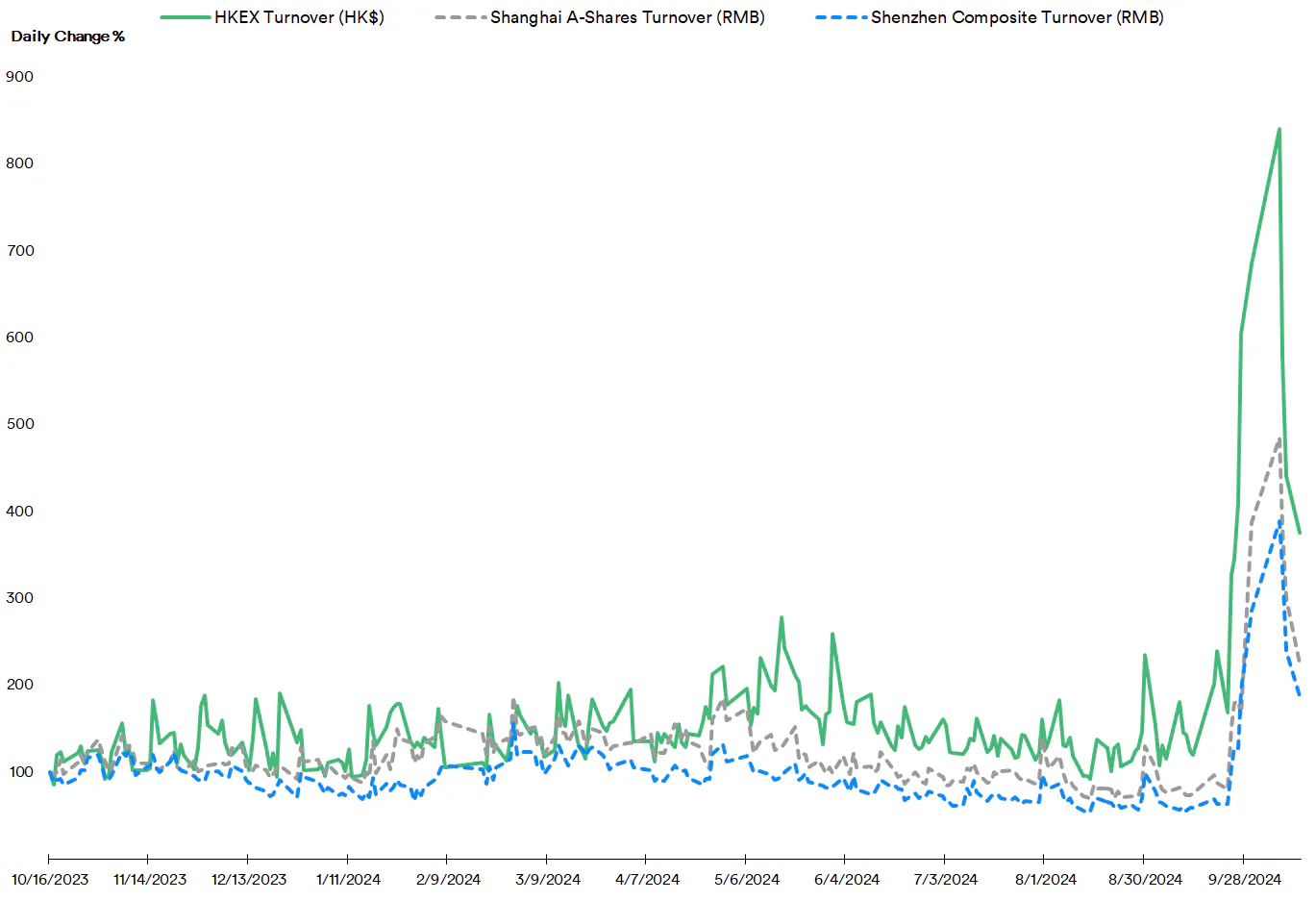
As a result, China’s domestic stocks registered a massive swing up that day, with virtually no prominent ticker in the Shenzhen Stock Exchange dipping red.

Households Remain Intransigent
China’s three engines of growth are (i) exports, (ii) infrastructure and real estate, and (iii) domestic consumption by its 1 billion-plus citizens. While the bulk of the fiscal stimulus measures are aimed at financial institutions and markets, the core fact remains that real estate markets remain moribund while infrastructure spending has saddled China’s municipal and provincial governments with $13 trillion of debt, much of which is held by Chinese financial institutions. There is little solace by way of domestic spending: China’s household spending is 20% below the global average by accounting for only 40% of its total Gross Domestic Product (GDP). Towards the problems with local governments and household spending, the government also announced a host of measures that will be financed via “special bonds” of varying designs.
China’s “special bonds” have already been hot in markets this year, with the government pledging to issue $137 billion (1 trillion yuan) in special sovereign notes in 2024 alone. In June, the sale of 50-year bonds valued at $4.8 billion attracted demand that was 5 times that of supply, while the sale of $5.5 billion (40 billion yuan) of 20-year bonds in May saw demand at 4 times that of supply. The bulk of the demand is estimated to be from China’s retail investors switching from stocks to “safer” bonds, prompting authorities to urge investors via state media to be “more rational”. On the 26th of September, China’s Ministry of Finance (MOF) was reported to be mulling raising 1 trillion yuan in special sovereign debt to bolster consumption via increasing subsidies for the trade-in and renewal of consumer goods and for the upgrade of large-scale business equipment. Also included are arrangements to provide a monthly allowance of 800 yuan per child (excluding the first child) to households with more than one child. Another 1 trillion of sovereign debt is being mulled to finance local governments buying up unsold properties, which could potentially free up household incomes.
With both financial systems and consumer markets potentially satiated, the rally seen on the 26th in China’s stock markets continued to push total market levels well beyond what was witnessed over the past year through most of the subsequent week and into October.
Source: Leverage Shares analysis
Advertisement
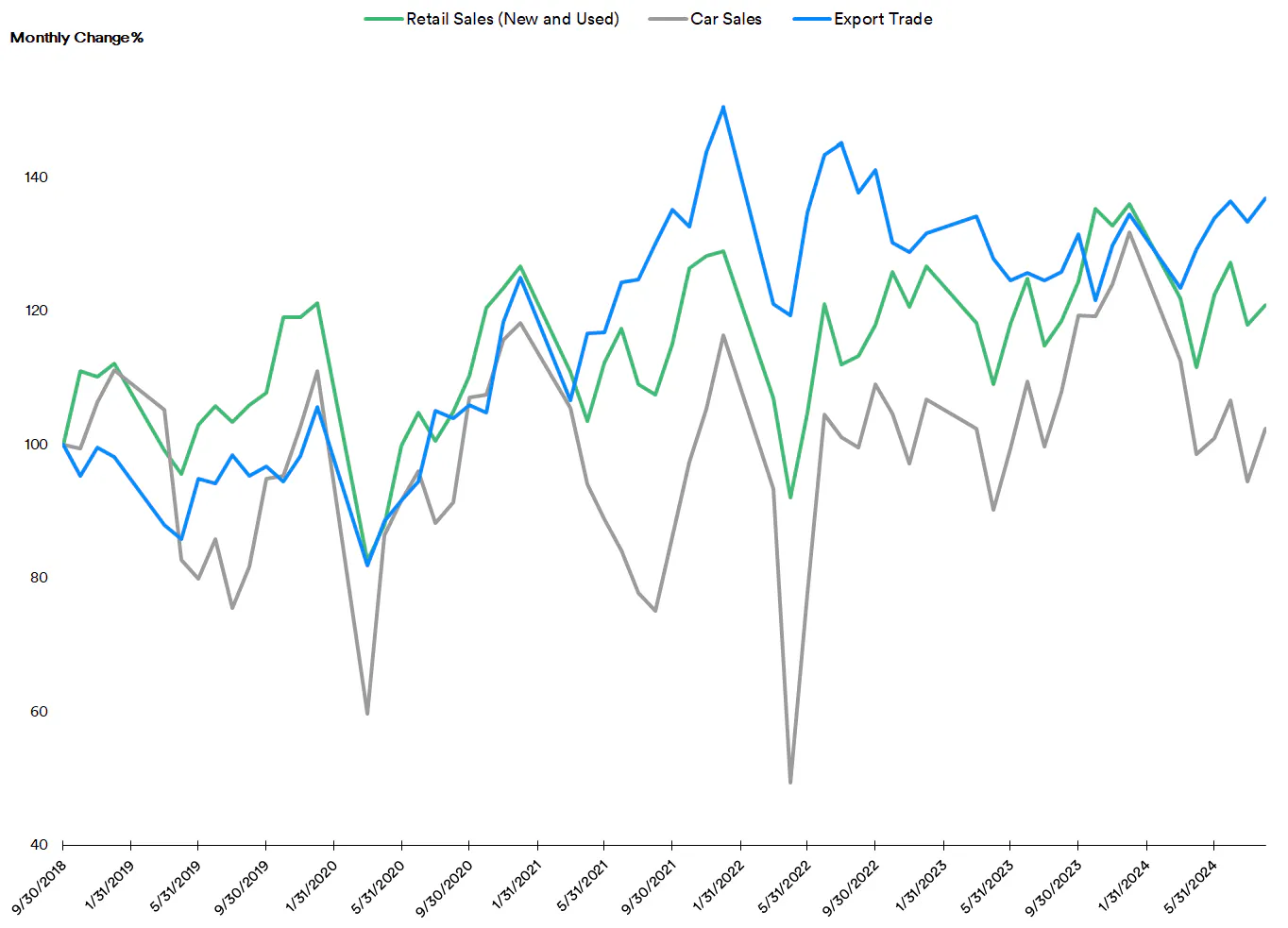
However, market conviction began to fade by the end of the second week of October with downturns manifesting again. The reason for this is somewhat nuanced: while domestic sales and exports are ostensibly supposed to be independent engines, in reality, they are now increasingly attuned to one another. For instance, when considering auto sales versus retail sales of both new and used goods as well as export trade volumes over the past six years:
Source: Leverage Shares analysis
it can be empirically established that the overall independence of the “outside” (exports) from the “inside” (retail and auto sales) showed signs of faltering shortly after the pandemic manifested, following which they were increasingly correlated. As of the end of August, while exports show slightly positive trends relative to the start of the year unlike auto and retail sales, they’re far and away from the peaks seen at the end of 2021.
As of May, factory prices had been in decline for 20 months in a row while consumer price changes were trending below estimates. While it was (on the whole) cheaper to buy goods, consumer confidence in high-value spending remained bleak. This is particularly noticeable in auto sales: despite a gruelling two-year price war being waged in China’s massively-fragmented auto market with a goal towards consolidating the industry that essentially makes it a buyer’s market, total growth in sales volumes as of the end of August are essentially flat relative to September 2018. Meanwhile, the outlook for export trends remains cloudy as plans for geographic substitutions to Southeast Asia, India and Latin America continue to roll out, further imperilling the outlook for consumer spending at home.
As it stands, markets determined that the volume of consumer spending stimulus fell short by several miles to be a sustained course correction in consumer habits which – in turn – weighed down the forward valuation of most publicly-traded Chinese companies.
More Stimulus Measures Incoming?
As market favour faded, the Chinese government’s economic apparatus held another meeting on the 12th of October wherein China’s Finance Minister Lan Foan announced that the government is considering significantly increasing debt via special bond issuances to prop up local governments. Although light on figures, China’s business media publication Caixin Global reported that the government is considering issuing $850 billion (6 trillion yuan) over the next 3 years.
Meanwhile, on the 15th, the last remaining bright spot in China’s three engines – exports – missed expectations by reporting a 2.4% growth in September versus a forecast of a 6% increase. Meanwhile, imports only edged up 0.3% versus an expectation of 0.9%, which has an interesting consequence for its exports over the next few months: a little under a third of China’s total imports are parts to be used for re-exports mostly in the form of electronics. This weakness in imports growth seems to imply that the forward outlook for exports in the coming months will be grim.
While firing on all cylinders, China’s three engines may be exponential and multiplicative. However, when they falter, they seem to misfire together. It is entirely possible that a bloodletting is in order before market convictions in Chinese tickers show a long-term positive. As of right now, market breadth is fading, which might be a net advantage for a handful of big tickers in the Middle Kingdom. The broad “China growth” story might have hit pause for now.
Advertisement
Note: Professional investors in Europe can consider tactical plays to boost returns or hedge against declines in their core China holdings. The +3X Long China ETP (LSE ticker: CHI3) and the -3X Short China ETP (LSE ticker: CHNS) offers magnified exposure to the performance of the iShares MSCI China ETF on the upside and downside respectively.
About Leverage Shares
Leverage Shares is the largest European issuer of single stock ETPs by AUM & trading volume. It is the only provider of physically-backed leveraged ETPs on single stocks, ETFs and commodities.
The opinions expressed in this publication are those of the authors and are subject to change. They do not purport to reflect the opinions or views of Trackinsight or its members. Trackinsight does not guarantee the accuracy, completeness, or reliability of the information provided.
More articles


About Trackinsight
Since our founding in 2016, we have been at the forefront of the industry, delivering accessible, comprehensive, and reliable tools to support the evolving needs of investors.
Over the past decade, Trackinsight has expanded its operations across six countries, serving thousands of professional investors. We’ve consistently innovated to provide cutting-edge solutions that meet the changing demands of the ETF market.
In 2024, Kepler Cheuvreux, a leading independent European financial services firm, acquired a majority stake in Trackinsight, becoming the company's principal shareholder.
This strategic partnership solidifies Trackinsight's position as a premier provider of ETF selection and analysis tools, while strengthening Kepler Cheuvreux’s commitment to becoming a leading player in the ETF sector.
Together, we are committed to offering advanced services that empower professional investors, advisors, institutions, and issuers. This new step enables us to deliver even more comprehensive and innovative technological solutions, driving ETF investing to new heights.
More about TrackinsightETF TOOLS
PLATFORM
ETF NEWS & RESEARCH
Privacy policy | Cookie policy | | Terms of use | Imprint