Global ETF Survey 2026: Answer now →
Help us improve your experience. Please confirm your investor type:
The ETF Industry Is Evolving Fast
From AI infrastructure to active strategies, the ETF landscape is shifting. Share your perspective in the 7th Annual Global ETF Survey.

Market rents will become a key problem for Fed policymakers
In a context where housing prices are rising most in decades, real estate is likely to become a real source of concerns for Fed policymakers.

By Christophe Barraud
July 21, 2021
- Real Estate
Advertisement
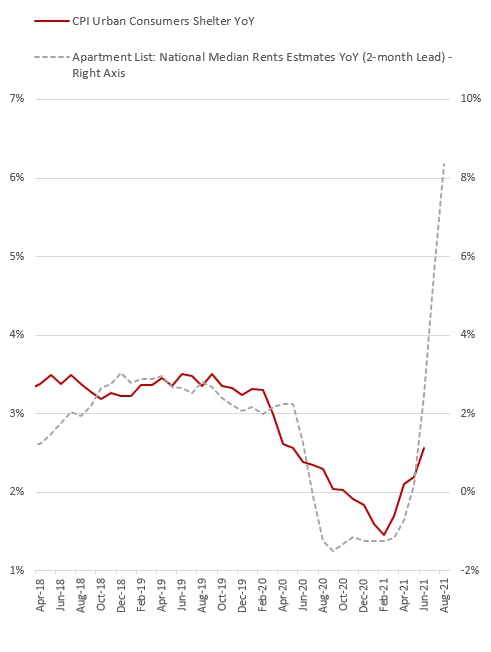
Academic research showed that Fed measures to assess the dynamic of the rental market, such as the shelter component of the Consumer Price Index (CPI), tend to lag market rents. This delay can be explained by data construction and suggests that the recent spike in market rents will impact Fed favourite measures in the coming months. Therefore, Fed policymakers could be under pressure to act by tapering MBS purchases before year-end.
Fed measures to assess the dynamic of the rental market tend to lag market rents
Economists have observed that Fed measures to assess the dynamic of the rental market tend to be “sticky” relative to market-based rental costs and also lagged them during expansionary periods. As a result, it seems that market rents reflect housing market turning points sooner and may allow the Federal Reserve to be more responsive to housing bubbles.
📊 Share your ETF outlook
From AI infrastructure to active strategies, the ETF landscape is shifting. Share your perspective in the 7th Annual Global ETF Survey and get exclusive early access to the final report.
This pattern can be explained by data construction. According to the BLS, “two CPI indexes, Owners’ equivalent rent of primary residence (OER) and Rent of primary residence (Rent), measure the change in the shelter cost consumers receive from their primary residences.” As a result, “the cost of shelter for renter-occupied housing is rent. For an owner-occupied unit, the cost of shelter is the implicit rent that owner occupants would have to pay if they were renting their homes.“
There are issues linked to OER and the implicit rent that owner occupants would have to pay if they were renting their homes. In a column for Bloomberg, Brian Chappatta noted “Americans are slower to adjust their expectations for a hypothetical rental price of their home than the housing market is to react to dynamic changes in supply and demand.” In other words, households are not perfectly aware of the potential rent prices of their homes especially when volatility is elevated (current situation). As a result, during strong expansionary periods, their estimates tend to lag market rents.
Academic research also pointed to methodological weakness of these measures. Firstly, the housing component of the CPI (and also the PCE price index) “mainly captures moderate changes in rents for existing tenants and miss larger rental updates that result upon tenant turnover.“
Secondly, “the BLS index construction method introduces additional smoothing effects by averaging the rent for each survey month and then calculating the six-month average growth rate on a rolling basis (i.e., January-July, February-August, etc.).“
Thirdly, “the BLS rent index lags contemporaneous rent measures. For example, if all leases are annual, then only 1/12th of the BLS sample will reflect market conditions with some observations reflecting economic environments that are nearly a year old. Thus, the BLS index only gradually incorporates market information, lagging the contemporaneous market rent measure by approximately one year.“
The recent spike in market rents will affect Fed favourite measures in the coming months
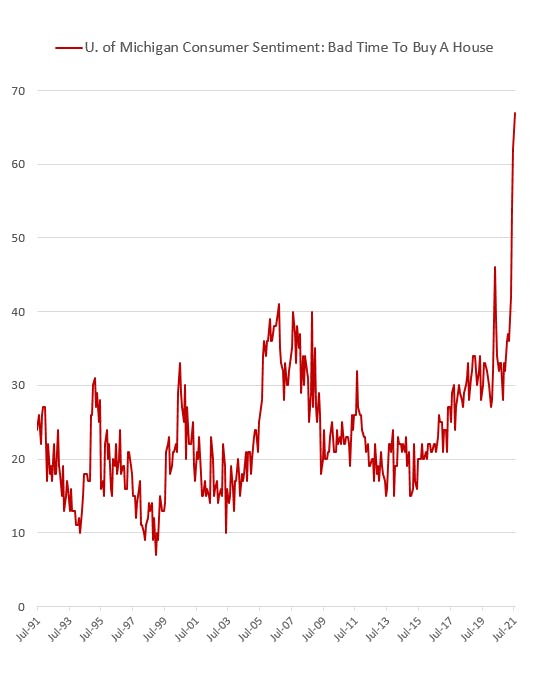
After US rent prices took a hit in 2020, the nation’s rental market has bounced back sharply supported by four main factors (the rebound of national mobility, the rent-versus-own arbitrage, increasing funds participation and the wage increases in certain lower-paid industries). At least one of them seems to be durable. The violent spike in housing prices for existing home sales (and also new home sales) has resulted in falling affordability and has squeezed a lot of first-time buyers out of the market. The latter are forced to rent rather than buy a home as suggested by the chart below.
In the meantime, the latest data confirmed that market rents rose significantly over the past few months, which is likely to impact the shelter component of the CPI in the coming months.
In a context where housing prices are rising most in decades, real estate is likely to become a real source of concerns for Fed policymakers. As an example, Federal Reserve Bank of Dallas President Robert Kaplan recently flagged that the housing market is overheating. He noted “we’re hearing more and more that the winning bidder for many of these single-family homes isn’t a family: It’s a fund of some type, not domiciled in our district, buying sight-unseen and planning to rent it. More and more families are being squeezed out of purchasing a home, particularly first-time home buyers and across at-risk communities. This is having ripple effects, in terms of higher rents and higher property taxes.”
Advertisement
Therefore, with the recent spike of market rents, housing metrics are now flashing red for Fed policymakers in terms of price dynamics. My guess is that they can’t ignore these developments and they will acknowledge that monetary support is no longer necessary in this area. As a result, a smart move would be to reduce MBS purchases substantially before year-end.
More articles


About Trackinsight
Since our founding in 2016, we have been at the forefront of the industry, delivering accessible, comprehensive, and reliable tools to support the evolving needs of investors.
Over the past decade, Trackinsight has expanded its operations across six countries, serving thousands of professional investors. We’ve consistently innovated to provide cutting-edge solutions that meet the changing demands of the ETF market.
In 2024, Kepler Cheuvreux, a leading independent European financial services firm, acquired a majority stake in Trackinsight, becoming the company's principal shareholder.
This strategic partnership solidifies Trackinsight's position as a premier provider of ETF selection and analysis tools, while strengthening Kepler Cheuvreux’s commitment to becoming a leading player in the ETF sector.
Together, we are committed to offering advanced services that empower professional investors, advisors, institutions, and issuers. This new step enables us to deliver even more comprehensive and innovative technological solutions, driving ETF investing to new heights.
More about TrackinsightETF TOOLS
PLATFORM
ETF NEWS & RESEARCH
Privacy policy | Cookie policy | | Terms of use | Imprint