Get your free ETF data sample from our comprehensive offerings. Start your free trial→
Help us improve your experience. Please confirm your investor type:
The ETF Industry Is Evolving Fast
From AI infrastructure to active strategies, the ETF landscape is shifting. Share your perspective in the 7th Annual Global ETF Survey.
Fed quantitative tightening could become a real option in 2022
Latest FOMC Minutes suggested that the Federal Reserve is not only on track to raise rates faster than expected but can also implement quantitative tightening as soon as 2022.

By Christophe Barraud
January 9, 2022
- United States
- Real Estate
Advertisement
Chief Economist and Strategist at Market Securities since 2011, Christophe Barraud has been awarded by Bloomberg the title of Top Forecaster of the U.S. Economy (2012-2020), Eurozone Economy (2015-2019), and Chinese Economy (2017-2020). He also won the Forecaster of the Year contest organized by MarketWatch in 2020.
ETF Data Built for Precision
Trackinsight delivers reliable and comprehensive coverage on 14,000+ ETFs
Latest FOMC Minutes and recent speech from both Reserve Bank of St. Louis President James Bullard suggested that the Federal Reserve is not only on track to raise rates faster than expected but can also implement quantitative tightening as soon as 2022. Such a scenario would be coherent with my view that the risk of a wage-price spiral is now real with low-income families asking for higher salaries.
The Labor market is probably tighter than indicated by the unemployment rate
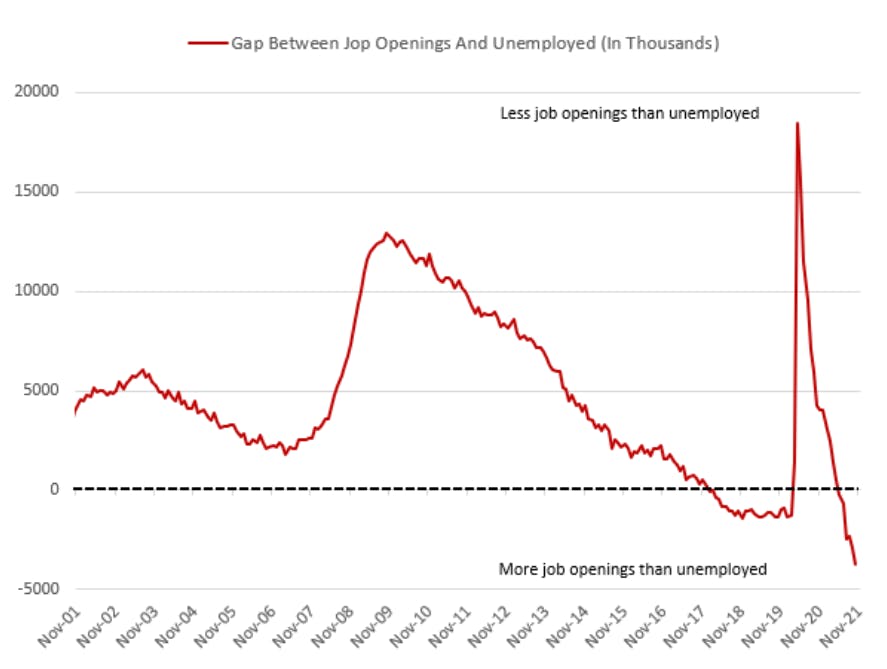
Most of the indicators suggest that, right now, the labor market is probably tighter than indicated by the unemployment rate (at 3.9% in December 2021). As a matter of fact, the excess of job offers compared to unemployed exceeded 3.7 million in November 2021.
Over the same period, the quits rate in the private sector hit another record high, which implies that wages growth will keep accelerating in the coming months. Reuters highlighted that “workers walking away from jobs in record numbers, particularly from lower-paid and often front-line service-sector positions where health risks are considered more acute and work-from-home options less available.“

Wages growth of lower-paid employees remained robust in December
The December employment report highlighted that in the private sector, wages growth of “production and non-supervisory employees” increased by 5.8% YoY (still well above the headline of 4.7% for all employees). In the meantime, the NFIB survey showed “a record 48% of U.S. small-business owners said they raised compensation in December and nearly a third said they plan to do so in the coming months“.

Transitory effects from the Omicron wave will give employees more bargaining power in the short term
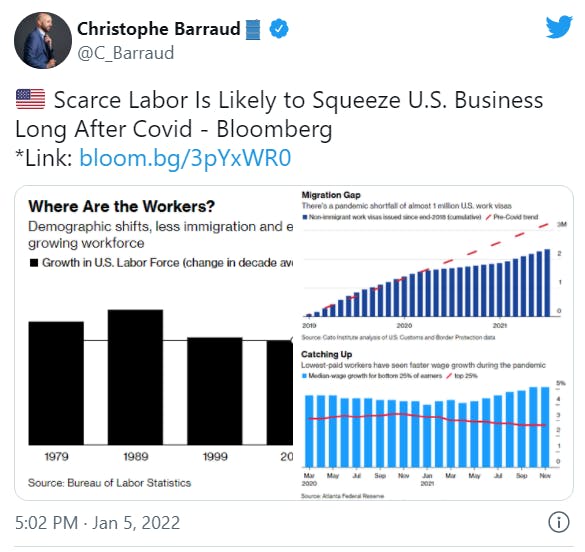
Transitory effects from the Omicron wave are also giving employees more bargaining power. On the one hand, people more exposed at their workplace want a premium (especially in the hospitality sector associated with low salaries). On the other hand, net migration flows crashed, creating a shortfall of ~1 million work visas in 2022.
Low-Income families will ask for more wage increases this winter
In the meantime, low-income families will also ask for more wage increases because they will face a huge shock of inflation this winter. The fact is that several analysis show that excess savings among many working- and middle-class households could be already exhausted.

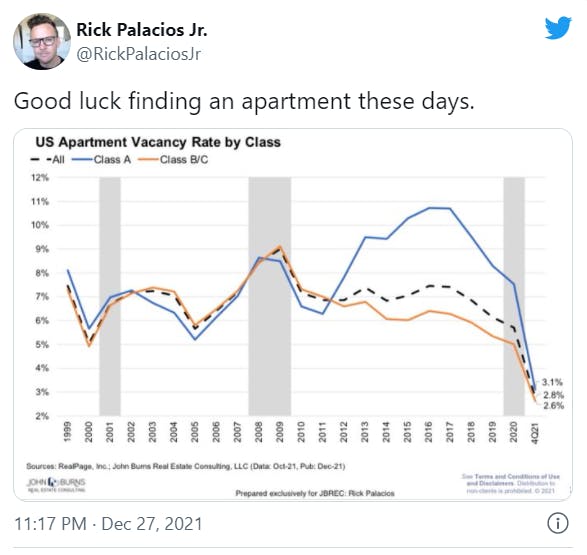
As I already noted, one of the key problems is that the spike of rents seems durable, especially in a context where vacancy rates kept dropping.
Quantitative tightening is now on the table for 2022
Most of market participants were surprised by the latest FOMC minutes which revealed that the strengthening economy and higher inflation could lead to earlier and faster interest-rate increases than previously expected, with some of them also favoring starting to shrink the balance sheet soon after. “Some participants also noted that it could be appropriate to begin to reduce the size of the Federal Reserve’s balance sheet relatively soon after beginning to raise the federal funds rate,” the minutes underlined.
Advertisement
More recently, Federal Reserve Bank of St. Louis President James Bullard said that “Fed policymakers could start to raise their target interest rate as soon as March and shrink the central bank’s balance sheet as a next step in response to surging inflation“.
It’s not really surprising that several policymakers are open to reducing the size of the Fed balance sheet because it’s a key tool to push long-term yields higher, which could be useful to cap housing prices and therefore solve a part of the rents problem.
In my opinion, even though, it seems premature to talk about quantitative tightening, it could become a real option later this year especially if the Fed starts raising rates as soon as March or May. This scenario looks credible because inflation is likely to keep rising on a YoY basis, probably breaking the 7% threshold. In addition, it will take more time to normalize downward towards the 2% target in a context where rents will support the headline until at least 1H 2022. As a reminder, Fed measures to assess the dynamics of the rental market tend to be “sticky” relative to market-based rental costs and also lagged them during expansionary periods.
Moreover, if the effects of Covid-19 waves persist, lower-paid employees, which are already facing a huge shock of inflation (without any excess savings), will be forced to ask for more wage increases, potentially creating a wage-price spiral.
More articles


About Trackinsight
Since our founding in 2016, we have been at the forefront of the industry, delivering accessible, comprehensive, and reliable tools to support the evolving needs of investors.
Over the past decade, Trackinsight has expanded its operations across six countries, serving thousands of professional investors. We’ve consistently innovated to provide cutting-edge solutions that meet the changing demands of the ETF market.
In 2024, Kepler Cheuvreux, a leading independent European financial services firm, acquired a majority stake in Trackinsight, becoming the company's principal shareholder.
This strategic partnership solidifies Trackinsight's position as a premier provider of ETF selection and analysis tools, while strengthening Kepler Cheuvreux’s commitment to becoming a leading player in the ETF sector.
Together, we are committed to offering advanced services that empower professional investors, advisors, institutions, and issuers. This new step enables us to deliver even more comprehensive and innovative technological solutions, driving ETF investing to new heights.
More about TrackinsightETF TOOLS
PLATFORM
ETF NEWS & RESEARCH
Privacy policy | Cookie policy | | Terms of use | Imprint