Global ETF Survey 2026: Answer now →
Help us improve your experience. Please confirm your investor type:
Don’t Miss a Move in the ETF Market
Sign up and keep track of everything that moved the ETF industry this week. From new launches to regulatory shifts across the Atlantic.

Investing in Covered Call ETFs - are they worth the hype?


By Daniel Chivu
February 24, 2023
- Covered Call
Advertisement
Covered call ETF strategies have existed for at least the last 10 years in North America, and have provided income-seeking investors with above-average yields over the same period of time. European investors, on the other hand, have only recently started gaining access to covered call ETFs, and although they do not yet enjoy the same variety of options, they can still gain exposure to these high-income strategies through local exchanges. But is it worth it?
What are Covered Call ETFs?
Covered call ETF strategies make use of derivative products called options, to enhance the yield provided by a given security or fund offering. The strategy consists of buying shares of the underlying holdings (which may or may not provide a dividend yield on their own), and at the same time selling call options on those holdings for a premium. The premium is received the moment that the call options are sold by the fund manager, and can then be used to enhance the existing dividend yield or to create yield where there is none.
ETF Data Built for Precision
Trackinsight delivers reliable and comprehensive coverage on 14,000+ ETFs
Confused? You wouldn't be alone.
An example may help with the explanation. Let's assume you buy Stock A for $10 and sell a call option for that same stock with a strike price of $13. You sell that call option for a premium of $2 which you pocket immediately. Where is the risk? There is no risk to you until the price of the stock reaches at least $13. You get the $2 premium and the $3 in price appreciation, for a total of $5 or 50% return. Not bad right?
The risk (which mostly comes in the form of opportunity cost), appears once the price goes beyond $13. The moment the market price goes above the $13 strike price, the buyer of the call option can now exercise the right to buy the security at the agreed-upon price regardless of what the market price is. Therefore, if the market price is $15 but the buyer "calls" the security from you for $13, they can make an instant $2 profit. That is a $2 profit that you are no longer entitled to, therefore you have capped your gain at $5 total (including the $2 premium). The price of the security continues to rise to $20, you essentially gave up an additional $5 of future profit, for $2 of yield in the present.
Therefore, the risk is that you will miss out on the potential gains above the strike price if the stock of the security increases more than you expected. Since markets tend to move up over time, holding on to a covered call ETF for a long period of time seems guaranteed to lose money.
When should you buy a Covered Call ETF?
The answer to this question depends on a few factors, some of which are personal, and some that are related to the overall markets
Personal factors that contribute to the individual decision to invest in covered call ETFs can include an investor's need for income now versus future capital gains, the individual's tax situation, and their wish to offset some of the costs of high inflation. Investors may also want to purchase a covered call ETF if they want to draw yield from sectors that traditionally do not pay high dividends, such as most technology companies.
European investors at the moment have limitations when it comes to covered call investing, but some options exist for them to invest in the technology sector or a broad European index. Two such fund options are offered by firms Global X and UBS, through the respective Global X Nasdaq 100 Covered Call UCITS ETF and the UBS- Euro Equity Defensive Covered Call SF UCITS ETF.
In terms of Market factors that affect the performance of covered call ETFs, there are three scenarios that have historically occurred, and from which we can draw conclusions.
Advertisement
Scenario 1: Bear Market
The main goal in a bear market is for investors to limit losses as best as possible. One way to achieve this result is through a covered call strategy which provides additional income from the premiums received, and has the effect of offsetting some of the losses experienced by the underlying securities while waiting for a recovery. In theory, it pays investors for their patience until the rebound occurs. But theory is often different than practice, and the track record of covered call ETFs is somewhat spotty.
Looking at the two examples below, we see that the Global X Nasdaq 100 Covered Call ETF underperformed the Nasdaq 100 index in 2022, which was undoubtedly a bad year for tech equities, while Invesco’s covered call ETF, the Invesco S&P 500 BuyWrite ETF, outperformed the S&P 500 Index.
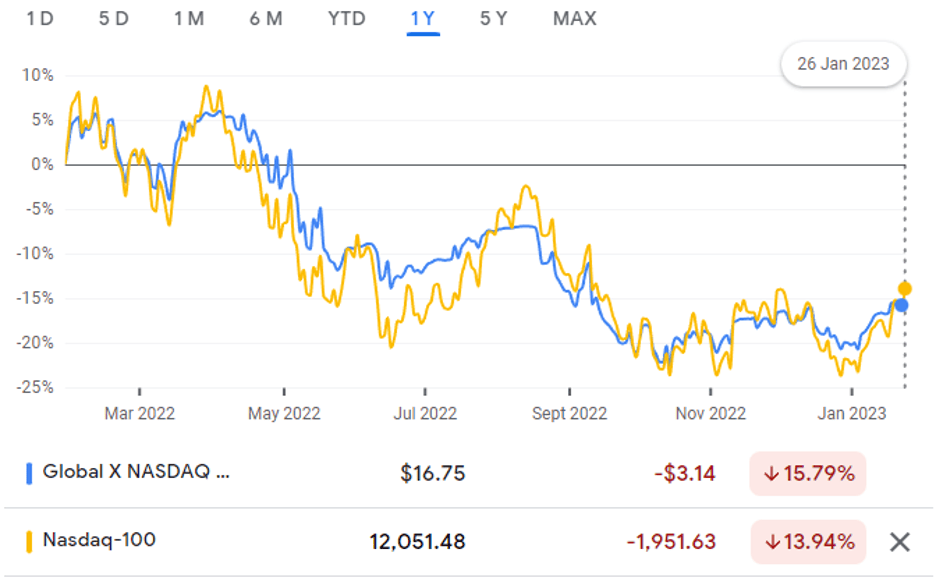
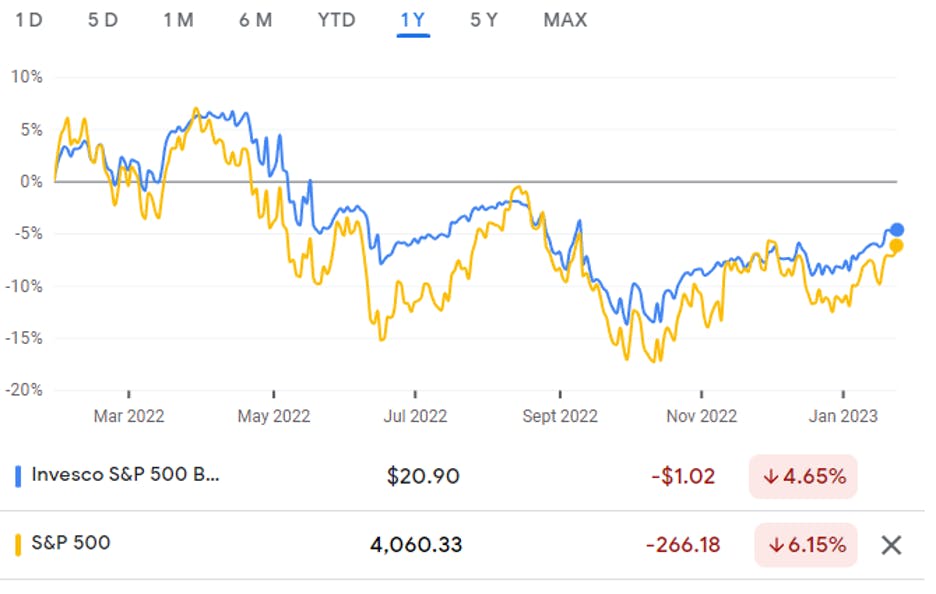
Therefore, it would appear that manager selection is a consideration when it comes to covered call strategies and, all things equal, investors should choose the ETF manager with the best historical performance.
Scenario 2: Sideways Market or Volatile Market
In a sideways market, where equity prices are not expected to move up or down significantly, adding additional yield - especially to equities that do not normally provide dividends - could be the deciding factor between a negative year and a positive year. The option premiums earned during a sideways market can be lower due to the fact that volatility adds to the price of an option. In the absence of volatility, call options sell for a lower price, resulting in a lower overall yield. This is perhaps the best scenario, because it guarantees you additional yield, with stable market prices.
In a volatile market however, covered call ETFs have the potential to earn higher premiums due to the relationship described above. High volatility has the effect of increasing option prices, which means the manager can receive a higher premium when selling options on the holdings of the ETF. Volatility can mean significant moves both up and down in price, and so it's possible for covered call ETFs to still underperform, if the price drops by more than the premium received. It all depends on what holdings have options written on them, and what holdings actually experience volatility. Usually, managers write options on only a portion of the holdings. The risk is writing options on holdings that remain relatively stable, while experiencing volatility in other parts of the portfolio.
Scenario 3: Bull Market
The bull market scenario is the easiest to explain, and pretty much the clearest cut. Covered call strategies do not perform well in bull markets due to the simple fact that capital gains are limited by the options. Although investors may still see positive performance in any given year, it is likely that the index will outperform the covered call strategy since it is not limited by any options written on the holdings.
The verdict
As a closing statement, it seems the benefit of covered call ETFs is primarily in a flat market environment, where investors can draw additional income from the premiums. The performance record during bear markets seems to be spotty at best, and heavily dependent on the ETF manager.
European investors wishing to gain exposure to covered call strategies are somewhat limited at the moment, but given the historical performance of these funds, it’s perhaps not as big of a loss as it looks.
Advertisement
*IMPORTANT: The views and opinions expressed herein are the views and opinions of the author and do not necessarily reflect those of Trackinsight. Past performance is not indicative of future results. Investors should undertake their own due diligence and carefully evaluate companies before investing. ADVICE FROM A FINANCIAL PROFESSIONAL IS STRONGLY ADVISED.
More articles


About Trackinsight
Since our founding in 2016, we have been at the forefront of the industry, delivering accessible, comprehensive, and reliable tools to support the evolving needs of investors.
Over the past decade, Trackinsight has expanded its operations across six countries, serving thousands of professional investors. We’ve consistently innovated to provide cutting-edge solutions that meet the changing demands of the ETF market.
In 2024, Kepler Cheuvreux, a leading independent European financial services firm, acquired a majority stake in Trackinsight, becoming the company's principal shareholder.
This strategic partnership solidifies Trackinsight's position as a premier provider of ETF selection and analysis tools, while strengthening Kepler Cheuvreux’s commitment to becoming a leading player in the ETF sector.
Together, we are committed to offering advanced services that empower professional investors, advisors, institutions, and issuers. This new step enables us to deliver even more comprehensive and innovative technological solutions, driving ETF investing to new heights.
More about TrackinsightETF TOOLS
PLATFORM
ETF NEWS & RESEARCH
Privacy policy | Cookie policy | | Terms of use | Imprint