Trackinsight is part of ETF One, the fully integrated ETF platform of Kepler Cheuvreux. Learn more →
Help us improve your experience. Please confirm your investor type:
The ETF Industry Is Evolving Fast
From AI infrastructure to active strategies, the ETF landscape is shifting. Share your perspective in the 7th Annual Global ETF Survey.
How Non-Financial Factors Drive ESG Outperformance


By Ben Taylor
January 19, 2023
Advertisement
Capital continues to flow to ESG funds. Consider research from PwC showing that, globally, ESG-related assets under management are expected to increase to $33.9tn by 2026, from $18.4tn in 2021.
Moreover, ESG assets are on track to represent 21.5% of total global assets under management in less than 5 years.
📊 Share your ETF outlook
From AI infrastructure to active strategies, the ETF landscape is shifting. Share your perspective in the 7th Annual Global ETF Survey and get exclusive early access to the final report.
The ability of ESG firms to draw this amount of investment is due, in part, to the fact that investors are increasingly choosing assets that reflect their preference for values-driven companies.
However, some research suggests that capital is rapidly moving to ESG businesses for an additional reason: namely that some non-financial factors, unique to ESG companies, also contribute to their success.
Here we look at the data behind this idea.
How Do Sustainable Practices Drive Positive Financial Returns?
An NYU Stern School of Business meta-study analyzing over 1,000 research papers concluded that the majority of ESG-focused funds outperform the broader market.
Within this group was one study from The Journal of Management Studies. The authors of this paper conducted a meta-analysis of 344 primary studies. They determined that there is a link between corporate social responsibility and corporate financial performance. Moreover, they concluded that four key “mechanisms” together explain 20% of this link.
Those four mechanisms are:
- Mitigating firm risk
- Strengthening innovation capacity
- Enhancing firm reputation
- Increasing stakeholder reciprocation
Let’s look at each.
Risk
The authors posit that risk management is one key factor underpinning success because ESG companies have a more diverse set of stakeholders and are therefore better able to recognize firm-specific risk. Another reason suggested is the simple fact that ESG firms, by design, are more focused on risks because they have committed to reducing them externally. These businesses aim to create pollution prevention practices, initiate employee health and safety programs, and participate in fair-trade policies.
Advertisement
Research from McKinsey expands on the connection between ESG principles and lower risk. They conclude that “better performance in ESG also corresponds with a reduction in downside risk, as evidenced, among other ways, by lower loan and credit default swap spreads and higher credit ratings.”
Innovation
The authors of The Journal of Management Studies also suggest that ESG firms are better innovators because adopting corporate social responsibilities often requires the development of new practices and capabilities.
They also theorize that a commitment to corporate social responsibility drives innovation because the leadership is focused on reducing waste which drives efficiencies and the development of new processes and products.
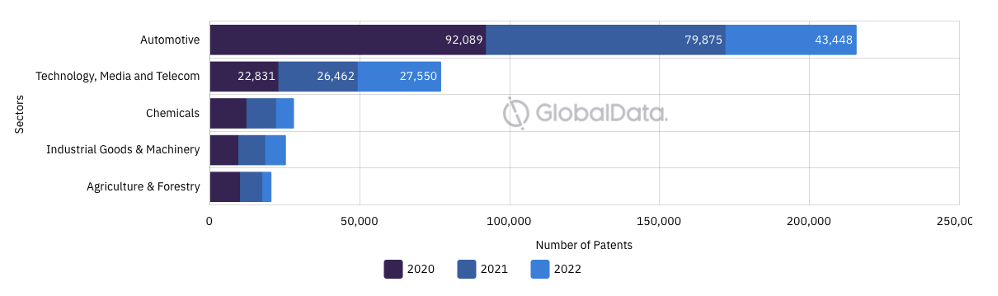
This theory rings true when combined with research from GlobalData which shows a dramatic increase in patents filed for green technologies in the last decade. Patents in the automotive category lead the group followed by media & telecom, and chemicals.
Top Five Sectors with 'Environment' Patents over the Last 3 Years
Reputation
Companies understand the reputational advantage that comes from a commitment to ESG practices. Consider that today more than 90% of S&P 500 companies publish some kind of ESG report. The same is true for 70% of Russell 1000 companies. Companies know that investors view ESG companies more favorably.
Research from PwC illustrates this point. They surveyed hundreds of investors globally and found that 75% of the respondents believe that “companies should address ESG issues, even if doing so reduces short-term profitability.” Incredibly, nearly half of the survey participants (49%) stated that they would be “willing to divest from companies that aren’t taking sufficient action on ESG issues.”
The positive reputation enjoyed by ESG firms will only become more beneficial as today’s younger, more environmentally-minded generation, ages into their prime investing years.
Advertisement
Reciprocation
ESG practices create value for stakeholders in several ways. Often, these companies deliver fair pay, a safer work environment, and professional development opportunities. Benefits like these lead to greater satisfaction among employees. This satisfaction leads to greater performance and more buy-in to corporate goals. This dynamic is called reciprocation.
Reciprocation is also important in the context of a firm’s relationship with customers and even those that surround the physical location of the business. As the research in the Journal of Management Studies explains, “firms in extraction industries often sign community benefit agreements, which are contracts between the firm and local communities stating how firms compensate communities for the social and environmental disruptions they will cause.”
Put simply, reciprocation is when the whole is greater than the sum of its parts. By focusing on the interests of others and the environment, the company benefits.
The Bottom Line
Many investors know that ESG offers real potential for outperformance relative to non-ESG firms as seen in the below chart.
What is less known is the fact that this financial outperformance is often due to a combination of non-financial characteristics that are unique to ESG companies.
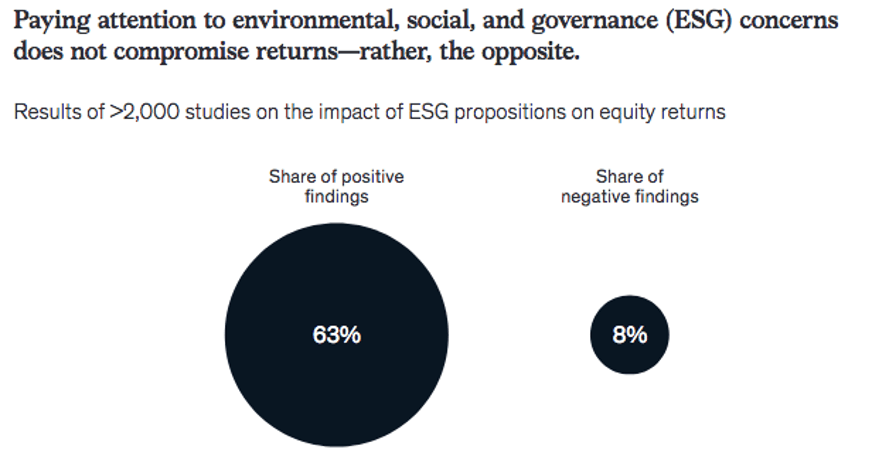
Source: McKinsey
Please note this article is for information purposes only and does not in any way constitute investment advice. It is essential that you seek advice from a registered financial professional prior to making any investment decision.
More articles


About Trackinsight
Since our founding in 2016, we have been at the forefront of the industry, delivering accessible, comprehensive, and reliable tools to support the evolving needs of investors.
Over the past decade, Trackinsight has expanded its operations across six countries, serving thousands of professional investors. We’ve consistently innovated to provide cutting-edge solutions that meet the changing demands of the ETF market.
In 2024, Kepler Cheuvreux, a leading independent European financial services firm, acquired a majority stake in Trackinsight, becoming the company's principal shareholder.
This strategic partnership solidifies Trackinsight's position as a premier provider of ETF selection and analysis tools, while strengthening Kepler Cheuvreux’s commitment to becoming a leading player in the ETF sector.
Together, we are committed to offering advanced services that empower professional investors, advisors, institutions, and issuers. This new step enables us to deliver even more comprehensive and innovative technological solutions, driving ETF investing to new heights.
More about TrackinsightETF TOOLS
PLATFORM
ETF NEWS & RESEARCH
Privacy policy | Cookie policy | | Terms of use | Imprint