Global ETF Survey 2026: Answer now →
Help us improve your experience. Please confirm your investor type:
The ETF Industry Is Evolving Fast
From AI infrastructure to active strategies, the ETF landscape is shifting. Share your perspective in the 7th Annual Global ETF Survey.

Climate Change is Driving Demand for Clean Water
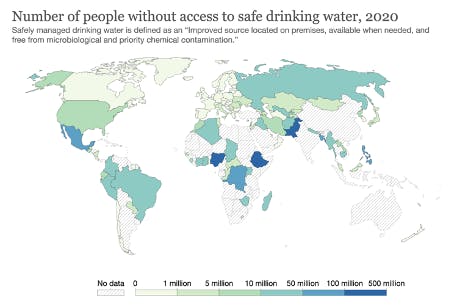
Over two billion people globally don’t have access to safe drinking water.


By Ben Taylor
June 15, 2023
- Clean Water
Advertisement
This finding from the World Health Organization underscores the breadth of a problem that is getting worse.
Consider that just 0.5% of the Earth’s water is usable and available freshwater. This already small amount is running dangerously low given that the amount of terrestrial water has been falling at a rate of about 1 cm per year for the last two decades as a result of climate change.
📊 Share your ETF outlook
From AI infrastructure to active strategies, the ETF landscape is shifting. Share your perspective in the 7th Annual Global ETF Survey and get exclusive early access to the final report.
This dwindling supply is becoming less drinkable as floods and droughts, brought on by global warming, increase pollutants in the water like sediments, pathogens and pesticides. Additionally, rising sea levels will extend areas of salinization of groundwater resulting in even less freshwater resources. These challenges are all coming at a time when developing countries are in greater need of water to drive larger crop yields. This only exacerbates the problem because an increase in agriculture means more pesticides will enter the water supply.
Even lake water will change as a result of global warming resulting in reduced oxygen concentrations and an increased release of phosphorus according to research from the Intergovernmental Panel on Climate Change.
It’s not an exaggeration to call the problem existential given that “climate-resilient water supply and sanitation could save the lives of more than 360,000 infants every year” based on additional data from the UN.
Here we look at the scope of the problem, the solution, and how investors can take a purpose-driven approach to the issue by including clean water tech in their portfolio.
Source: Our World in Data
The Scope of the Problem
Climate change has accelerated the water cycle. This means that as global temperatures rise, so does the rate of evaporation. The warmer air can also retain more water vapor leading to heavier rainfall during storms. This cycle can deplete potable water supplies because heavy rain tends to overwhelm the infrastructure needed to treat water and make it drinkable. Major storms also tend to introduce more impurities into the water because the rain picks up petrochemicals from roads and carries them into rivers and lakes.
Rising temperatures also mean warmer water which can amplify the conditions needed for bacteria and viruses to breed. This further shrinks the availability of usable freshwater. This problem will only grow in the coming years given that by 2050, a projected total of more than 5 billion people will face inadequate access to water based on research from the World Meteorological Organization.
While there have been many international efforts to combat climate change, the results have been unimpressive. Only 26 of 193 countries that made an agreement in 2021 to take meaningful climate action have followed through with their plans. This means that countries, especially developing ones, will need more resources to treat what little water they have. This is critical to protecting their children, of which 1 in 4 live in an area of high water stress which are areas that have limited water resources.
Advertisement
The Solution to the Problem
A problem of this size requires immediate solutions. While efforts to combat climate change are important, these actions do nothing to ease the problems billions of people face today. Therefore, better and more pervasive water treatment capabilities are needed.
One project in Venezuela offers a clear example of how this approach can drive meaningful change. Nearly 8 out of 10 Venezuelans do not have continuous access to clean water due to ongoing conflicts within the country. In 2020, UNICEF partnered with the Ministry of Water, the Hidrolago water authority, and private sector companies to bring clean water to more than 860,000 people in the northwest region of the country. By rehabilitating the Wüimpala water treatment plant and installing an advanced treatment and purification process, the project made drinking water available again to the population of the area.
This project illustrates the value of clean water programs focused on infrastructure. Projects like these work because they apply tested methods to regions with an existing water supply that require an updated treatment process.
Solutions for Investors to Consider
Investors have several options for investing in companies that are engaged in the international clean water industry by providing the technology, engineering, and utilities needed to deliver drinking water.
L&G Clean Water UCITS ETF (GLUG)
The L&G Clean Water UCITS ETF has 53 holdings with an expense ratio of 0.49%. The top five holdings - representing 24.1% of the fund - are Severn Trent, United Utilities, Core & Main, Badger Meter, and American Water Works. A little over half (54.5%) of the holdings are in the industrials sector followed by one-quarter (25.1%) in the utilities sector. The fund carries an Article 9 SFDR designation making it a “dark green” sustainable investment.
iShares Global Water UCITS ETF (IH20)
The iShares IH20 UCITS ETF has 43 holdings with an expense ratio of 0.65%. The top five holdings which account for 32% of the fund are, Xylem, American Water Works, and United Utilities Severn Trent. About half (51.5%) of the fund is made up of the industrial sector followed by utilities at 39%. The fund has an Article 8 SFDR designation making it a “light green” sustainable option.
Global X Clean Water UCITS ETF (AQWA)
The Global X Clean Water UCITS ETF is the smallest of this group by holdings with 39 companies. The expense ratio is 0.50%. The top five holdings include Xylem, Ecolab, Ferguson, American Water Works, and Pentair. The sector breakdown is similar to the other two funds with 51.6% in industrials and 35.3% in utilities. The fund is “light green” with an Article 8 SFDR designation.
Please note this article is for information purposes only and does not in any way constitute investment advice. It is essential that you seek advice from a registered financial professional prior to making any investment decision.
More articles


About Trackinsight
Since our founding in 2016, we have been at the forefront of the industry, delivering accessible, comprehensive, and reliable tools to support the evolving needs of investors.
Over the past decade, Trackinsight has expanded its operations across six countries, serving thousands of professional investors. We’ve consistently innovated to provide cutting-edge solutions that meet the changing demands of the ETF market.
In 2024, Kepler Cheuvreux, a leading independent European financial services firm, acquired a majority stake in Trackinsight, becoming the company's principal shareholder.
This strategic partnership solidifies Trackinsight's position as a premier provider of ETF selection and analysis tools, while strengthening Kepler Cheuvreux’s commitment to becoming a leading player in the ETF sector.
Together, we are committed to offering advanced services that empower professional investors, advisors, institutions, and issuers. This new step enables us to deliver even more comprehensive and innovative technological solutions, driving ETF investing to new heights.
More about TrackinsightETF TOOLS
PLATFORM
ETF NEWS & RESEARCH
Privacy policy | Cookie policy | | Terms of use | Imprint