Global ETF Survey 2026: Answer now →
Help us improve your experience. Please confirm your investor type:
The ETF Industry Is Evolving Fast
From AI infrastructure to active strategies, the ETF landscape is shifting. Share your perspective in the 7th Annual Global ETF Survey.

How COVID-19 Accelerated Digital Payment Trends
Almost half of the adults in low and middle-income economies who made payments did so for the first time since the start of Covid-19.


By Ben Taylor
June 9, 2023
- Digital Payment
Advertisement
Social distancing and shutdowns pushed millions of people into the 21st century. Consider that over 80 million adults in India made their first digital payment after the pandemic started according to the World Bank. This number was 100 million in China.
This trend is likely to accelerate given that digital payments necessitate more digital solutions. For example, as more employers and governments turned to digital payments during the pandemic, more employees adopted digital money management tools. The same body of research from the World Bank found that “when people receive digital payments, 83% used their accounts to also make digital payments.” This has major implications given that over one-third of adults in developing economies now collect their wages or government payments into a digital account.
📊 Share your ETF outlook
From AI infrastructure to active strategies, the ETF landscape is shifting. Share your perspective in the 7th Annual Global ETF Survey and get exclusive early access to the final report.
The rise of digital payment solutions is not limited to developing economies. Research from McKinsey shows that last year digital payment penetration increased to 89% in the US. As a result, nearly 9 out of 10 Americans use some form of digital payment. Part of this growth is being driven by peer-to-peer payment systems and digital wallet adoption.
Here we look at the regions driving digital payment growth, the digital payment capabilities that will allow that growth to continue, and how investors can access this growing industry.
What Regions Are Driving Digital Payment Growth?
While digital payments are growing globally, emerging markets are experiencing especially strong growth. Areas like Africa and Southeast Asia have benefited from payment providers who see these underbanked areas as an opportunity to access huge markets. As a result, the number of non-cash retail payments between 2018 and 2021 has increased at a compound annual growth rate of 25% in emerging markets compared to 13% globally.
This growth rate is not just a result of the pandemic. Digital payments continue to rise as e-commerce services continue to reach further into these markets giving consumers greater access to goods. Additionally, governments in these areas have been instrumental in driving the trend as they adopt digital solutions as a means to distribute aid.
These supportive factors have caught the attention of payment-focused fintechs who, in 2021, represented 40% of the $5.2 billion of tech start-up capital in Africa. Many of these ventures tend to perform well in regions in which telecom companies face less regulation and therefore can more easily provide consumers with nonbank wallets. These businesses see the growth of other industries like ride-hailing and gaming as accelerants which will only drive a greater need for digital payments. The breadth of this framework explains forecasts from market researcher Global Market Estimates showing that the global digital payments market is on track to grow from $88.1 billion in 2022 to $180.2 billion by 2027, at a CAGR of 15.4%. The region representing the highest CAGR is Asia Pacific at 16.6%. Moreover, research from Bankrate projects that the global market size for digital wallets is estimated to reach 4 billion next year.
Additional data from PwC projects that cashless transactions will more than double by 2030 with Asia Pacific cashless “transaction volume growing by 109% until 2025 and then by 76% percent from 2025 to 2030, followed by Africa (78%, 64%).”
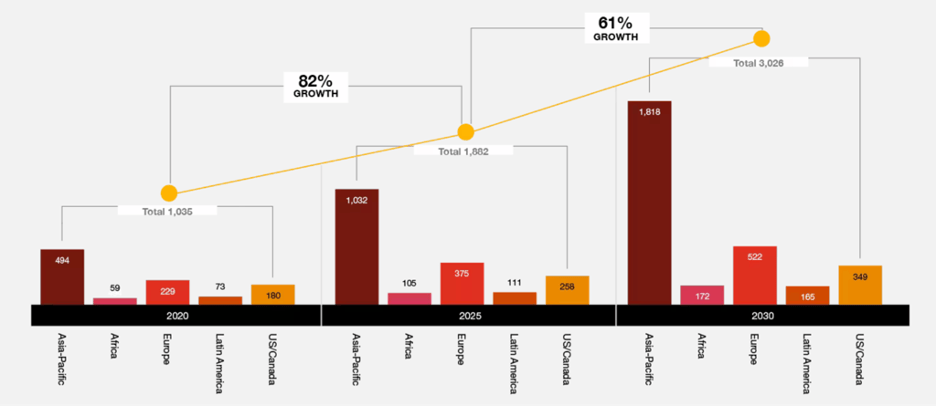
Source: PwC
Advertisement
What Capabilities Will Sustain Digital Growth?
As digital payments become more accessible across markets, providers are expanding their services. This means that users can benefit from investment and wealth management services via digital payment solutions. The technology is also supporting the growth of lending via P2P networks and insurance services.
Each of these capabilities acts as another anchor which allows the technology to become a fixture of the global economy while the ease of use and versatility makes the offering more “sticky” thereby driving and sustaining adoption.
Some providers are leveraging this characteristic of digital payments by appealing to users’ purpose-driven transactions by offering “green points” for every cashless transaction made. After the account owner earns enough points they can plant a virtual tree which means that the provider will plant a real tree. Other providers offer a way for users to track and visualize the carbon footprint of their spending. Other features like loyalty reward programs and built-in social media functionality are also keeping users engaged.
How Can Investors Benefit from the Growth of the Industry?
With a 42% increase in global cashless payment volumes, investors stand to benefit from gaining exposure to a booming market. The opportunities in this arena are not always top-of-mind for investors in developed markets because digital payments have been so ever-present for so long. However, as the numbers above show, the industry is poised for considerable growth globally in the coming years.
There are several ways for investors to participate.
L&G Digital Payments UCITS ETF (DPAY)
The L&G Digital Payments UCITS ETF gives investors exposure to a range of companies involved in the value-chain of digital payments. The holdings include businesses engaged in payment gateways, payment technology providers, card issuers, payment processors, and cardless payment service providers. The top five holdings include Remitly Global, Flywire Corporation, Nuvei, Shopify, and FICO. The fund includes 41 holdings and has a total expense ratio of 0.49%.
Rize Digital Payments Economy UCITS ETF (PMNT)
The Rize Digital Payments UCITS ETF includes companies offering services including digital wallets, digital payments and digital currencies. A little over half (58.8%) of the holdings are US-based companies followed by Japan (7.9%), Brazil (4.6%), and the UK (3.6%). The top five holdings include Remitly Global Inc, Nuvei Corp Subordinate, Shift4 Pmts, Flywire Corp, and Coinbase Global Inc. The fund includes 61 holdings and has a total expense ratio of 0.45%.
Please note this article is for information purposes only and does not in any way constitute investment advice. It is essential that you seek advice from a registered financial professional prior to making any investment decision.
More articles


About Trackinsight
Since our founding in 2016, we have been at the forefront of the industry, delivering accessible, comprehensive, and reliable tools to support the evolving needs of investors.
Over the past decade, Trackinsight has expanded its operations across six countries, serving thousands of professional investors. We’ve consistently innovated to provide cutting-edge solutions that meet the changing demands of the ETF market.
In 2024, Kepler Cheuvreux, a leading independent European financial services firm, acquired a majority stake in Trackinsight, becoming the company's principal shareholder.
This strategic partnership solidifies Trackinsight's position as a premier provider of ETF selection and analysis tools, while strengthening Kepler Cheuvreux’s commitment to becoming a leading player in the ETF sector.
Together, we are committed to offering advanced services that empower professional investors, advisors, institutions, and issuers. This new step enables us to deliver even more comprehensive and innovative technological solutions, driving ETF investing to new heights.
More about TrackinsightETF TOOLS
PLATFORM
ETF NEWS & RESEARCH
Privacy policy | Cookie policy | | Terms of use | Imprint