Trackinsight is part of ETF One, the fully integrated ETF platform of Kepler Cheuvreux. Learn more →
Help us improve your experience. Please confirm your investor type:
The ETF Industry Is Evolving Fast
From AI infrastructure to active strategies, the ETF landscape is shifting. Share your perspective in the 7th Annual Global ETF Survey.

Here’s Why Nvidia's Stock Price Dropped Despite Beating Q2 2025 Earnings Expectations
Leverage Shares' Sandeep Rao explains why Nvidia's stock dropped despite a Q2 earnings beat, citing concerns over AI demand, client dependency, and speculative tech investments.


By Leverage Shares
September 4, 2024
- Leverage Shares
- NVIDIA
Advertisement
Leading AI-relevant chipmaker Nvidia Inc's (ticker: NVDA) earnings for its second quarter (Q2) beat analysts' consensus estimates by delivering $30.04 billion versus an expectation of $28.7 billion and adjusted earnings per share (EPS) of $0.68 versus an expectation of $0.64.
Despite projecting $32.5 billion in revenue over the current quarter versus expectations of $31.7 billion and Chief Financial Officer Colette Kress expressing confidence in the company being able to several billion dollars in value of its next-generation Blackwell products (currently being tested as samples) in its fourth quarter, the company's stock dropped by 8% in extended trading. When markets opened, the stock fell another 6.38%.On the 8th of September, it dropped almost 10%.
📊 Share your ETF outlook
From AI infrastructure to active strategies, the ETF landscape is shifting. Share your perspective in the 7th Annual Global ETF Survey and get exclusive early access to the final report.
Trend Analysis
As of the first half (H1) of its ongoing fiscal year (FY) 2025, trends indicate that the company's explosive growth in FY 2024 isn't going to be repeated in the current FY:
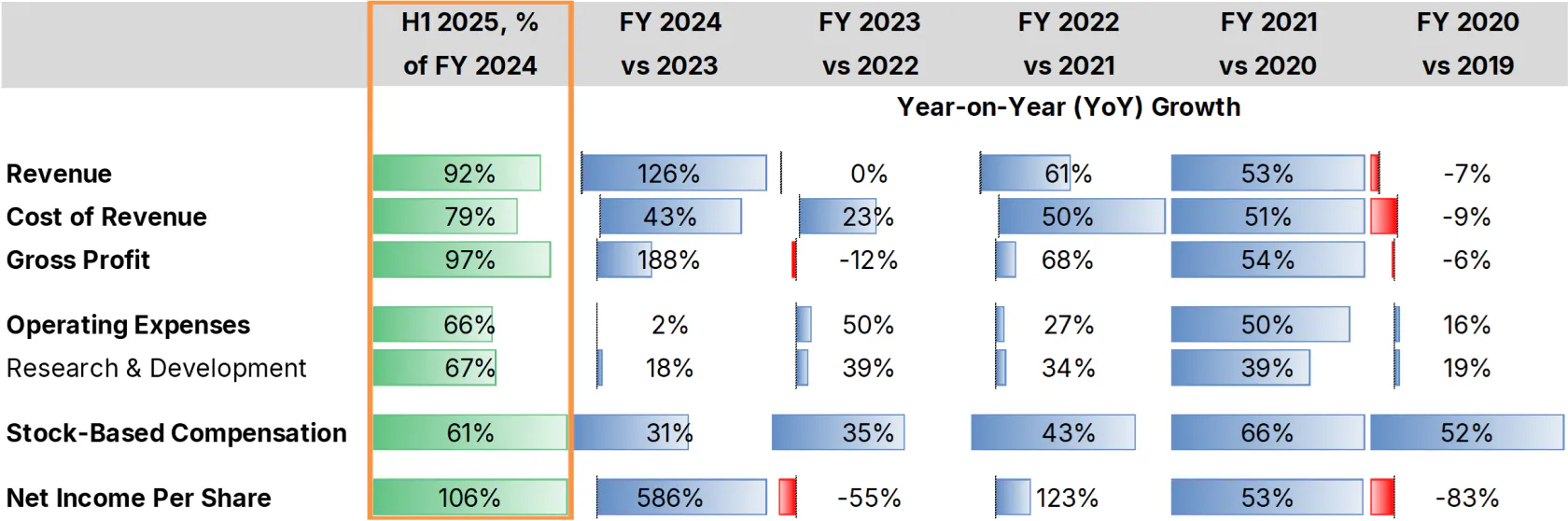
Source: Company Information; Leverage Shares analysis
Note: Net Income Per Share has been restated with the stock split factored in.
Outside of CFO Kress' projections on sales of Blackwell products, the company is looking to close overall revenues at a 16% deficit relative to the previous year albeit with net income per share effectively closing the year with a 12% over the previous FY.
The previous FY was the beginning (and possibly the end) of the "AI Stock Boom" which Nvidia led. A 126% rise in revenue was accompanied by an over fourfold boom in net income per share while operating expenses more-or-less ran flat as expenses incurred in research and sales preparation in the previous few years paid off. While the stock's high valuation does create a massive bump in stock-based compensation, it clocks in at 4% of net revenue - far lower than the levels seen over the past six FYs.
Current-generation hardware inventory is over twice that of the previous FY, which could possibly indicate that either demand is flagging or that expected order volume might have been an overshooting on actual demand.
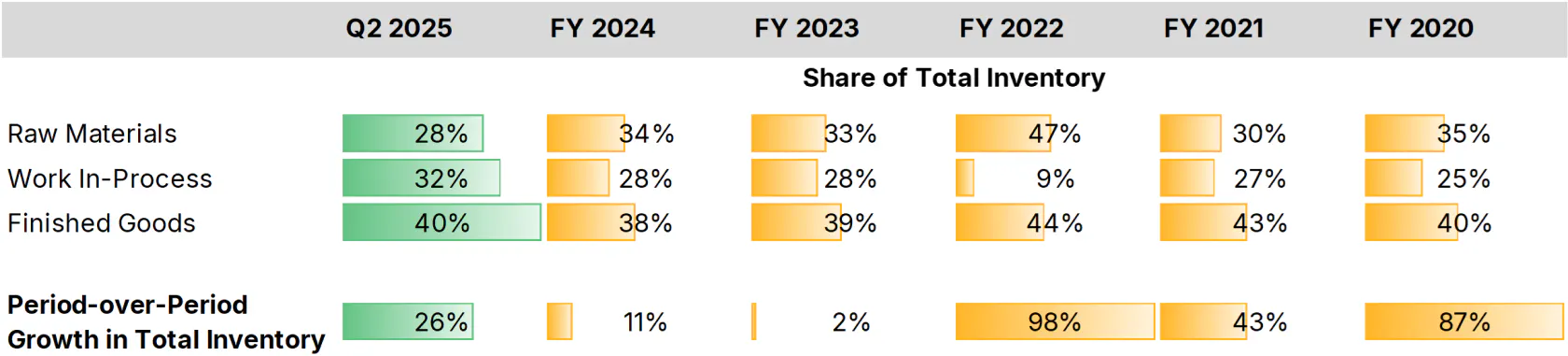
Source: Company Information; Leverage Shares analysis
As the company went "corporate", it became increasingly dependent on a small number of clients: Microsoft, Meta Platforms, Alphabet and Amazon together contribute over 40% of Nvidia's total revenue.
Advertisement
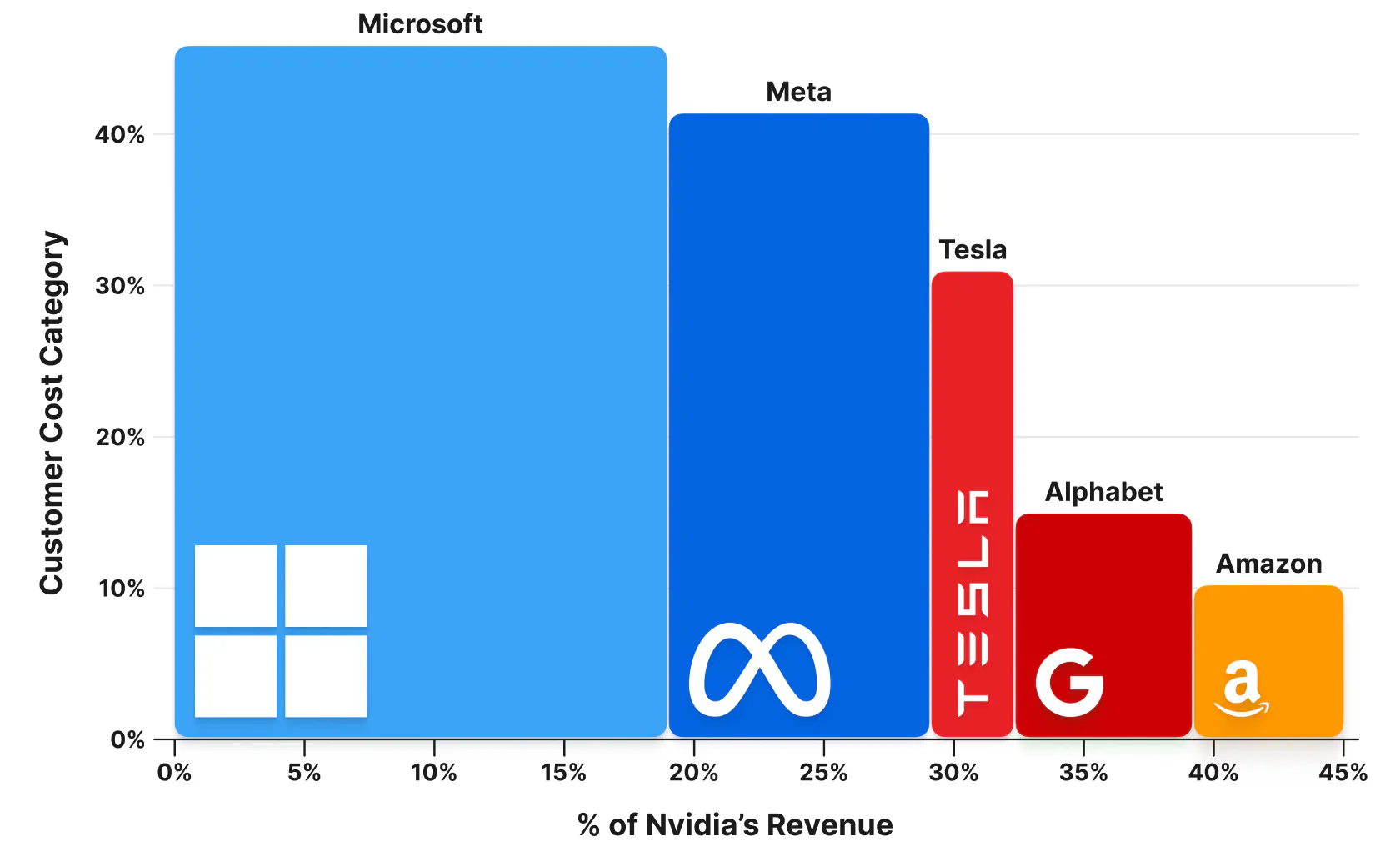
Source: Bloomberg; Yahoo! Finance
Factors for Consideration
Currently, the breadth of investing public is pondering as to whether the speculation-level high valuations imparting on certain names in the semiconductor space can be deemed sustainable. Institutional investors, in particular, have grown skeptical over whether promises of high capital expenditure by "Big Tech" are justifiable given marginal contributions by AI-driven processes in supplanting human labour. Barclays research analyst Ross Sadler stated in late June that large companies’ estimated AI investment in 2026 alone would be enough to “support the existing internet plus 12,000 new ChatGPT-scale AI products.” In other words, the data center capacities of Google, Meta, Microsoft, and Amazon at the time will exceed what people currently seem to ask of the internet. While Mr. Sadler concedes that incremental AI utilization will bring some new use cases to light, it most certainly wouldn't equal 12,000 new services.
One great promise of AI made was in the possible automation of low-wage jobs and subsequent cost savings. Jim Covello, Goldman Sachs’ head of global equity research, pointed out that, at current commitment levels, companies' investments wouldn't be recouped even if that were to hold true. He estimated that the next several years will see $1 trillion in AI investment and asks, "What $1 trillion problem will AI solve?" He goes on to state a very fundamental "human" reason for the AI investment frenzy: FOMO (i.e., "Fear of Missing Out"). Contending that "over-building" often tends to things ending badly, he stated that if AI tech doesn't have as many use cases as people expect, it will be "problematic for many companies spending on the technology today."
Meanwhile, David Cahn, head of the growth team at venture capital firm Sequoia Capital – which partly funded Elon's xAI's $6 billion capital raise – contends that AI will continue to be a part of the economic engine in the years to come and considers the current investment cycle to be part of the "speculative frenzy" that is inherent within the tech industry. However, he deemed the idea of some companies stockpiling chips in anticipation of needing them later is a "delusion that has spread from Silicon Valley to the rest of the country, and indeed the world". The moderation of demand particularly affects Nvidia, given its high exposure to a handful of clients leading the consumption of its products.
The company's centering of focus on Blackwell chips also has a significant market limitation factor: as it stands, the current-generation A100, H100, A800 and H800 chips are forbidden from being exported to China, which is a key market for the company – standing at almost 17% by the end of FY 2024. In a similar vein, the company's Blackwell chips are almost certain to be banned as well, given their enhanced AI-relevant processing capability. While China's tech giants have doubled capital spending on AI infrastructure in the year so far, the company hobbled in terms of client breadth and ever-more dependent on its existing small band of clients.
Roughly about 10% of the company's Q2 revenue ($3.7 billion) came from the sale of networking products. In this space, bête noire and (almost literal) cousin AMD is aiming to close the gap: roughly ten days before Nvidia's earnings release, AMD announced a $4.9 billion acquisition of ZT Systems, a leading AI compute infrastructure and storage solutions provider in a bid to provide enhanced services to datacenter clients. In the current FY, nearly half of its revenue is generated from its increasing footprint among corporate clients.
With a host of startups (such as Sambacore) scrambling to provide next-generation computing hardware to select set of clients outside of China and existing solutions in the market largely being deemed more than sufficient to handle current AI-relevant processing loads and a dimming outlook on a repeat of explosive capital investments, the company's ability to have sustained sales volumes over a long horizon comes into question.
In Conclusion
Advertisement
Without sustained sales volumes in the outlook, conviction stills and high valuations are likely to be tested. While "instituitionals" aren't likely to start offloading in bulk any time soon, there is very little incentive to acquire more. However, the likelihood of a paring of exposure in a "risk-off" exercise in favour of a more secular exposure to the universe of investable assets increases.
Despite splurging $15.4 billion in H1 2025, $7.5 billion of board-authorized capital for share buybacks had remained unutilized in Q2 2025. The company is topping this amount up with an additional $50 billion for share buybacks to prop up valuations. While this might indeed help ameliorate the speed with which the share value will depreciate, given the loss of sky-high conviction, this doesn't alter the forward outlook: as far as the company's products are concerned, it's a buyer's market with a small number of buyers and an almost-equal (if not greater) number of sellers.
Buyer-seller dynamics are very much a play in motion with no great incentive to either "buy the dip" or "sell the crest". At the same time, there is precious little reason to load up and hold over a long term. While the company did start offering dividends as of FY 2023, the dividend yield is currently vanishingly small and of little incentive for dividend-focused investors.
While the company remains an integral part of the hardware industry with great products and services, it is entirely divorced from the stock's valuation which remains massively distorted on account of the massive pile-on across much of FY 2023 and FY 2024.
Note: Leverage Shares offers a variety of Exchange-Traded Products (ETP) to professional investors via LSE and European exchanges. For instance, NVD3 provides a daily-rebalanced 3X leveraged exposure to the upside of the stock’s performance while NV3S provides the same exposure to the downside.
About Leverage Shares
Leverage Shares is the largest European issuer of single stock ETPs by AUM & trading volume. It is the only provider of physically-backed leveraged ETPs on single stocks, ETFs and commodities.
The opinions expressed in this publication are those of the authors and are subject to change. They do not purport to reflect the opinions or views of Trackinsight or its members. Trackinsight does not guarantee the accuracy, completeness, or reliability of the information provided.
More articles


About Trackinsight
Since our founding in 2016, we have been at the forefront of the industry, delivering accessible, comprehensive, and reliable tools to support the evolving needs of investors.
Over the past decade, Trackinsight has expanded its operations across six countries, serving thousands of professional investors. We’ve consistently innovated to provide cutting-edge solutions that meet the changing demands of the ETF market.
In 2024, Kepler Cheuvreux, a leading independent European financial services firm, acquired a majority stake in Trackinsight, becoming the company's principal shareholder.
This strategic partnership solidifies Trackinsight's position as a premier provider of ETF selection and analysis tools, while strengthening Kepler Cheuvreux’s commitment to becoming a leading player in the ETF sector.
Together, we are committed to offering advanced services that empower professional investors, advisors, institutions, and issuers. This new step enables us to deliver even more comprehensive and innovative technological solutions, driving ETF investing to new heights.
More about TrackinsightETF TOOLS
PLATFORM
ETF NEWS & RESEARCH
Privacy policy | Cookie policy | | Terms of use | Imprint