Global ETF Survey 2026: Answer now →
Help us improve your experience. Please confirm your investor type:
Don’t Miss a Move in the ETF Market
Sign up and keep track of everything that moved the ETF industry this week. From new launches to regulatory shifts across the Atlantic.

Hang Seng index hits 2008 lows: Chinese equity ETFs to watch
The recent turmoil in Chinese markets provides ample opportunities for bulls and bears alike.


By Tony Dong
October 28, 2022
- China
Advertisement
One of the main barometers of Chinese stock market performance, the Hang Seng index, recently sold off on October 23rd by over 7% intra-day, hitting levels not seen since the 2008 Great Financial Crisis.
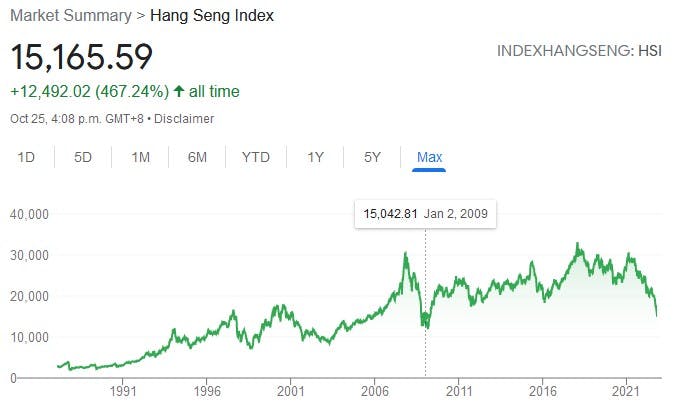
The reason? Widespread, difficult-to-price-in political risk after Chinese President Xi Jinping secured an unprecedented third term. Investors sought to risk-off, fearing more policy changes and regulations that could hamper China's battered stock market.
📊 Share your ETF outlook
From AI infrastructure to active strategies, the ETF landscape is shifting. Share your perspective in the 7th Annual Global ETF Survey and get exclusive early access to the final report.
This event comes after a tumultuous year for Chinese equities. Year-to-date, the 66 constituents of the market-capitalization weighted Hang Seng Index are down an average of -34.84% as a result of supply chain issues, contagion from the Evergrande credit crisis, and the ongoing strict "Zero-Covid" policies.
Yet, there is still a bull case for Chinese equities, namely when it comes to their low valuations relative to U.S. ones. Let's take a look at some ETFs investors could use to go long or short.
Why are people investing in China equities?
Investors looking to gain exposure to Asian equities do so for a variety of reasons. Passive investors will generally want to weigh Chinese equities according to their world market cap weights. For these investors, Chinese equities usually comprise a significant portion of their emerging market exposure.
Value investors may like Chinese equities for their low valuations relative to U.S. ones. For instance, the iShares Core S&P Total U.S. Stock Market ETF (ITOT) has a price-to-earnings (P/E) and price-to-book ratio (P/B) of 17.33 and 3.21 respectively. Comparatively, the iShares MSCI China ETF (MCHI) has a much lower P/E of 9.32 and P/B of 1.30.
There is also historical evidence to suggest that after strong U.S. outperformance, emerging markets like China usually see a resurgence. In this respect, diversifying into Chinese equities may offer investors a hedge against prolonged U.S. market stagnation.
Following the 2000 Dot-Com Bubble where the valuations of U.S. companies hit an all-time high, emerging markets in China strongly outperformed their U.S. counterparts from 2001 – 2009, posting a 15.02% return compared to the flat performance of U.S. markets at 0.95%.
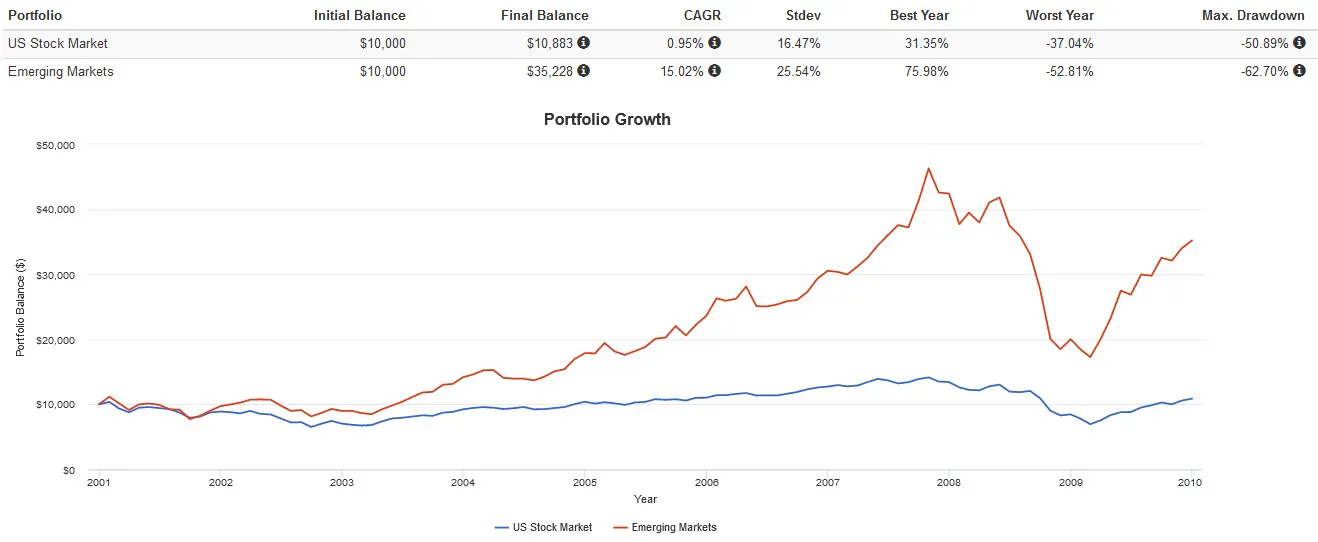
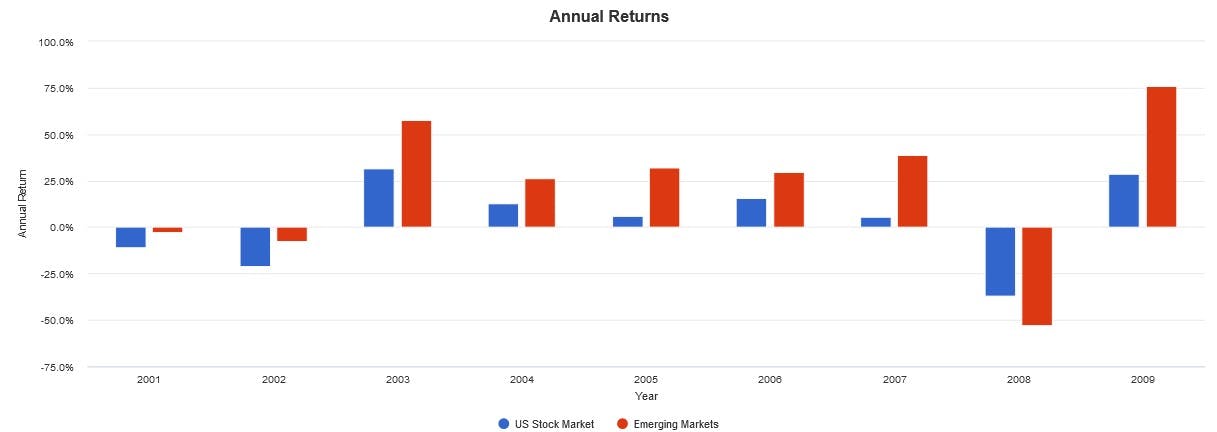
After 2009, the trend reversed, and the U.S. saw a sustained decade of outperformance led by the rise of mega-cap technology stocks. I don't have a crystal ball, but with U.S. valuations stretched and Chinese ones perennially low, one could argue for a possible reversion to the mean.
Reasons investors might avoid China equities
Still, there are apt reasons to avoid or underweight Chinese equities, chief among them being political risk. Political risk is notoriously hard to discount for investors. A great example was the overnight decimation of the third-party private tutoring industry in China following a sudden crackdown.
Advertisement
Other industries in China have suffered the same fate, most notably technology companies that were heavily impacted by the government’s strict "Zero-COVID" regulations in tech centers like Shanghai and Hong Kong in addition to lasting supply chain constraints.
These factors, coupled with lasting contagion in the real estate market from the Evergrande credit crisis and ongoing political tensions with Taiwan make Chinese stocks difficult to value for the layperson. As a result, one could argue that their low valuation reflects these inherent risks.
The best way to access Chinese equities: ETFs
ETFs are a convenient, transparent way of accessing Chinese equities without the need for currency conversions or American Depository Receipts (ADRs). Their creation/redemption structure can offer liquidity for difficult-to-access foreign securities. Using Chinese market index ETFs can also help investors diversify without the need for detailed individual securities analysis.
Some ETFs also offer exposure to "China A Shares ."These are shares of companies that are listed and traded only on mainland Chinese stock exchanges, namely the Shanghai Stock Exchange (SSE) and the Shenzhen Stock Exchange (SZSE). Indexes like the Hang Seng which are based in Hong Kong will therefore not track China A shares.
Depending on your thesis, the following ETFs might be suitable for expressing a long or short view of the Chinese market as a whole or for specific sectors. Clicking on each link will take you to a page where you can see their fee, strategy, and underlying holdings. Alternatively, you can search for Chinese equity ETFs via the Trackinsight ETF Screener by sorting for "Geographical Focus" under the "Exposure" tab.
- iShares MSCI China ETF (MCHI)
- iShares MSCI China A ETF (CNYA)
- Invesco China Technology ETF (CQQQ)
- Global X MSCI China Consumer Discretionary ETF (CHIQ)
- Direxion Daily China Bull 3x Shares ETF (YINN)
- Direxion Daily China Bear 3x Shares ETF (YANG)
Disclaimer: This article is limited to the dissemination of general information pertaining to investment strategies and financial planning and does not constitute an offer to issue or sell, or a solicitation of an offer to subscribe, buy, or acquire an interest in, any securities, financial instruments or other services, nor does it constitute a financial promotion, investment advice or an inducement or incitement to participate in any product, offering or investment.
More articles


About Trackinsight
Since our founding in 2016, we have been at the forefront of the industry, delivering accessible, comprehensive, and reliable tools to support the evolving needs of investors.
Over the past decade, Trackinsight has expanded its operations across six countries, serving thousands of professional investors. We’ve consistently innovated to provide cutting-edge solutions that meet the changing demands of the ETF market.
In 2024, Kepler Cheuvreux, a leading independent European financial services firm, acquired a majority stake in Trackinsight, becoming the company's principal shareholder.
This strategic partnership solidifies Trackinsight's position as a premier provider of ETF selection and analysis tools, while strengthening Kepler Cheuvreux’s commitment to becoming a leading player in the ETF sector.
Together, we are committed to offering advanced services that empower professional investors, advisors, institutions, and issuers. This new step enables us to deliver even more comprehensive and innovative technological solutions, driving ETF investing to new heights.
More about TrackinsightETF TOOLS
PLATFORM
ETF NEWS & RESEARCH
Privacy policy | Cookie policy | | Terms of use | Imprint