Global ETF Survey 2026: Answer now →
Help us improve your experience. Please confirm your investor type:
The ETF Industry Is Evolving Fast
From AI infrastructure to active strategies, the ETF landscape is shifting. Share your perspective in the 7th Annual Global ETF Survey.

The Global Workforce Shortage: How Robotics and Automation Can Help
The world will need a new way to meet the demands of an aging population.


By Ben Taylor
March 9, 2023
- Robotics
- AI
Advertisement
Many countries are experiencing a worker shortage. In the US, half of all Baby Boomers are now 65 or older and are moving into retirement.
This trend is not limited to the US. Between 2015 and 2030, the number of people aged 60 or more is expected to grow by 56% globally. The younger generations, in most cases, simply won’t be big enough to fill the jobs left vacant.
📊 Share your ETF outlook
From AI infrastructure to active strategies, the ETF landscape is shifting. Share your perspective in the 7th Annual Global ETF Survey and get exclusive early access to the final report.
Some call this demographic decline. It is especially pronounced in countries like China, Germany, and Japan.
Economists Charles Goodhart and Manoj Pradham describe the problem in their book The Great Demographic Reversal. They explain that “there will be an absolute decline in the labor force in several countries.” Adding to this problem is the fact that “improvements in morbidity and mortality rates, will lead to a rapid increase in the number of retirees over 65.” The large population of elderly people will still need goods or services but meeting those needs will be difficult because the working age population will be smaller.
As the trend intensifies the world will need new ways to drive more productivity out of a smaller workforce. In many industries, the answer will be automation and robotics.
Here we look at
1. Why older people will outnumber younger people globally
2. How robotics and automation can help
3. Where individuals may want to invest
Why Are Global Populations Getting Old?
People age. That’s natural. What is happening today, however, is more than just aging. Consider that the median age globally was just over 20 in 1970. Today it’s just over 30. As the older demographic continues their march into their 60s and 70s the younger demographic behind them is fewer in numbers. Why?
Advertisement
Fewer children are being born. In the past, more people lived in rural settings than they do now. Children were needed to tend to the land. As economies grew, more people moved to cities to take manufacturing jobs and they had fewer children. This trend has been continuing for 70 years. As a result, we have more old people today than young people. This global imbalance intensified due to China’s one-child policy running from 1980 to 2015.
The problem is that most economic activity comes from people aged 18 to 45. They are working and producing output while also buying homes and spending to raise their families. What lies ahead is a world where the economic power of those 18 to 45 is overshadowed by the consumption, but not contribution, coming from those 65 and older.
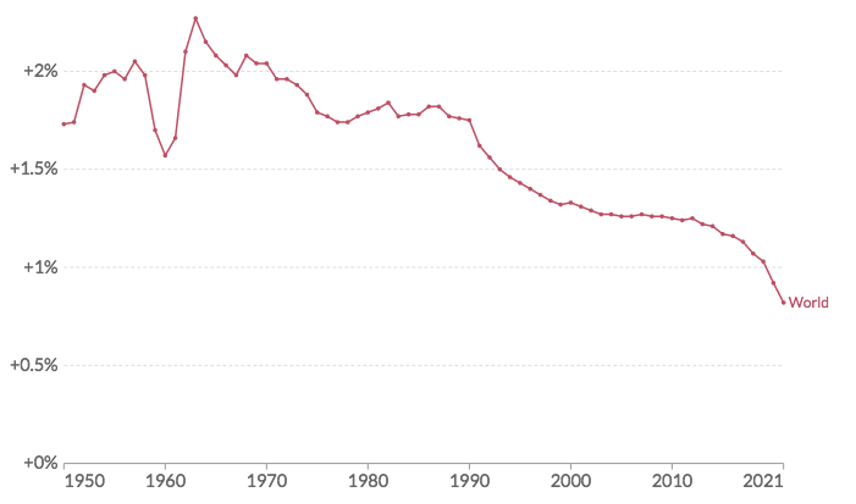
As researchers at Our World in Data explain, “We are on the way to a new balance. The big global demographic transition that the world entered more than two centuries ago is then coming to an end.”
Population growth rate, 1950 to 2021
Can Robotics and Automation Help the $10.9 Trillion Problem?
The productivity problem is already enormous. The cumulative loss in output due to falling productivity is now over $10.9 trillion based on data from the US Bureau of Labor Statistics. This is a loss of $95,000 in output per worker.
Those who are still in their working years will need to be more productive in order to support the much larger older generations that are not in the workforce. Workers will also need to be more productive for longer because people are living longer. The average global life expectancy since 1900 has more than doubled and is now over 70 years.
Some are beginning to turn to robotics and automation to help augment the output of the working population. Estimates from McKinsey suggest that “automation could raise productivity growth on a global basis by as much as 0.8 to 1.4 percent annually.” Over just a few years this could add up to considerable gains.
One specific example of this phenomenon can be seen in BMW’s Spartanburg factory. Originally, workers were responsible for fitting doors with sound and moisture insulation. This part of the production was particularly strenuous and difficult. When the plant turned to robotics to assist they saw a 50% increase in productivity without job losses.
Robotic and automation technology adoption rates will vary across industries. Some, like auto manufacturers, are suited to immediately take advantage of advancements in robotics and automation. Other industries will need to be more creative to fold these solutions into their business model.
Advertisement
The bottom line is that eventually all industries will need these technologies because without them they will not be able to reach the productivity needed to survive.
How Can Investors Position Themselves for This Change
Investors have several ways to invest in technologies that will power the global economies of the next several decades.
L&G Global Robotics and Automation UCITS ETF (ROBO)
The L&G Global Robotics and Automation ETF spans sectors including information technology, industrials, and health care. Some of the top holdings offer exposure to companies that make machines and semiconductors that increase the productivity and efficiency of manufacturing operations. Some of the companies relying on these solutions include IBM, Samsung, and Texas Instruments.
Global X Robotics & Artificial Intelligence ETF (BOTZ)
The Global X Robotics & Artificial Intelligence ETF is most heavily weighted to the information technology sector (45.4%) followed by industrials (39.5%). The majority of companies in the ETF are located in the US, Japan, and Switzerland.
iShares Robotics and Artificial Intelligence Multisector ETF (IRBO)
The iShares Robotics and Artificial Intelligence ETF offers exposure to a global equal-weighted index composed of companies in sectors like information technology, communication, and industrials.
*IMPORTANT: The views and opinions expressed herein are the views and opinions of the author and do not necessarily reflect those of Trackinsight. Past performance is not indicative of future results. Investors should undertake their own due diligence and carefully evaluate companies before investing. ADVICE FROM A FINANCIAL PROFESSIONAL IS STRONGLY ADVISED.
More articles


About Trackinsight
Since our founding in 2016, we have been at the forefront of the industry, delivering accessible, comprehensive, and reliable tools to support the evolving needs of investors.
Over the past decade, Trackinsight has expanded its operations across six countries, serving thousands of professional investors. We’ve consistently innovated to provide cutting-edge solutions that meet the changing demands of the ETF market.
In 2024, Kepler Cheuvreux, a leading independent European financial services firm, acquired a majority stake in Trackinsight, becoming the company's principal shareholder.
This strategic partnership solidifies Trackinsight's position as a premier provider of ETF selection and analysis tools, while strengthening Kepler Cheuvreux’s commitment to becoming a leading player in the ETF sector.
Together, we are committed to offering advanced services that empower professional investors, advisors, institutions, and issuers. This new step enables us to deliver even more comprehensive and innovative technological solutions, driving ETF investing to new heights.
More about TrackinsightETF TOOLS
PLATFORM
ETF NEWS & RESEARCH
Privacy policy | Cookie policy | | Terms of use | Imprint