Global ETF Survey 2026: Answer now →
Help us improve your experience. Please confirm your investor type:
The Ultimate ETF Comparison Tool - Try Now!
Analyze up to 5 ETFs side-by-side and gain instant insights on performance, fees, holdings, and more to make data-driven investment decisions.
ESG ETF investing outlook for 2022
Get an overview of ESG investing activity in 2021 and future expectations.


By Rony Abboud
February 1, 2022
Advertisement
Environmental, Social, and Governance (ESG) assets are on track to exceed $50 trillion by 2025, representing more than a third of the projected $140.5 trillion in total global assets under management. As an increasingly popular investment vehicle, Exchange-Traded-Funds (ETFs) are an important source of growth for sustainable strategies. In this article, we look at the latest ESG ETFs landscape and what will shape it in the near future.
2021 ESG investing overview
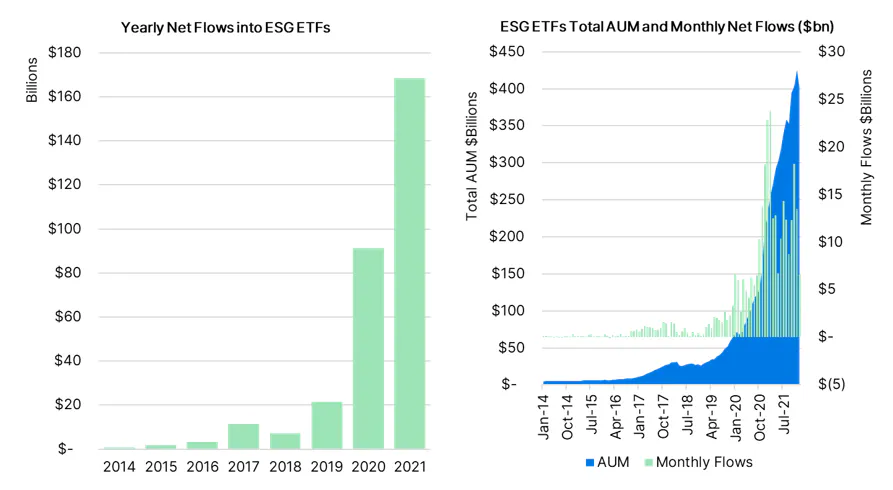
Once an afterthought, ESG ETFs have become a force to be reckoned with. Over the past 8 years, green investment vehicles have racked up over $300 billion in net flows and grown at a CAGR of 75% from $4.7 billion in assets under management (AuM) on January 1st, 2014, to $425 billion AuM by 2021 year-end. ESG ETFs reached a tipping point in 2020 — witnessing an incredible 223% growth over the year and achieving a new record of $189 Billion in AuM. The spurt in inflows rippled through 2021, to shatter the previous record. That year, 14% of the total ETF flows went to ESG.
ETF Data Built for Precision
Trackinsight delivers reliable and comprehensive coverage on 14,000+ ETFs
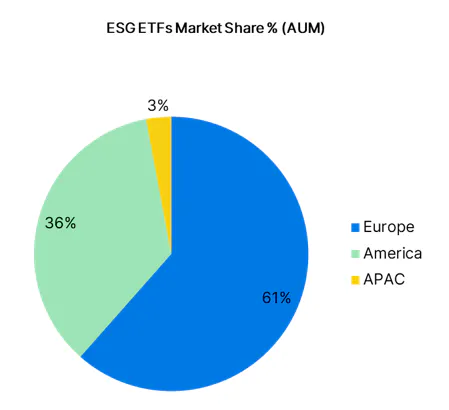
Europe remains the primary ESG ETF hub with $263 billion in AuM. America lags with $152 billion, while APAC has a meager $12 billion worth of exposure. Last year, Europe accounted for 63% of net inflows into ESG-focused investment products. America took in 33% and APAC the rest. 55% of all net inflows into Europe went into ESG ETFs, compared to just 11% of APACs' and 6% of Americas'.
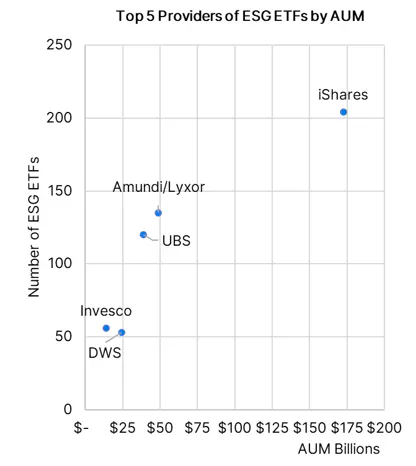
Globally, iShares remains at the helm of ESG investing with over 200 ESG ETFs and a total of more than $170 billion in ESG assets. Amundi, Europe's largest asset manager by AuM added to its ESG arsenal with the acquisition of Lyxor and now has over 135 ESG ETFs and a combined AuM of $50 billion. Next on the list are UBS (120 ESG ETFs, $39 billion AuM), DWS (53 ESG ETFs, $24 billion AuM), and Invesco (56 ESG ETFs, $14 billion AuM). The top 5 ESG ETFs issuers attracted over 65% of the total ESG ETFs net flows in 2021 ($169 billion).
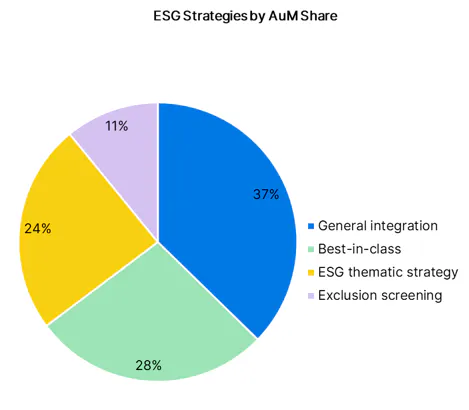
General Integration is still the most common adopted ESG strategy (430 ETFs, 37% of all ESG AuM), followed by Best-in-Class (235 ETFs, 28% of all ESG AuM), ESG Thematic Strategy (312 ETFs, 24% of all ESG AuM), and Exclusion screening (154 ETFs, 11% of all ESG AuM). In 2021, 40% of the total ESG net flows went into General Integration while Thematic garnered 26%. Best-in-Class came in third with 24% while exclusion screening took in the rest (10%).
Catalysts for the ESG Landscape in 2022 & Beyond
As the dust settled for 2021, asset managers are optimistic about the future of ESG Investing. Matthieu Guignard, Global Head of Product Development and Capital Markets at Amundi said: "ESG adoption is now advanced in the institutional market, especially Europe. However, we believe that we are far from reaching a tipping point on ESG adoption, with growing interest from institutional investors in the US and Asia". He added that retail investors have only recently begun to incorporate ESG strategies in their portfolios, leaving plenty of room for further penetration.
Asset managers and investors are preparing for the batch of regulatory catalysts coming their way. “We anticipate an ESG regulatory “revolution” for 2022 and early 2023 with the implementation of Taxonomy and SFDR coupled with the introduction of ESG preference for investors with MiFID2… not forgetting the revision of BMR", Guignard added.
Catalyst # 1: Increased global sustainable regulations
According to the Principles for Responsible Investment (PRI), government and policymaker interest in sustainable finance and investment has grown dramatically since the start of the century. Of the policies identified by PRI, 96% have been developed since the year 2000. The pace continues to increase – the PRI has identified 159 new or revised policy instruments so far in 2021, more than the whole of 2020. This continues the trend identified when the PRI first published its database of global sustainable finance policy in 2016.
Catalyst #2: Inclusion of Nuclear, Gas as Green Investments Under EU Taxonomy
The EU taxonomy is a critical pillar of the EU's strategy to achieve climate and energy targets for 2030 under the European Green Deal. This aims to establish a classification system for environmentally sustainable economic activities and scale up ‘green’ investment. On December 31st, 2021, the EU Commission proposed expanding the criteria to include nuclear energy and gas.
In a statement announcing the consultations, the Commission said that it “considers there is a role for natural gas and nuclear as a means to facilitate the transition towards a predominantly renewable-based future”, and that these energy sources would be classified under tight and clear conditions, such as requiring gas to come from renewable sources or have low emissions by 2035. While the proposal is meeting resistance from some member states, an eventual inclusion could impact the ESG investing landscape, including ESG ETFs.
Advertisement
Catalyst #3: Implementation of SFDR Sustainable Investment Product Disclosures to 2023
The European Commission announced last December, in a letter to the European Parliament and the Council of the EU, the deferment of the implementation of the second stage of the Sustainable Finance Disclosure Regulation (SFDR) to January 1st, 2023.
SFDR Level 1 was adopted in March, requiring disclosures from investment firms, on their sustainable investment strategy, risk management, and categorization of products in terms of sustainability. Level 2 will introduce regulatory technical standards (RTSs), through which asset managers must justify their fund categorizations via a series of both environmental and social principal adverse impact (PAI) disclosures. Level 2 was originally delayed by six months until July 2022 due to difficulties finalizing the RTSs. The further delay — according to the letter "…would facilitate the smooth implementation of the delegated act by product manufacturers, financial advisers, and supervisors.” It would give asset managers more time to prepare for the more complex disclosure requirements.
Catalyst #4: Introduction of ESG preference for investors with MiFID2
Starting August 2022, European advisers will be required to introduce sustainability factors into suitability assessments under Markets in Financial Instruments (MiFID II). They will have to integrate ESG factors and preferences such as good governance or environment to support a client suitability assessment and not only investor preferences like risk tolerance, risk capacity, and financial expertise. This new requirement will have a major impact on the operations and processes of most financial institutions and fund managers, including how their approach and educate their clients when it comes to product recommendations.
Catalyst #5: Asia-Pacific: The rise of the Dragon
While dubbed as an ESG laggard, the Asia-Pacific (APAC) region can catch up to Europe and America given the size of its markets and the concentration of Western production and manufacturing in the region. Governments in a handful of APAC markets, including Hong Kong, India, Japan, Malaysia, Singapore, South Korea, and Thailand, have made recent strides in improving companies’ management and disclosure of climate-related ESG issues, but China is poised to lead the breakthrough.
According to PRI, APAC's cumulative numbers of responsible investment policy interventions have been rising since 2010 and have continued to climb steadily in 2021. China has led the rally with over 35 interventions since 1995 — more than the U.S., U.K., and Japan. In 2021, the Chinese government released multiple notices and interim measures to create and support the implementation of the national carbon ETS, promote investment in renewables, assess insurance companies on their ESG investment. The PRI expects such measures will continue to grow as China aims to meet peak carbon emissions by 2030, as set out in its 14th Five-Year Plan. China's leadership will eventually ripple throughout the region and restore the balance in ESG prowess.
Looking into ESG Investing in 2022
As these catalysts mesh, 2022 is bound is to be another exciting year for ESG investing. It will be interesting to see how these "green" assets will perform in a higher interest rates environment, and whether they would have the same appeal of the past couple of years among investors. On the flip side, the "Greenwashing" phenomena will likely persist as a major crack in the industry and will be among the most pressing conundrums for regulators to eradicate. But for sure, the coming regulatory changes will be an important stepping stone towards making "investing with a purpose" a true reality.
Keep reading:
- Water security: protecting life’s essential essence
- Invest in UN SDG 14: Life Below Water with ESG ETFs
- Top 5 Green Bond ETFs in 2021
FIND AND COMPARE OVER 10,000 ETFS WITH OUR FREE TOOLS:
INTERESTED IN TOP ETF LISTS? CHECK OUT OUR INVESTING GUIDES:
- Investing in Gold ETFs
- Investing in Silver ETFs
- Investing in Commodity ETFs
- Investing in Oil ETFs
- Investing in ESG ETFs
More articles


About Trackinsight
Since our founding in 2016, we have been at the forefront of the industry, delivering accessible, comprehensive, and reliable tools to support the evolving needs of investors.
Over the past decade, Trackinsight has expanded its operations across six countries, serving thousands of professional investors. We’ve consistently innovated to provide cutting-edge solutions that meet the changing demands of the ETF market.
In 2024, Kepler Cheuvreux, a leading independent European financial services firm, acquired a majority stake in Trackinsight, becoming the company's principal shareholder.
This strategic partnership solidifies Trackinsight's position as a premier provider of ETF selection and analysis tools, while strengthening Kepler Cheuvreux’s commitment to becoming a leading player in the ETF sector.
Together, we are committed to offering advanced services that empower professional investors, advisors, institutions, and issuers. This new step enables us to deliver even more comprehensive and innovative technological solutions, driving ETF investing to new heights.
More about TrackinsightETF TOOLS
PLATFORM
ETF NEWS & RESEARCH
Privacy policy | Cookie policy | | Terms of use | Imprint