Global ETF Survey 2026: Answer now →
Help us improve your experience. Please confirm your investor type:
The Ultimate ETF Comparison Tool - Try Now!
Analyze up to 5 ETFs side-by-side and gain instant insights on performance, fees, holdings, and more to make data-driven investment decisions.
Water security: protecting life’s essential essence
A conversation with Thomas Schumann, Founder & CEO, Thomas Schumann Capital and Markus Barth, Founder & CEO, Anatase Ltd. who have created a series of innovative indexes that measure the impact of water risk on companies across the world.


By Simon Mott
January 31, 2022
Advertisement
Water is one of life’s essentials and is not normally a commodity that you consider as part of an investment strategy. However, millions of gallons of water are used by businesses, manufacturers, and industry as part of their day-to-day operations and without it, they would simply be unable to run their companies – for example, imagine what would happen to Coca-Cola’s share price if they ran out of water and had to stop producing soft drinks!
Just last year, Taiwanese semi-conductor manufacturer, TSMC, which used over 150,000 tons of water a day, had to import water via trucks at a high cost to shore up its operations when a drought-impacted Taiwanese supplies. The risk to businesses across the world is increasing as competition for water from both industrial and retail users grows.
ETF Data Built for Precision
Trackinsight delivers reliable and comprehensive coverage on 14,000+ ETFs
Access to water is therefore not just a concern for humanity that needs clean, potable water to sustain life, but also to businesses for whom it is a lifeblood of their operations. Managing water in a sustainable manner is good for the environment, but also good for investors too as water risk is poised to impact the performance and ratings of companies that rely on H2O to produce goods and run their operations.
In this interview, Simon Mott, CMO at Trackinsight, caught up with Thomas Schumann, Founder & CEO, Thomas Schumann Capital, and Markus Barth, Founder & CEO, Anatase Ltd. who have created a series of innovative indexes that measure the impact of water risk on companies across the world.
Simon Mott (SM): Gentlemen, thanks so much for taking the time to speak with us today. Let’s kick off with some background - Can you tell us a little about your companies and how you got involved in indexing water security?
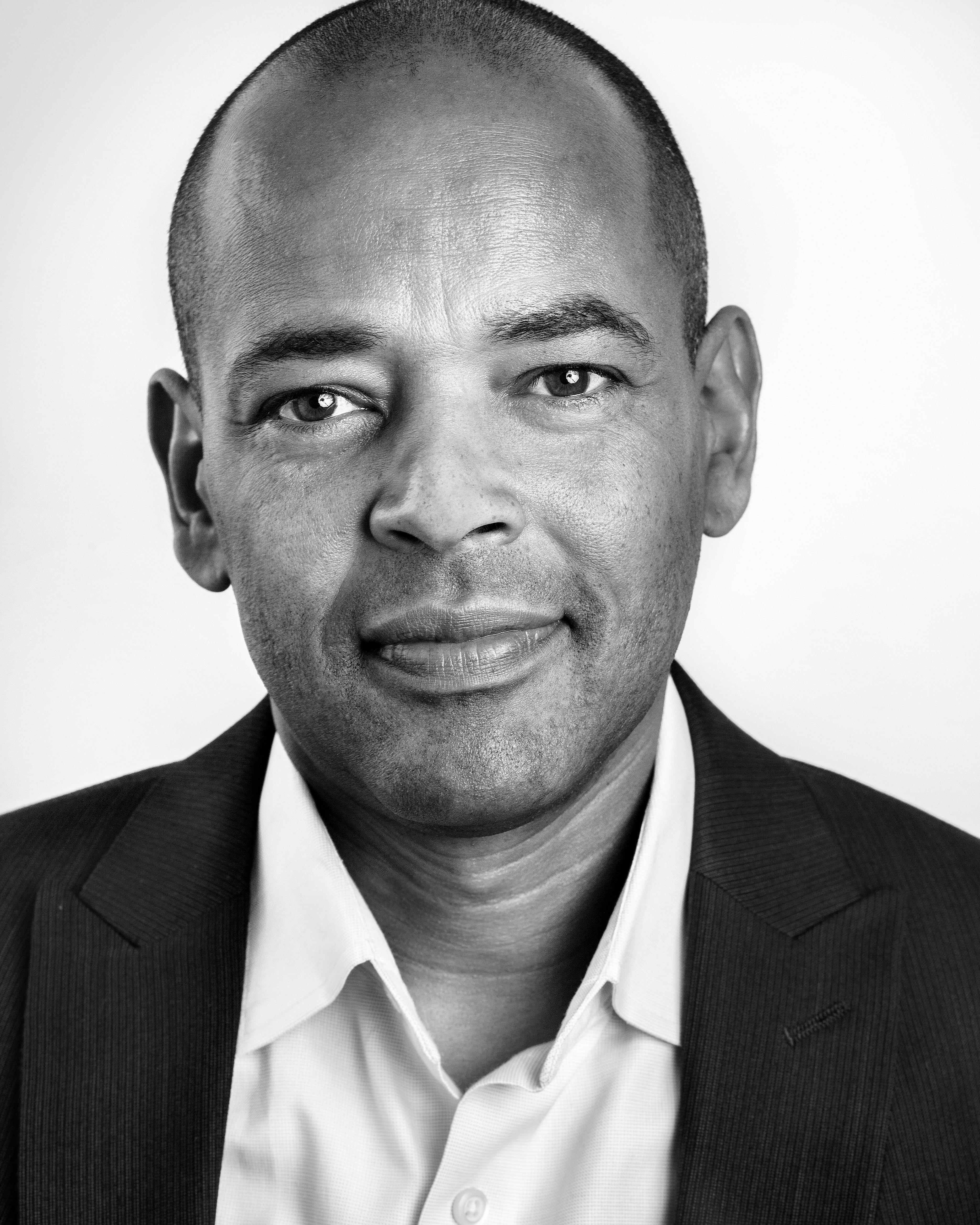
Thomas Schumann (TS): I formed Thomas Schumann Capital in November 2011 with the intention and purpose to make a positive difference and impact in the world. Water became my calling, passion, medium, purpose. In the following years the “Flow” took Thomas Schumann Capital from trying to resurrect “Trinity Water” a defunct super-premium alkaline spring water source in Paradise, Idaho to helping California water technology start-ups with their financing needs, to creating the world’s first online platform watercluster.com for water techs, investors, NGOs, academia, corporates, utilities to “Connect, Communicate, Collaborate” for a “Better Future for Water”, to helping large-scale California desalination projects with their financing needs, to realizing that helping and serving global capital markets to understand, assess, track water risk in equities and portfolios is the most impactful path to advance “Water Security”, UN Sustainable Development Goal 6, to creating, sponsoring, and developing with Markus, LSEG/Refinitiv and Moorgate Benchmarks a new, institutional-grade global index family that is the first one to track water risk in equities, while outperforming all existing benchmark indices on a financial, water footprint and carbon footprint basis.
Markus Barth (MB): Anatase Ltd is a consulting company which I founded in June 2019 after 35 years in Financial Services designing Indices and Investment Strategies, Portfolio Management, ESG Research, and Investment Applications, ETF Platform Design, and Quantitative Research. I provide consultation, development, intellectual property, and a unique approach to index design based on my successful track record.
SM: What inspired you to create water indexes and what do they track?
MB: The TSC Water Security Indices don't really "track" anything. Constituents are weighted by our proprietary measure of Water Risk such that companies with High Water Risk are underweighted while those with Low Water Risk are overweighted. You might say that the index is "tilted" towards better water stewardship and lower water risk.
TS: After meeting and collaborating with Dr. Peter Adriens of Equarius Risk Analytics, researching and engaging with all major index providers, reading Dr. Upmanu Lall’s, Columbia Water Center “A water risk for portfolio exposure to climatic extremes”, and countless hours of research and analysis I realized that the index is the most favorable wrapper to influence $360 Trillion AUM to embrace “Water Security” for the benefit of 7.8 billion stakeholders. The US, Euro, and Global Water Security Indices can be quantified by measuring water use, water stewardship, and environmental controversies of the largest, most liquid equities (who disclose, report, provide data).
SM: What sources do you use for research and what complexities did you discover as you went about creating the indexes?
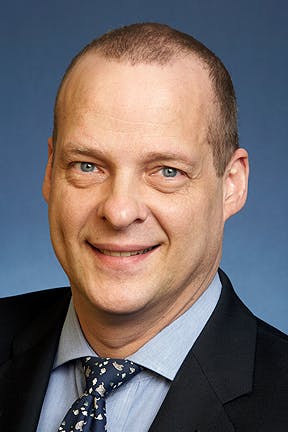
MB: We source all raw water data from Refinitiv after an extensive analysis of all of the available data from various providers. Refinitiv was by far the most robust source of our required water metrics, and they had a comprehensive history going back 7 years which helped validate our backtesting.
There are many complexities with available water data. Primarily, there are no standards for the reporting of water data and Refinitiv applies consistent methods to ensure comparability across companies. The biggest problem in sourcing raw water data is the massive difference in the reported levels of water usage / disposal / recycling / polluting. Some companies report 100's of billions of cubic liters while others only thousands. Anatase developed the first and only existing model that adjusts raw water data into a comparable water risk measure. This is the true IP of our Indices.
Advertisement
TS: I researched/research anything and everything that has been published on water risk, collaborate with the world’s leading authorities and NGOs on water, and together with Markus Barth and Moorgate Benchmarks developed a proprietary methodology which is an evolution of all benchmark indices which to date do not price in water, climate and environmental risks in their offerings.
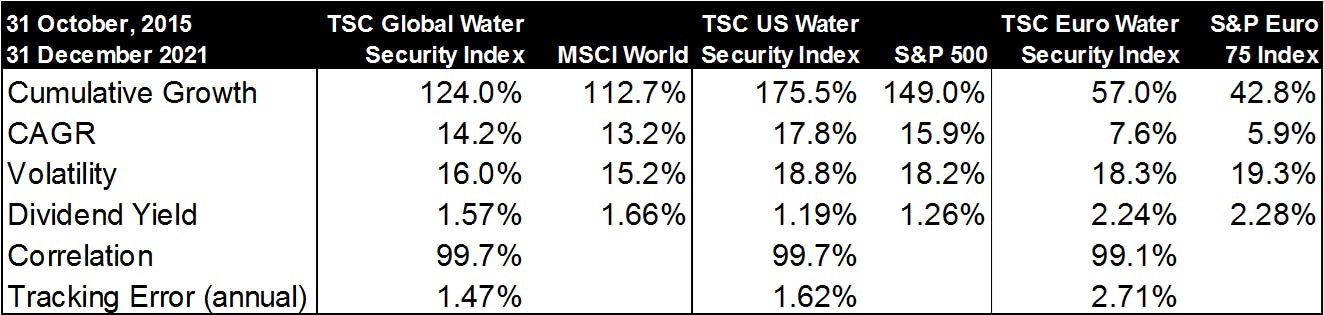
TSC Water Security Index Financial Characteristics vs Market Benchmarks
SM: So. you say that Wall St. hasn’t yet priced in water risk. Why do you think this is the case?
MB: It’s not affecting the right people – or the people who can make a change. The issue just isn’t visible to them yet. When we think about climate and sustainability, the focus has been almost entirely on Carbon emissions, but when it comes to water risk, there’s almost no research from analysts or brokerages available.
SM: In Europe, we have the new SFDR regulation, and globally, more investors are looking at things like the UN SDGs when they select ESG funds. How does water fit into this framework?
MB: Water informs Climate. While companies who spew CO2 into the atmosphere can continue to operate, generate revenues, and grow earnings - if Coca-Cola can't get enough water, they have to shut the plant. Water has a much more direct impact on the earnings of companies than CO2 emissions, and yet as I said earlier, the market is 100% focused on the CO2 aspect of Climate and ESG. The TSC Indices have a significantly lower Water Footprint (another proprietary measure designed by Anatase) and a lower Carbon Footprint than the market. Therefore, our indices are environmentally friendly while still generating equity market performance without taking additional risk.
MB: Acting on Water Risks makes business sense. The CDP Global Water Forum estimates that the potential financial impact from water risks exceeds $300 billion while the cost of mitigating these risks is only $55 billion. The financial penalty for failing to mitigate water risk is over five times larger than the mitigation costs! Investors who fail to consider water risk in their portfolios face potentially significant future market underperformance.
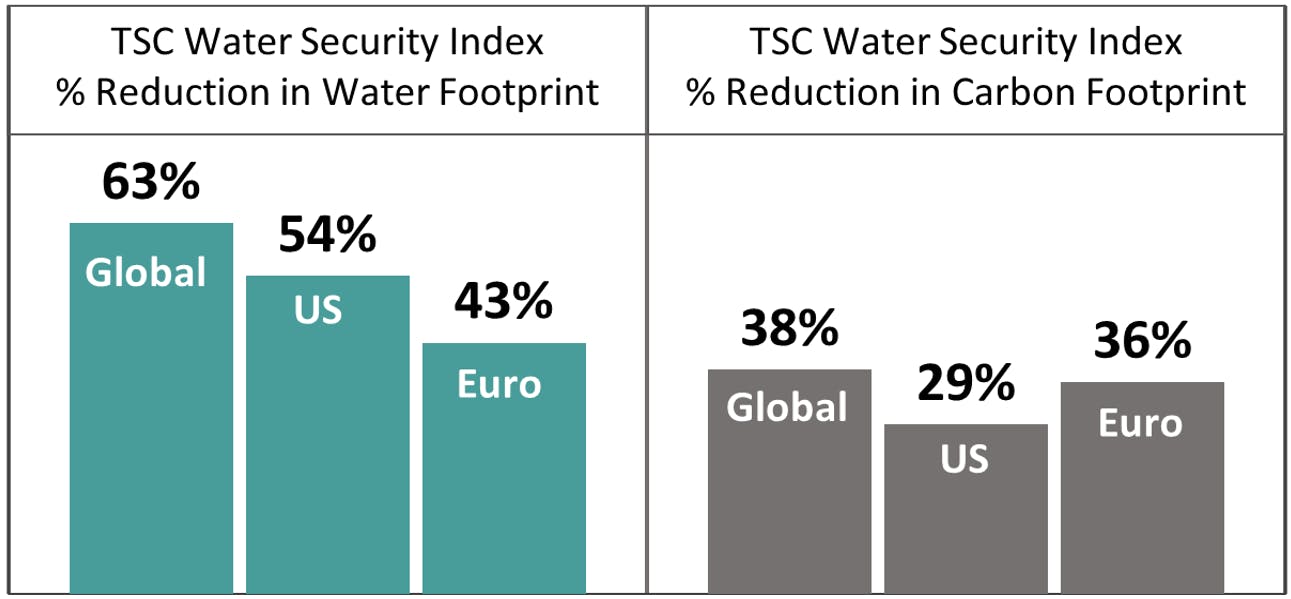
As a requirement of SFDR and the other ESG Protocols, we report our exposure to ESG characteristics via our Index Administrator (Moorgate Benchmarks). The chart below highlights the reduction in Water and Carbon Footprints that the TSC Indices are able to generate vs. their Market Benchmarks. Clearly, the TSC Index methodology results in a much lower Water Footprint and an incidentally lower Carbon Footprint while not sacrificing market performance.
TSC Water Security Index Reduction in Water & Carbon Footprints vs Market Benchmarks
SM: There’s been a massive number of ESG ETFs launched in the last two years – do you think the market is getting too crowded?
MB: Yes, there is now certainly an abundance of ESG ETFs, but the issue isn't with the number of them, it is with the methodologies used to create the underlying Indices they track. Greenwashing and arbitrary ESG ratings provided by various ESG Rating Agencies (who all use a different interpretation of the data and therefore can have wildly differing ratings for the same company) plus tilt towards a particular ESG Climate concept (usually low CO2 emissions) are not necessarily proper methodologies to create "real" Climate-focused investment products and yet they completely dominate the landscape.
Our approach is to actively measure the water risk of each company in the index and then by applying our own ranking, we can adjust the weights of each constituent to derive a water-secure investment product. The market for Water Security is entirely represented by the TSC Indices. No other Index provider has been able to come even close to measuring water risk and has kept out of the market.
TS: I think it’s too early to tell. The ETF is the best wrapper to fast-track Agenda 2030 “Transforming our World” and the 17 UN Sustainable Development Goals. To meet the UN SDGs, massive capital redirection towards the SDG’s targets and indicators is required. ETFs are playing an important role in this. The more the better, however the data and index integrity and most importantly a true, authentic commitment and dedication to ESG, Stewardship, Impact, Responsible Investing, Sustainable Finance, using capital to serve people and planet and not vice versa are imperative.
Advertisement
SM: What are your thoughts on greenwashing and how have you avoided this in index construction?
TS: For Markus, myself, and our index partner in London integrity is key. Greenwashing is becoming a major problem now that everyone wants to be a good steward, wants to “Do well by doing good”, wants to “Save the Planet” we all need to realize that the data, corporates, regulators, and investors are not where they should be yet. It takes the timely collaboration and alignment of all parties to transform ESG from an aspiring trend and “hot” (as in Climate) theme to a sustainable, solid new reality and framework of how we all need to think, act, invest, buy, sell to achieve Agenda 2030.
MB: Greenwashing is abundant because unfortunately, many ETF providers and the companies in their ETFs realize that the market (and especially the Media) responds more to the hype around ESG than the actual environmental impact of companies on the planet. Investors are becoming more aware of this and are now signaling their disagreement with this approach by speaking out and divesting from the greenwashed assets. Since our Indices are constructed entirely based on reported Water Usage and Water Stewardship (sourced from the Annual Reports), we are not compromised by the impact of greenwashing and avoid it entirely.
SM: People might be surprised that some of your top holdings include Apple, Microsoft, Amazon, Facebook, and Google. Why are these companies in a water index?
TS: Every business and company needs water to manufacture and sell their products and services. Surprisingly technology companies have a large water and carbon footprint due to their global reach and usage of the physical supply and value chain. Think along the lines of massive data and server operations, transportation, logistics, manufacturing, energy consumption, chip manufacturing, etc.
MB: Our Index is not a "water" index. We are "water security". There's a big difference. Water Security relates to ALL companies and not just Water Purification Manufacturers and Water Utilities. Every company in our Index has a measure of water risk and water stewardship which permits them to be included in the index.
The market is chock-full of so-called "water indices" but this approach ignores water risk and water security - they are nothing more than a highly concentrated (30-40 stocks) portfolio of companies in the water purification / recycling equipment manufacturing industry as well as some water utilities. These indices are a pure-play on the expectation that as water becomes more important to the corporate world, those companies will benefit from the increased demand for their products. It's a viable argument but not at all what TSC Indices are about. Our approach could be thought of as "Water 2.0" in that we are focused on the impact of water on the entire market (because water risk is ubiquitous) rather than a single sector. This gives our indices a broader market exposure which eliminates concentration risk while still providing a significantly lower Water/Carbon footprint.
SM: You’re working with my old friends Gareth and Tobias at Moorgate Benchmarks. Why did you choose them over any other provider and what kind of support do they offer?
MB: I've known these two for the past 20 years and have always had the greatest respect for their knowledge, experience, and integrity. Given that the TSC Indices represent an innovation that goes against the tide of the big boys (MSCI, S&P, etc), it made complete sense to partner with an Index disrupter like Moorgate. Gareth has been a huge help in getting our indices to market and his expertise has proved invaluable.
TS: Moorgate Benchmarks was the logical choice due to their integrity, deep domain, expertise, commitment to quality, excellence, innovation, disruption, and importantly their geographic location, London being the global financial capital for responsible investing, sustainable finance. Without Moorgate’s continuous support the indices would have not been where they are today: To be commercialized globally in real-time to create massive impact and profit for all stakeholders.
SM: When are you planning to launch an ETF on the back of the indexes?
TS: TSC Water Security Index is available for Direct Indexing on the London-based C8 Technologies platform, a leading Direct Indexing provider for global capital markets. TSC is also in progressed discussions with leading asset managers, financial institutions, and index providers for collaborations to help global capital markets to embrace Water Security, de-risk portfolios, advance Agenda 2030 “Transforming our World”. The first ETF with aligned partners is tentatively scheduled for issuance in Q2-2022.
To explore the range of ESG and sustainable ETFs available in your region and to find out which ETFs best align with UN SDGs, visit our Sustainable Investing Portal.
More articles


About Trackinsight
Since our founding in 2016, we have been at the forefront of the industry, delivering accessible, comprehensive, and reliable tools to support the evolving needs of investors.
Over the past decade, Trackinsight has expanded its operations across six countries, serving thousands of professional investors. We’ve consistently innovated to provide cutting-edge solutions that meet the changing demands of the ETF market.
In 2024, Kepler Cheuvreux, a leading independent European financial services firm, acquired a majority stake in Trackinsight, becoming the company's principal shareholder.
This strategic partnership solidifies Trackinsight's position as a premier provider of ETF selection and analysis tools, while strengthening Kepler Cheuvreux’s commitment to becoming a leading player in the ETF sector.
Together, we are committed to offering advanced services that empower professional investors, advisors, institutions, and issuers. This new step enables us to deliver even more comprehensive and innovative technological solutions, driving ETF investing to new heights.
More about TrackinsightETF TOOLS
PLATFORM
ETF NEWS & RESEARCH
Privacy policy | Cookie policy | | Terms of use | Imprint