Get your free ETF data sample from our comprehensive offerings. Start your free trial→
Help us improve your experience. Please confirm your investor type:
The ETF Industry Is Evolving Fast
From AI infrastructure to active strategies, the ETF landscape is shifting. Share your perspective in the 7th Annual Global ETF Survey.
Does ESG Affect Financial Performance?
Researchers analyzed thousands of studies so you don’t have to. Here’s what they found.


By Ben Taylor
February 10, 2023
Advertisement
As the popular adage goes, there’s strength in numbers. Few studies have the depth and breadth of this one published in the Journal of Sustainable Finance & Investment. In fact, the data set used in the study is 35 times larger than the average of prior studies.
The team of three researchers wanted to reach the final conclusion on a long-debated question: Do ESG practices influence financial performance? For too long other studies, limited in scope, simply conclude that the results are “ambiguous, inconclusive, or contradictory.” The work in this analysis, titled ESG and financial performance: aggregated evidence from more than 2000 empirical studies, is much more conclusive.
📊 Share your ETF outlook
From AI infrastructure to active strategies, the ETF landscape is shifting. Share your perspective in the 7th Annual Global ETF Survey and get exclusive early access to the final report.
What did they find?
They report that “the results show that the business case for ESG investing is empirically very well founded.” They also determined that this positive ESG impact on corporate financial performance appears stable over time.
Here we show:
- How they conducted the study
- How the results breakdown by asset class
- How the results breakdown by ESG category and region
How They Conducted the Study
The research took a two-step approach.
First, they gathered the results from all available “vote-count” studies. This approach counts the number of studies with “significant positive, negative, and nonsignificant results and ‘votes’ the category with the highest share as the winner.”
Second, the researchers aggregated findings from meta-analysis studies. These are studies that are a combination of the results of multiple scientific studies.
These two steps yielded a total of 3,718 underlying studies examining the relationship between ESG and corporate financial performance. Once the researchers eliminated all duplicated studies, they were left with just over 2,200 unique studies.
The result: Approximately 90% of the studies found a non-negative relation between ESG and corporate financial performance.
Advertisement
How The Results Breakdown by Asset Class
The researchers’ work examined more than just equities. They also looked at bonds and even real estate.
While the majority of equity studies found a positive link between ESG and corporate financial performance, the researchers learned that “nonequity asset classes both for bonds and real estate display a considerably higher share of positive findings.”
Other researchers have reached similar conclusions. A study published in The Journal of Real Estate Finance and Economics used data from Global Real Estate Sustainability Benchmark to conduct an analysis which concluded that “REITs with higher levels of ESG disclosure have lower cost of debt, higher credit ratings, and higher unsecured debt to total debt ratio.”
Additionally, bonds with higher MSCI KLD scores, which assess the ESG profile of an investment’s environment, community & society, employees & supply chain, customers, and governance & ethics, have better credit ratings which lowers the cost of capital based on Research from Fordham University.
These findings show that ESG can influence performance across asset classes. These results make intuitive sense because ESG principles tend to promote efficiency, innovation, and conscientiousness.
How The Results Breakdown by ESG Category and Region
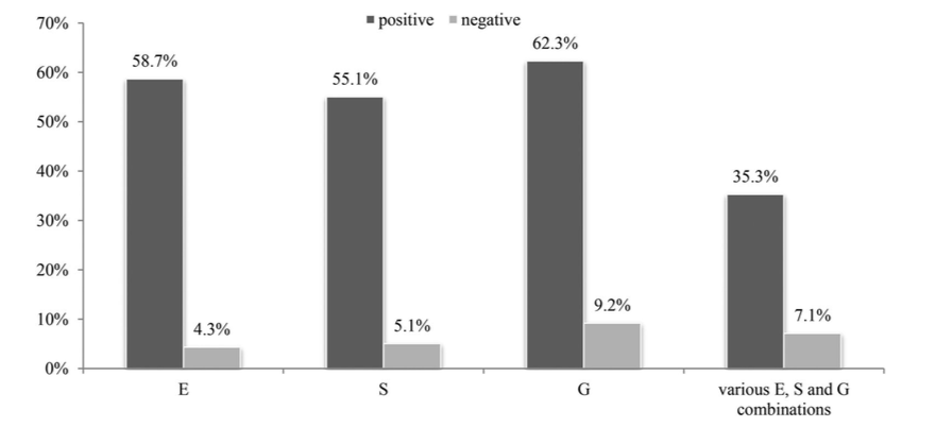
The researchers examined the various levels of influence the E, S, and G factors had on corporate financial performance.
They found that E and G exhibit a somewhat more positive relation to financial performance than S-focused studies. That said, the “difference between E and S studies with positive and negative outcomes is marginal,” according to the authors. Overall, there is no clear winner when it comes to the influence of the environmental, social, or governance factors.
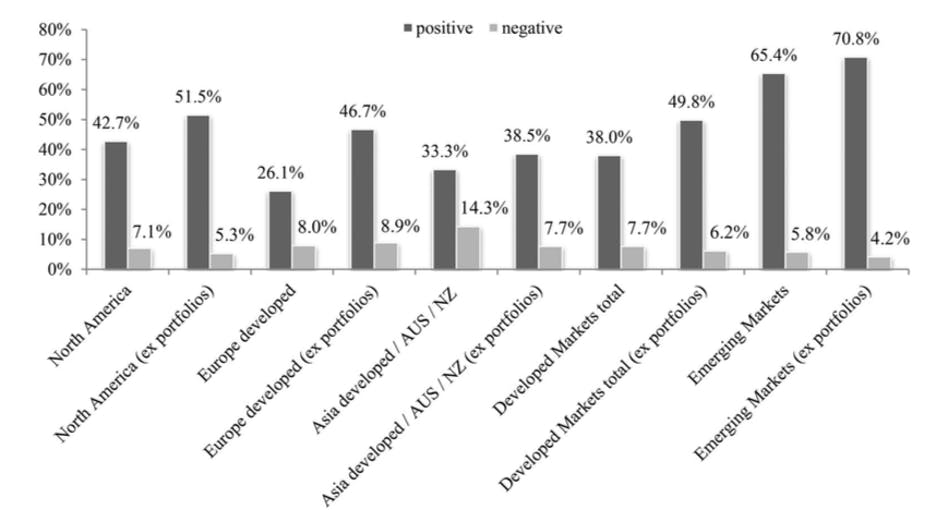
The regional findings show that there is a higher portion of positive results from North America compared to Europe and Asia/Australia. This finding, however, is influenced by the fact that there were fewer portfolio studies within the sub-sample for North America.
Advertisement
Does ESG affect financial performance? The Takeaway
As the authors make clear, “investing in ESG pays financially.”
The spectrum of studies included in this analysis makes it among the most comprehensive pieces of ESG research available to investors. Moreover, these findings complement the research discussed in our recent piece Do ESG Rating Changes Affect Stock Returns? which shows that buy-and-hold returns respond positively to ESG rating upgrades.
More articles


About Trackinsight
Since our founding in 2016, we have been at the forefront of the industry, delivering accessible, comprehensive, and reliable tools to support the evolving needs of investors.
Over the past decade, Trackinsight has expanded its operations across six countries, serving thousands of professional investors. We’ve consistently innovated to provide cutting-edge solutions that meet the changing demands of the ETF market.
In 2024, Kepler Cheuvreux, a leading independent European financial services firm, acquired a majority stake in Trackinsight, becoming the company's principal shareholder.
This strategic partnership solidifies Trackinsight's position as a premier provider of ETF selection and analysis tools, while strengthening Kepler Cheuvreux’s commitment to becoming a leading player in the ETF sector.
Together, we are committed to offering advanced services that empower professional investors, advisors, institutions, and issuers. This new step enables us to deliver even more comprehensive and innovative technological solutions, driving ETF investing to new heights.
More about TrackinsightETF TOOLS
PLATFORM
ETF NEWS & RESEARCH
Privacy policy | Cookie policy | | Terms of use | Imprint