Global ETF Survey 2026: Answer now →
Help us improve your experience. Please confirm your investor type:
The Ultimate ETF Comparison Tool - Try Now!
Analyze up to 5 ETFs side-by-side and gain instant insights on performance, fees, holdings, and more to make data-driven investment decisions.

Do ESG Rating Changes Impact Stock Returns?
What happens to a stock’s price when the company’s ESG rating increases or decreases?

By Ben Taylor
February 3, 2023
Advertisement
There are many reasons why an ESG fund might outperform its non-ESG counterpart. For example, ESG companies are more likely to reduce waste making them more operationally efficient which, in turn, reduces costs. They may also have a more inclusive approach to governance which drives innovation.
But is a high ESG rating alone enough to meaningfully influence the stock’s return?
ETF Data Built for Precision
Trackinsight delivers reliable and comprehensive coverage on 14,000+ ETFs
Researchers at MIT think they have found the answer.
Their work is comprehensive, to say the least. They examined a sample of 3,665 listed U.S. corporations and 4,678 MSCI ESG rating changes. This breaks down to:
- 2,545 ESG rating upgrades
- 2,133 ESG rating downgrades
Their work exhaustively examines the impact of ESG rating changes on stock returns.
The researchers also examined if the amount of an ESG stock owned by mutual funds increases or decreases due to changes in ESG ratings. In their study, ownership is measured by “the fraction of a firm’s shares that are owned by domestic U.S. mutual equity funds with an explicit ESG objective.”
Here, we look at the answers to both of these questions and what it means for investors.
ESG Rating Changes and Stock Price Performance
In their research, The Economic Impact of ESG Ratings, MIT researchers examine stock performance as a result of MSCI ESG rating changes.
They selected the MSCI ESG rating because their analysis showed that this rating has “by far the highest correlation with the holdings of ESG mutual funds” when compared to others like Sustainalytics, Moody’s ESG, ISS, and S&P Global.
What did they find?
The researchers concluded that ESG rating downgrades have a “pronounced negative” effect on buy-and-hold returns. The next question is, how negative? The researchers explain that this negative effect is strongest 19 months after the downgrade and amounts to -3.78% which corresponds to “an annualized abnormal return of -2.37%”
Advertisement
They also learned that buy-and-hold returns respond positively to ESG rating upgrades. This effect begins to occur about 10 months after the upgrade and becomes even more significant at the 17, 20, and 22-month mark at which point returns improve by 2.62%.
The Bottom Line:
A change in the ESG rating of a stock has a clear effect on returns.
After a stock has received an ESG downgrade, the buy-and-hold returns suffer for a period of up to 24 months. The worst part of this performance is a -3.78% drop at the 19-month mark.
An upgrade creates a positive effect on buy-and-hold returns. This effect reaches its maximum at the 22-month mark with an increase of 2.62%.
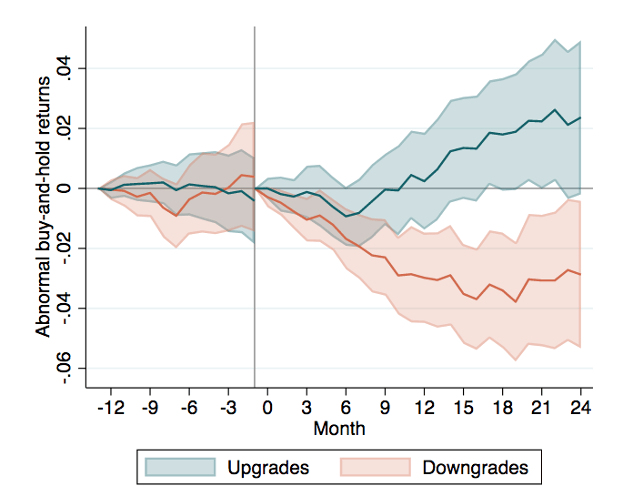
Source: The Economic Impact of ESG Ratings (September 4, 2022).
ESG Ownership Changes Relative to Rating Changes
Next, the researchers examined if ESG stock ownership by ESG US equity mutual funds changes in response to ESG rating upgrades and downgrades. Like their analysis of stock prices and ESG ratings, the researchers started by examining a range of ESG ratings including MSCI, Sustainalytics, Moody’s ESG, ISS, and S&P Global.
They determined that among all of these, the strongest relationship was, once again, between MSCI’s ESG scores and ESG ownership. Their calculations revealed that “the relationship between the MSCI ESG rating and ESG fund holdings is persistent and increases over time.”
Specifically, this means that two years after a downgrade, the average ESG ownership falls by 13.1%. Two years after an upgrade, ESG ownership climbs 17.1%. While the data shows that ESG ownership is in fact influenced by MSCI ESG ratings, it is important to note that the process is gradual.
Advertisement
Moreover, the strength of this relationship appears to be increasing over time. The authors explain that the correlation coefficient increased by a factor of approximately three between 2018 and 2020.
The Bottom Line:
An ESG rating upgrade from MSCI will increase the fraction of a firm’s shares that are owned by domestic U.S. ESG mutual equity funds by 17.1% over a period of two years.
An ESG rating downgrade from MSCI will decrease the fraction of a firm’s shares that are owned by domestic U.S. ESG mutual equity funds by 13.1% over a period of two years.
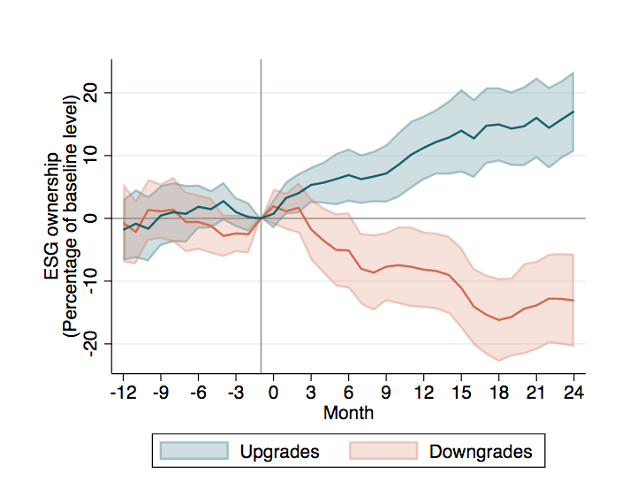
Source: The Economic Impact of ESG Ratings (September 4, 2022).
The Takeaway
The MSCI ESG rating commands considerable influence over both the performance of the stock being rated and the ownership of the stock by domestic U.S. mutual equity funds with a stated ESG objective.
Based on these findings it seems reasonable to project that a stock will see some share price appreciation after it receives an ESG upgrade from MSCI. A downgrade in ESG rating from MSCI can reasonably be expected to cause a drop in share price.
These findings suggest that the market places the most trust in the MSCI ESG rating scale above Sustainalytics, Moody’s ESG, ISS, and S&P Global.
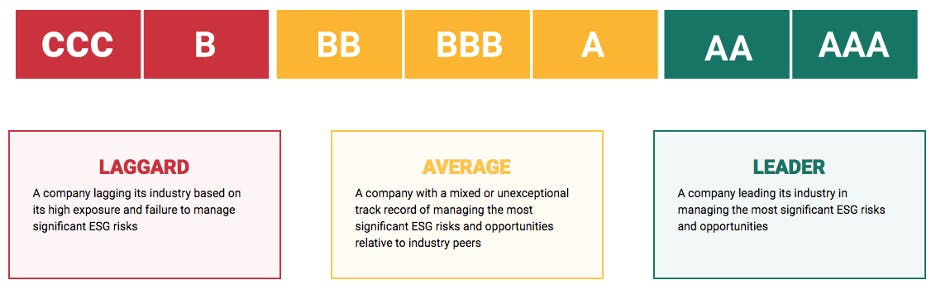
The MSCI ESG ratings use the following scale:
The views and opinions expressed herein are the views and opinions of the author and do not necessarily reflect those of Trackinsight. Past performance is not indicative of future results. Investors should undertake their own due diligence and carefully evaluate companies before investing. ADVICE FROM A FINANCE PROFESSIONAL IS STRONGLY ADVISED.
More articles


About Trackinsight
Since our founding in 2016, we have been at the forefront of the industry, delivering accessible, comprehensive, and reliable tools to support the evolving needs of investors.
Over the past decade, Trackinsight has expanded its operations across six countries, serving thousands of professional investors. We’ve consistently innovated to provide cutting-edge solutions that meet the changing demands of the ETF market.
In 2024, Kepler Cheuvreux, a leading independent European financial services firm, acquired a majority stake in Trackinsight, becoming the company's principal shareholder.
This strategic partnership solidifies Trackinsight's position as a premier provider of ETF selection and analysis tools, while strengthening Kepler Cheuvreux’s commitment to becoming a leading player in the ETF sector.
Together, we are committed to offering advanced services that empower professional investors, advisors, institutions, and issuers. This new step enables us to deliver even more comprehensive and innovative technological solutions, driving ETF investing to new heights.
More about TrackinsightETF TOOLS
PLATFORM
ETF NEWS & RESEARCH
Privacy policy | Cookie policy | | Terms of use | Imprint