Trackinsight Enterprise, a unified platform for institutional ETF research, analytics, and compliance, is now live. Explore Trackinsight Enterprise →
Help us improve your experience. Please confirm your investor type:
Don’t Miss a Move in the ETF Market
Sign up and keep track of everything that moved the ETF industry this week. From new launches to regulatory shifts across the Atlantic.

How Battery Cost Breakthroughs Will Boost Green Shipping
Nearly half of all containership traffic could become electrified within a decade.


By Ben Taylor
May 24, 2023
- Battery
Advertisement
The world runs on global shipping. Close to 90% of the total mass of goods shipped every year are moved by maritime operations.
However, the emissions output from these vessels presents a problem as nations work to reduce CO2 and slow the effects of climate change. Each year the global shipping industry uses about 3.5 million barrels of oil. Projections suggest that as soon as 2050 the entire industry could be responsible for 17% of global CO2 emissions. Advancements in battery technology could change that.
📊 Share your ETF outlook
From AI infrastructure to active strategies, the ETF landscape is shifting. Share your perspective in the 7th Annual Global ETF Survey and get exclusive early access to the final report.
The possibility of electrified shipping transport is closer than many realize. Research published in Nature Energy found that at battery prices of US$100 kilowatt-hour (kWh) the total cost of propulsion of a battery-powered containership is less expensive than a traditional internal combustion engine over distances of less than 1,000 km, about 621 miles.
Today, the average lithium-ion battery costs $151 per kWh but that number is falling. Data from BloombergNEF forecasts that costs could fall to $100 per kWh by 2026.
Here we look at the following:
- Where maritime electrification stands today
- What this means for battery technology companies
- Investor opportunities
Where Maritime Electrification Stands Today
Major shipping companies have already started testing the feasibility of battery-powered solutions. Danish shipping company Maersk, which operates about 700 vessels worldwide, began testing a containerized 600 kWh marine battery system in 2019 on a ship operating between East Asia and West Africa. This was one of the first steps the company took towards reaching its stated long-term goal of becoming “carbon neutral by 2050,” according to the company's COO Søren Toft.
Similarly, Norwegian chemical company Yara International and tech company Kongsberg have partnered to build a zero-emission, autonomous container vessel that has the potential to “reduce diesel-powered truck haulage by 40,000 journeys per year” according to the companies. The ship began commercial operation last year.
As batteries become part of the logistics of ship transport, more people are rethinking how maritime trade can be reconfigured to yield more value from battery tech. Companies like FleetZero are developing electric-powered ships that make the numbers work by relying on smaller ships.
Traditional, internal combustion ships have room for 10,000 or 20,000 shipping containers and are designed to travel their global route on just one tank of fuel. This design leaves no room for batteries. However, a smaller ship that can carry 3,000 to 4,000 containers while making quick stops along the way can effectively rely on battery power.
Other, lesser-known innovations are starting to reduce shipping emissions. An innovation called cold ironing allows diesel engine ships to switch to shore-supplied electricity during berthing. While this technology is not new, it is becoming a larger part of a multi-faceted approach to reducing the use of oil to power international trade.
Advertisement
What this Means for Battery Technology Companies
Battery tech companies are already experiencing growth as the technology becomes a more viable solution for international shipping.
The Solactive Battery Value-Chain Index, which tracks the performance of a group of stocks of companies involved in electro-chemical energy storage technology, has seen a gain of more than 100% since the start of 2020.
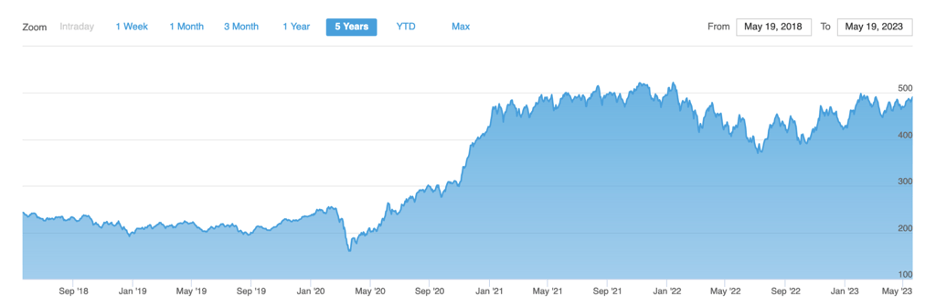
Source: Solactive
Major international shippers have not yet adopted battery-powered solutions at scale. However, some companies are beginning to slowly expand their use of lithium-ion batteries.
SPBES, a Canadian energy-technology company, has installed their NMC batteries in about 20 tugboats and ferries internationally. These batteries which use lithium, nickel, manganese, and cobalt, are similar to those used in EVs and many consumer electronics. Importantly, these batteries use a liquid cooling system that reduces heat buildup which can cause fires.
To solve the problem of the heavy-duty power needed to accommodate major cargo ships, some companies are turning to solid electrolyte batteries. This design uses a porous resin separator stacked between layers of solid electrolyte-carrying ions between the battery’s electrodes. This new approach generates nearly 3X the energy density of standard lithium-ion batteries.
These innovations are increasing the economic viability of battery-powered shipping. As a result, companies found in the battery value chain are positioned to become a major part of future global trade.
Investor Opportunities in Battery Technology
There are a few ways investors can gain exposure to the industries supporting battery technology.
Advertisement
L&G Battery Value-Chain UCITS ETF (XLON:BATT)
The L&G Battery Value-Chain UCITS ETF tracks the performance of the Solactive Battery Value-Chain Index. The fund includes companies involved in lithium mining, lithium processing, software, and electronic component manufacturers. The majority of the holdings are large-value stocks.
Fidelity Electric Vehicles and Future Transportation UCITS ETF (FDRV)
The Fidelity EV and Future Transport UCITS ETF includes holdings focused on semiconductor technology, EVs, GPUs, and software solutions for battery-powered transportation. The sectors represented are mostly consumer discretionary, information technology, and industrials.
Global X Lithium & Battery Tech UCITS ETF (LITU)
The Global X Lithium & Battery Tech UCITS ETF consists primarily of companies in the materials, industrials, and information technology sectors. Many of the holdings include lithium mining and processing companies.
Please note this article is for information purposes only and does not in any way constitute investment advice. It is essential that you seek advice from a registered financial professional prior to making any investment decision.
More articles


About Trackinsight
Since our founding in 2016, we have been at the forefront of the industry, delivering accessible, comprehensive, and reliable tools to support the evolving needs of investors.
Over the past decade, Trackinsight has expanded its operations across six countries, serving thousands of professional investors. We’ve consistently innovated to provide cutting-edge solutions that meet the changing demands of the ETF market.
In 2024, Kepler Cheuvreux, a leading independent European financial services firm, acquired a majority stake in Trackinsight, becoming the company's principal shareholder.
This strategic partnership solidifies Trackinsight's position as a premier provider of ETF selection and analysis tools, while strengthening Kepler Cheuvreux’s commitment to becoming a leading player in the ETF sector.
Together, we are committed to offering advanced services that empower professional investors, advisors, institutions, and issuers. This new step enables us to deliver even more comprehensive and innovative technological solutions, driving ETF investing to new heights.
More about TrackinsightETF TOOLS
PLATFORM
ETF NEWS & RESEARCH
Privacy policy | Cookie policy | | Terms of use | Imprint