All you need to get started with ETF selection and analysis. Create your account now →
Help us improve your experience. Please confirm your investor type:
Don’t Miss a Move in the ETF Market
Sign up and keep track of everything that moved the ETF industry this week. From new launches to regulatory shifts across the Atlantic.

Central Banks raise rates again to end the year
As the year comes to a close, major central banks have raised rates yet again with the promise to continue their fight against inflation in 2023.

By Daniel Chivu
December 23, 2022
- Bonds
Advertisement
After a tumultuous year for global equity and debt markets, December interest rate decisions were kicked off by the Bank of Canada, which raised interest rates to 4.25% on December 7th. This marks the 7th consecutive rate hike of 2022, and an increase of 4% since the hiking cycle began early this year.
Canadian banks wasted no time in passing the costs on to borrowers and swiftly moved their prime rate to 6.45%.
Since the BoC’s supersized hike of 100bps in July, the messaging has been clear and consistent from Canadian bank officials: rates must continue rising. The message was reinforced in October, and again in November, however a clear change in tone has occurred as of December 7th.
In the Bank’s post rate hike statement, they agreed on a “wait and see” approach, saying they “will be considering” whether further hikes are required. To date, this message has proved elusive, with talks of a “pivot” starting in the late summer.
However, given the lower-than-expected inflation numbers over the last few months, and what is projected to be an impending mild recession in 2023, the odds are rising that the BoC will likely temper down its aggressive hikes going forward. Stephen Brown, an economist from Capital Economics, also seems to favor this trajectory, stating “We would not rule out a final 25 basis point interest rate hike in January, but the Bank is very close to the end of its tightening cycle," in a note sent to clients on December 7th.
The Fed also announced its 7th rate hike for the year on December 14th, bringing its current rate to 4.5%, the highest in 15 years. Following previous comments from FED officials, the hike was only 50bps - lower than the 75bps hikes investors have become accustomed to over the last few months.
However, unlike the reaction to the BoC’s statement, the Fed’s comments - committing to continued rate hikes in the new year and raising the terminal rate above the 5.1% previously communicated – spooked US equity markets.
📊 Share your ETF outlook
From AI infrastructure to active strategies, the ETF landscape is shifting. Share your perspective in the 7th Annual Global ETF Survey and get exclusive early access to the final report.
The Fed’s most recent message stands in stark contrast with financial markets’ expectations that the terminal rate will land below 5%, after hawkish comments delivered by New York Fed President John Williams, San Francisco Fed President Mary Daly, and Cleveland Fed President Loretta Mester.
Despite this backdrop, however, it appears the Bond market is expecting the Fed to ultimately win its fight against inflation, and the recent deceleration in Core CPI has provided a much-needed sigh of relief.
The yield curve, although remaining steeply inverted, has retreated from its previous lows of -84bps, and sits at -0.64 as of December 19th.
European bond yields rise and the Bank of England hikes again
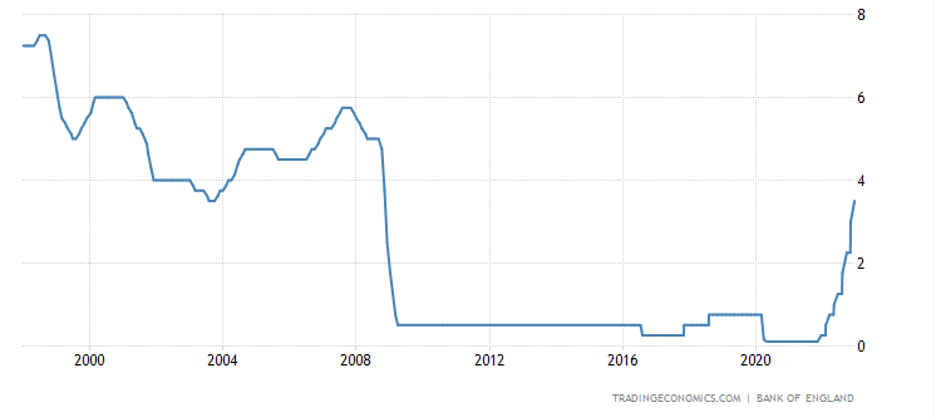
Banks in the UK have started bumping up the yields on savings accounts following the 9th straight hike from the Bank of England. The bank hiked its interest rate by 50bps on December 15th, to 3.5%, which marks its highest level in 14 years.
Banks such as Chase U.K and Starling have launched new savings products yielding anywhere from 2.7%-3.25% as of January 2023 in an effort to attract savers to guaranteed fixed term products.
First Direct, a subsidiary of HSBC, has even started offering rates as high as 7%, on the condition that clients deposit between £25-£300/month, to a maximum amount of £3600, and a lockup condition of a year.
The considerably higher guaranteed returns provided by savings accounts could potentially sap demand for low-yielding government bond funds, as investors worldwide elect to park their cash in guaranteed deposits yielding between 3-7%. Government bonds, despite being considered extremely safe, are not guaranteed, since technically the government can default on its debt.
European bond yields are experiencing a flattening of the curve, as the yields on 10-year Bunds, and Italian government bonds rose 5bps and 11.5bps respectively, on December 19th. And better than expected economic performance in Germany has lessened the likelihood of a recession, which ultimately had the effect of pushing up 10-year yields, and further flattening the curve.
Investors interested in gaining exposure to higher yields, without suffering from the lack of liquidity provided by Guaranteed Investment Certificates (GICs) or Deposits, could consider High Interest Savings ETFs. ETFs such as CASH, HSAV, and PSA invest in various high interest deposits and allow investors the option to cash out at any point.
Advertisement
Please note this article is for information purposes only and does not in any way constitute investment advice. It is essential that you seek advice from a registered financial professional prior to making any investment decision.
More articles


About Trackinsight
Since our founding in 2016, we have been at the forefront of the industry, delivering accessible, comprehensive, and reliable tools to support the evolving needs of investors.
Over the past decade, Trackinsight has expanded its operations across six countries, serving thousands of professional investors. We’ve consistently innovated to provide cutting-edge solutions that meet the changing demands of the ETF market.
In 2024, Kepler Cheuvreux, a leading independent European financial services firm, acquired a majority stake in Trackinsight, becoming the company's principal shareholder.
This strategic partnership solidifies Trackinsight's position as a premier provider of ETF selection and analysis tools, while strengthening Kepler Cheuvreux’s commitment to becoming a leading player in the ETF sector.
Together, we are committed to offering advanced services that empower professional investors, advisors, institutions, and issuers. This new step enables us to deliver even more comprehensive and innovative technological solutions, driving ETF investing to new heights.
More about TrackinsightETF TOOLS
PLATFORM
ETF NEWS & RESEARCH
Privacy policy | Cookie policy | | Terms of use | Imprint