Global ETF Survey 2026: Answer now →
Help us improve your experience. Please confirm your investor type:
The ETF Industry Is Evolving Fast
From AI infrastructure to active strategies, the ETF landscape is shifting. Share your perspective in the 7th Annual Global ETF Survey.

Baidu's Challenge to OpenAI Props Up China's Big Tech
Baidu’s AI push challenges OpenAI and DeepSeek, boosting China’s tech sector with strategic acquisitions and competitive pricing.


By Leverage Shares
April 4, 2025
- Leverage Shares
- Baidu
- China
- Technology
Advertisement
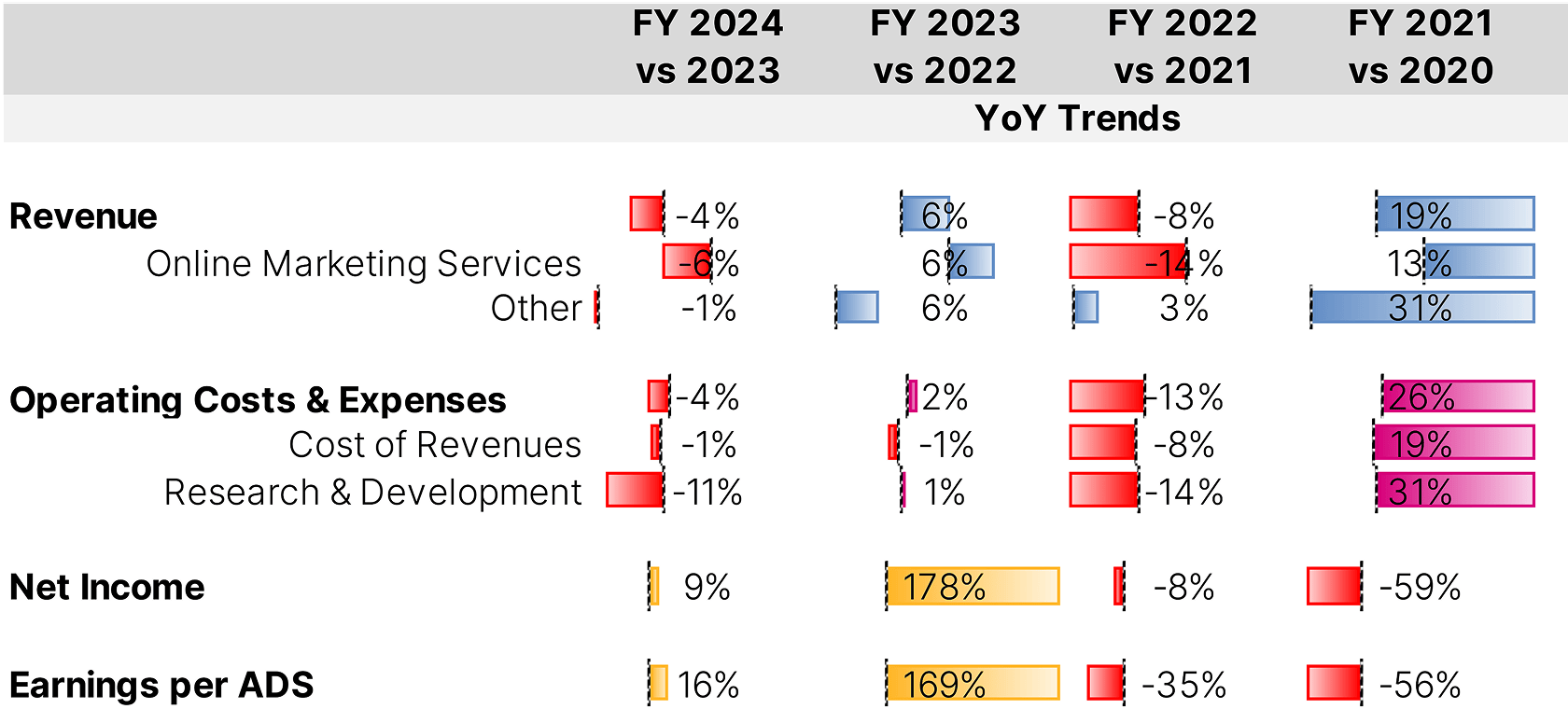
On the 18th of February 2025, China's search giant Baidu, Inc. (NASDAQ: BIDU) announced its earnings, which were an overall positive in terms of yearly trends.
Source: Company information; Leverage Shares analysis
📊 Share your ETF outlook
From AI infrastructure to active strategies, the ETF landscape is shifting. Share your perspective in the 7th Annual Global ETF Survey and get exclusive early access to the final report.
Despite overall revenue slipping by 4%, net income rose 9% from the previous Fiscal Year (FY) (which was also a blockbuster year for growth) and earnings per American Depositary Share (ADS) rising 16%.
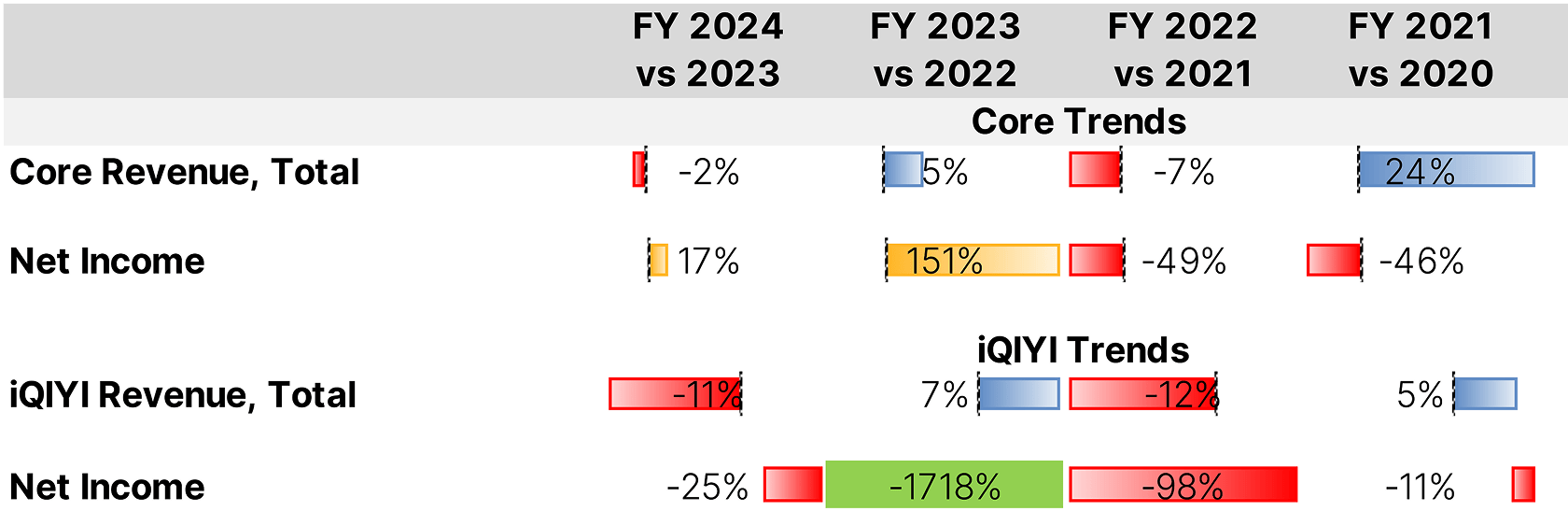
Like Google, the company has a YouTube-like streaming equivalent iQIYI, which remains a mixed bag.
Source: Company information; Leverage Shares analysis
The company's "Core" – which the company defines as "focusing on online marketing services, cloud services, and products/services from AI initiatives, including Baidu's Mobile Ecosystem, AI Cloud, and Intelligent Driving & Other Growth Initiatives" – delivered a positive net income growth despite a slight slowdown in revenue. The streaming services segment sustained losses both in revenue relative to the past year as well as net income.
Given that the "Core" generated 3.5 times the revenue delivered by the streaming services segment, the company is definitively an "AI/technology" company. However, this doesn't mean that the company isn't endeavouring further into online media: around a week after the earnings, the company announced that it acquired JOYY¹, a leading Chinese live-streaming platform for $2.1 billion.
The company has long been a leading AI player in China, with the latest release of its large language model (LLM) Ernie Bot piquing increased interest in the company.
The DeepSeek Effect on China's Big Tech
Baidu was the first major Chinese tech company² to release an LLM for China in March 2023 after the release of OpenAI’s ChatGPT created ripples around the world. After DeepSeek fueled an open-source wave around the world, Baidu's contemporaries such as Alibaba, Tencent and ByteDance launched LLMs and started making inroads among both Chinese businesses as well as consumers at Baidu's expense. Baidu has been hard at work and its latest release on the 16th of March this year is ostensibly the first step towards the company regaining relevance in China's AI market.
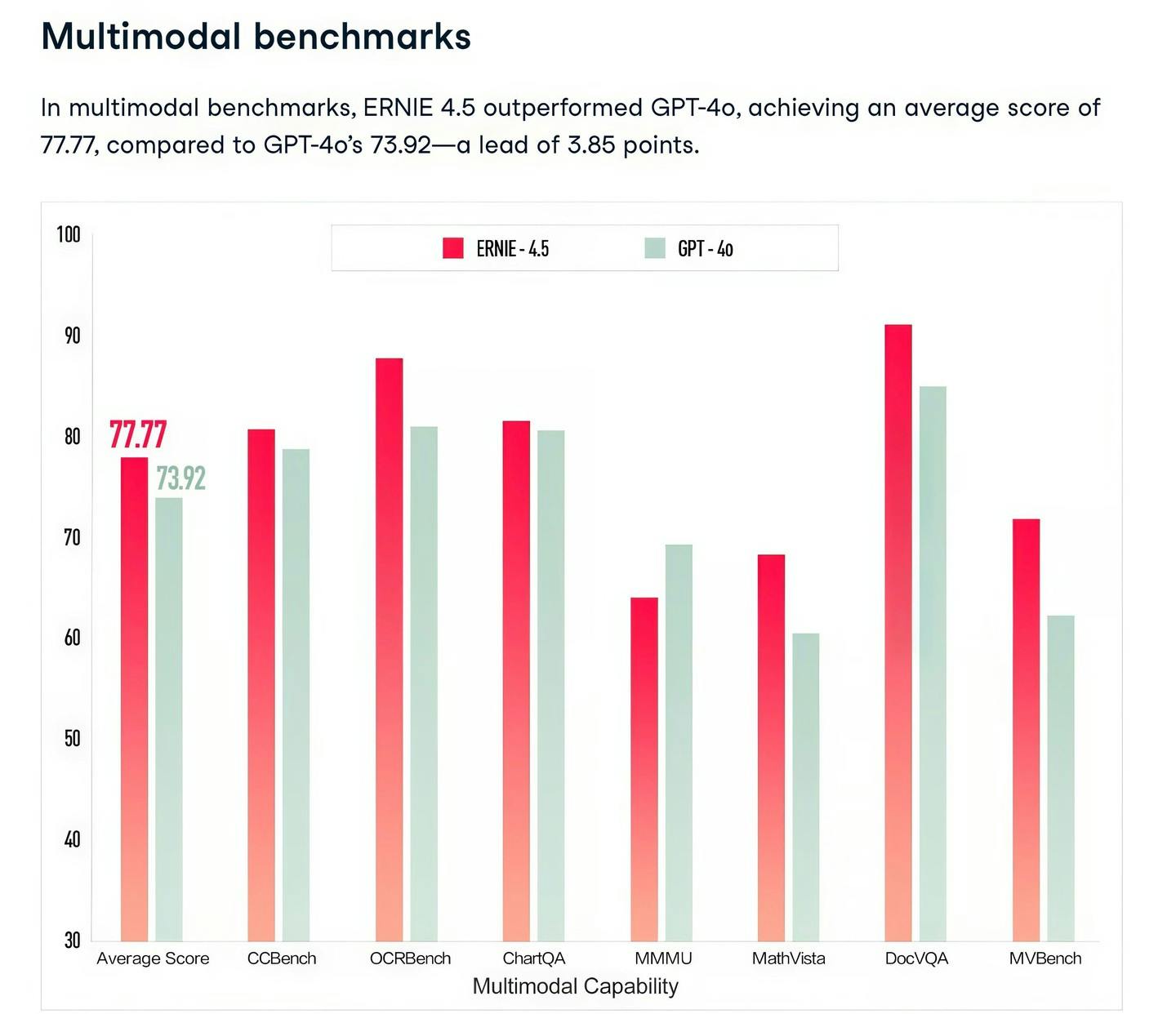
Its latest release features the foundation model Ernie 4.5, which acts as a "teacher" to the more-advanced reasoning model Ernie X1. Both 4.5 and X1 are multimodal models, i.e. they cover images, audio and video. The company claims that the foundational model outperforms OpenAI's GPT-4o, launched in May last year, along multiple benchmarks.
Advertisement
Source: Baidu
Both foundational model Ernie 4.5 and reasoning model Ernie X1 were made freely available on Ernie Bot’s official website on the day of the release. The company also made a surprising announcement: from the 30th of June, Ernie 4.5 would be open-source – a massive departure from the company's long-held OpenAI-like stance on closed-source development of AI.
Next, while the company has been coy about its accuracy versus DeepSeek, it takes square aim at DeepSeek's pricing model for commercial applications: while DeepSeek is currently charging US$$0.55 per million token inputs and US$2.19 per million token outputs, Baidu will charge US$0.28 per million token inputs and US$1.12 per million token outputs for Ernie X1 – effectively half the price. Given that DeepSeek is reportedly already struggling with meeting surging demand – thus prompting an increase in prices last month – the company's strategy might just pay off.
Baidu isn't the only Chinese Big Tech company to raise a challenge versus DeepSeek. Earlier this month, Alibaba stated³ that its open-source QwQ-32B reasoning model surpassed the performance of DeepSeek's R1 in areas such as mathematics, coding and general problem-solving, despite its relatively modest 32 billion parameters to DeepSeek's 671 billion. QwQ-32B also was stated to outperform against OpenAI’s o1-mini, which was built with 100 billion parameters.
Market Impact
Under the current U.S. administration, U.S.-listed Chinese companies are under increasing pressure to dual-list in China in order to remain accessible to global investors in the event that they're forced out of U.S. bourses. Baidu has been dual-listed for a while now in Hong Kong under the ticker "9888". The process of dual-listing has created some interesting disparities in ticker performance in the likes of Alibaba.
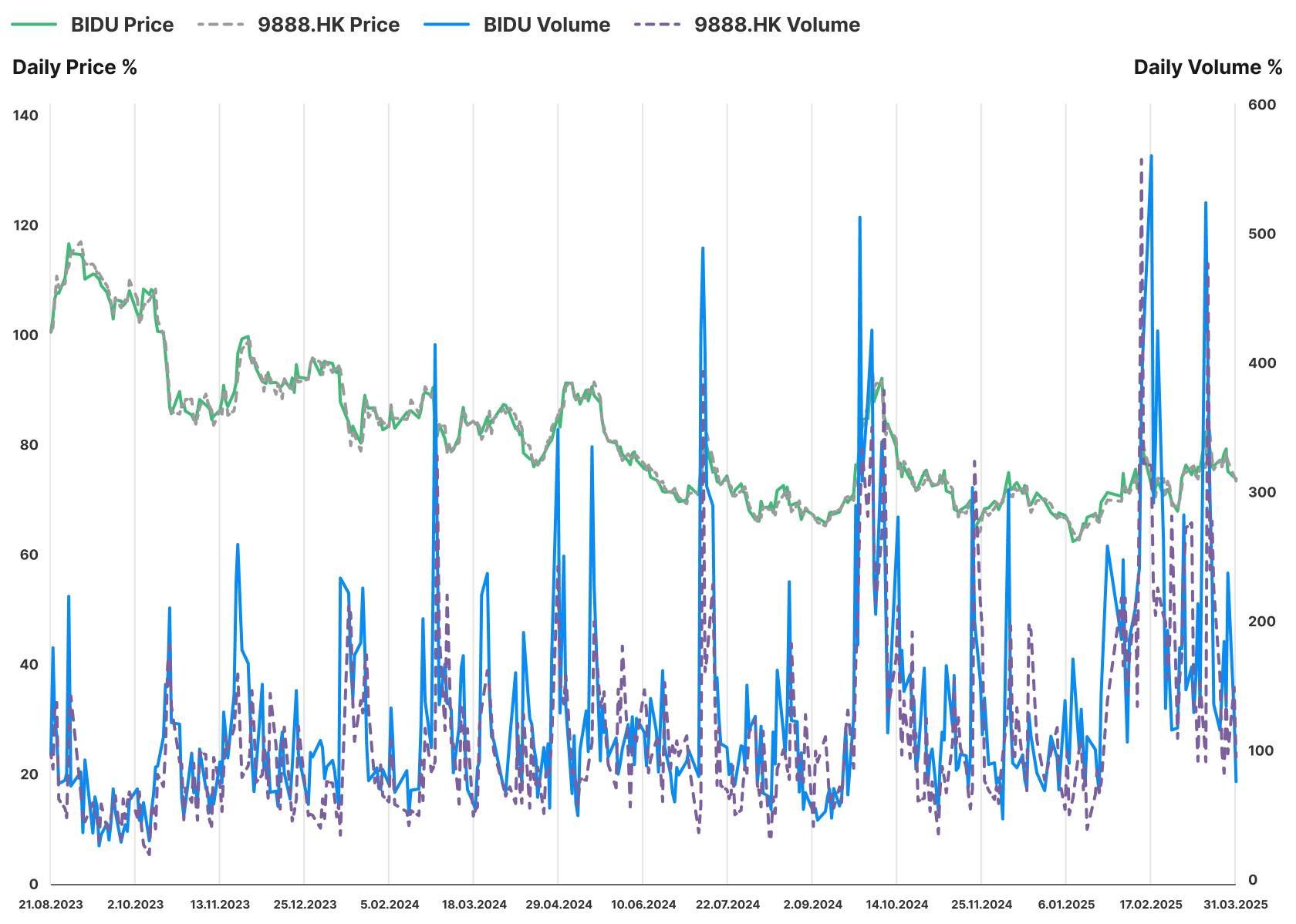
In Baidu's case, the valuations of its two tickers have remained relatively harmonized:
Source: Leverage Shares analysis
Barring a couple of spurts of trading volume misalignment, prices remain fairly consistent across bourses. Throughout 2024 and in the Year Till Date (YTD) in 2025, the Hong Kong-listed ticker's traded volumes were 2.8 times that of the U.S.-listed ticker, indicating that mainland and Hong Kong investors' relatively stronger yet largely-aligned conviction in the company's forward outlook. Across February and March so far, however, the "Hong Kong multiple" has begun to trend higher: as of the 24th of March, the average traded volume in Hong Kong is 3.2 times that in the U.S., with March showing very strong upticks well above the average.
Advertisement
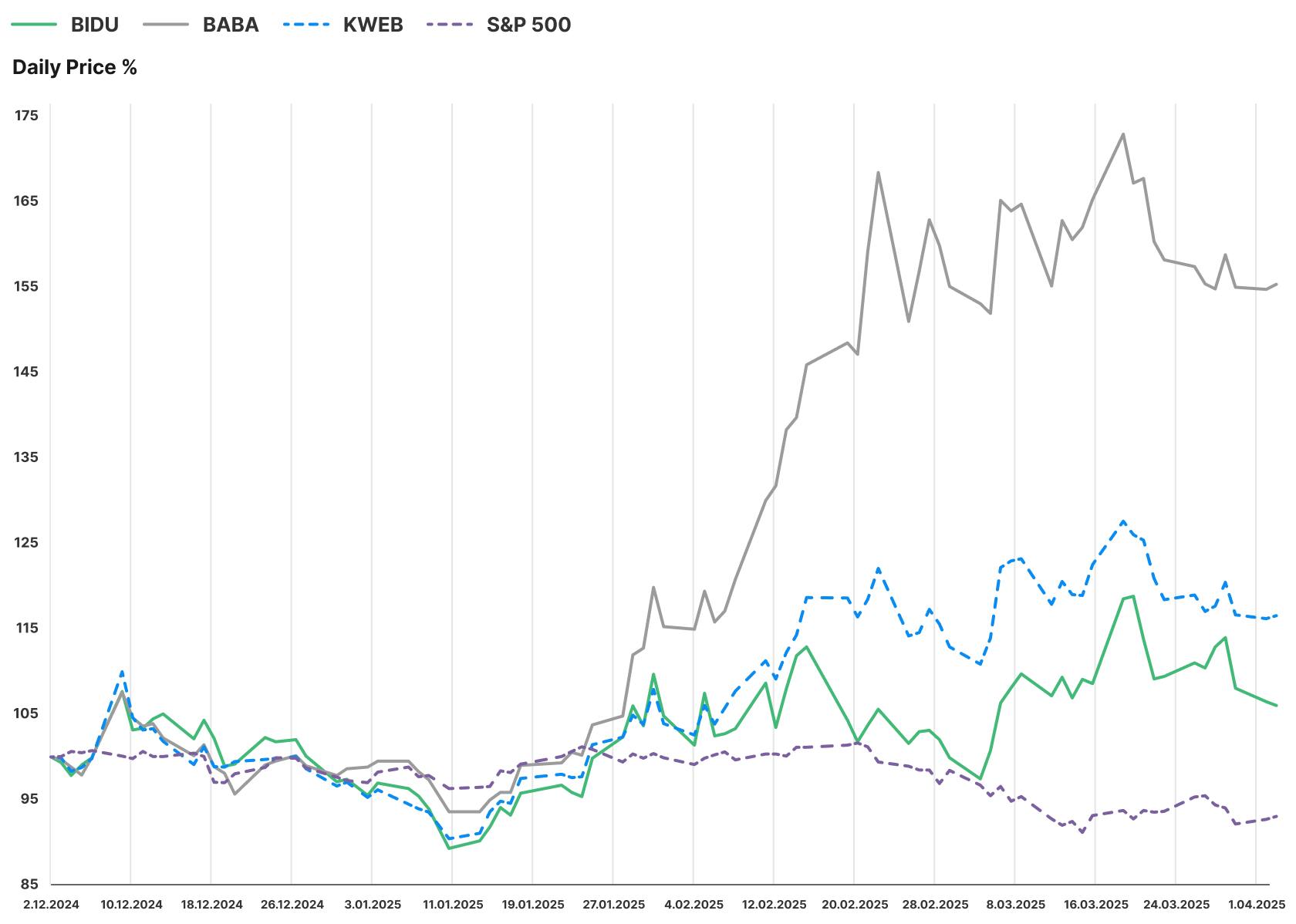
However, this isn't necessarily an indicative of a return of the China's "broad growth" story. For instance, when compared against the KraneShares CSI China Internet ETF (KWEB) – itself an aggregation of China's leading internet/tech companies – the disparity in outlook when drilled down to individual names becomes more apparent:
Source: Leverage Shares analysis
While Alibaba has been an outperformer against the average of its Chinese peers through much of the current year, Baidu has only begun to show signs of outperformance versus the average in the month of March. It also bears noting that the broad U.S. market as represented by the S&P 500 has been a substantial underperformer against Baidu, Alibaba as well as the average of China's leading tech companies.
In Conclusion
Much like in the U.S., China's "broad growth" story – at least as measured by market conviction – has supplanted with a relatively short list of names. Market breadth remains shallow with mainland/Hong Kong investors showing resilient conviction in the likes of Alibaba and now Baidu.
Given that China's market is relatively closed off and/or biased in favour of domestic players in strategic industries, it is very likely that Baidu's return to relevance has only just begun. This might very well be the beginning of a sustained bullish trajectory in Baidu – be it in the U.S. or in Hong Kong.
Given the recent strong performance of leading Chinese tech stocks relative to the U.S. market, professional investors in Europe might like to consider the +3x Long China Tech ETP (KWE3) for magnified exposure to the KWEB ETF. In addition, investors can also consider the +3x Long Baidu ETP (BID3) for magnified exposure to Baidu’s U.S. ticker during the upside of its trajectory and the -1x Baidu Short ETP (BIUS) for the equivalent of a short position on the stock without the necessity of a margin account.
About Leverage Shares
Leverage Shares is the largest European issuer of single stock ETPs by AUM & trading volume. It is the only provider of physically-backed leveraged ETPs on single stocks, ETFs and commodities.
The opinions expressed in this publication are those of the authors and are subject to change. They do not purport to reflect the opinions or views of Trackinsight or its members. Trackinsight does not guarantee the accuracy, completeness, or reliability of the information provided.
Footnotes:
¹ “Baidu buys JOYY’s China live-streaming unit for $2.1 billion in digital video push”, Reuters, 25 February 2025
² “Baidu launches new AI models, touts superiority to DeepSeek, OpenAI on benchmarks”, South China Morning Post, 16 March 2025
³ ‘Better than DeepSeek and OpenAI’: Alibaba touts open-source AI model that beats rivals”, South China Morning Post, 6 March 2025
More articles


About Trackinsight
Since our founding in 2016, we have been at the forefront of the industry, delivering accessible, comprehensive, and reliable tools to support the evolving needs of investors.
Over the past decade, Trackinsight has expanded its operations across six countries, serving thousands of professional investors. We’ve consistently innovated to provide cutting-edge solutions that meet the changing demands of the ETF market.
In 2024, Kepler Cheuvreux, a leading independent European financial services firm, acquired a majority stake in Trackinsight, becoming the company's principal shareholder.
This strategic partnership solidifies Trackinsight's position as a premier provider of ETF selection and analysis tools, while strengthening Kepler Cheuvreux’s commitment to becoming a leading player in the ETF sector.
Together, we are committed to offering advanced services that empower professional investors, advisors, institutions, and issuers. This new step enables us to deliver even more comprehensive and innovative technological solutions, driving ETF investing to new heights.
More about TrackinsightETF TOOLS
PLATFORM
ETF NEWS & RESEARCH
Privacy policy | Cookie policy | | Terms of use | Imprint