Get your free ETF data sample from our comprehensive offerings. Start your free trial→
Help us improve your experience. Please confirm your investor type:
The Ultimate ETF Comparison Tool - Try Now!
Analyze up to 5 ETFs side-by-side and gain instant insights on performance, fees, holdings, and more to make data-driven investment decisions.
Alternative Fixed Income: REITs and inflation protection
Real Estate in the form of publicly traded REITS often acts as a high yield bond proxy and can add a layer of diversification to investors’ fixed income portfolios.


By Daniel Chivu
October 21, 2022
Advertisement
The more traditional view of Fixed Income investments largely focuses on treasuries, investment grade bonds, and high yield bonds. The typical 60-40 portfolio is made up of blue-chip equities and complemented by traditional fixed income sources, usually bought for a laddered maturity strategy. This allows for maturity of the underlying bonds at periodic intervals, allowing investors to make use of the proceeds, or reinvest.
Despite this strategy’s relative success over the past few decades, investors must recognize the unique challenges and macroeconomic conditions facing them in 2022 and should embrace a wider view of fixed income. Although venturing from the safe harbor of Investment Grade bonds may seem like a daunting task, investors can take solace in knowing they are not alone in this endeavor; rather they are in good company among countless pension plans and endowment funds, who are also seeking to diversify their fixed income strategies in an environment where bond prices are volatile and yields have been historically low.
This is where Real Estate comes to fill the gap, in the form of REITs. Although pension plans and endowment funds have access to private deals, co-investments, and exposure to other complicated products, regular investors can also gain the benefit of diversification through publicly traded REITs. REITs act as a fixed income/equity hybrid in that they are highly liquid equity-like investments, but through the laws governing their payout ratios, they are often used as corporate bond proxies by investors.
📊 Share your ETF outlook
From AI infrastructure to active strategies, the ETF landscape is shifting. Share your perspective in the 7th Annual Global ETF Survey and get exclusive early access to the final report.
Investors can get exposure to a broad range of REITs, covering industrial, residential and commercial properties through REIT ETFs such as the Alps Active REIT ETF, which is actively managed and does not track an index, or theInvesco REIT Index ETF for a more passive approach. For investors with an appetite for more global diversification, the iShares Global Real Estate ETF is an option, while investors seeking exposure to European REITs could consider the Amundi FTSE EPRA Europe Real Estate UCITS ETF.
REITs in a rising rate environment
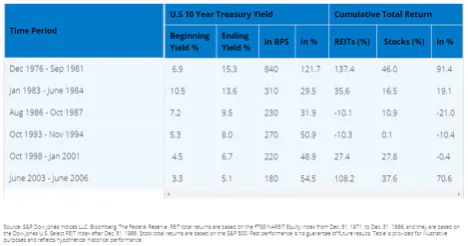
There is no question that 2022 has kicked off what seems to be the most aggressive rate hiking cycle in the last 4 decades. Equities and Bonds have been impacted negatively by the FED’s aggressive hikes, so investors may be sceptical of Bond Proxies outperforming. But what do historical metrics say about the performance of REITs during periods of aggressive interest hikes?
As it turns out, over the last 4 decades we have had 6 distinct periods of rate hike cycles, and in 3 of those 6 instances, REITs have outperformed stocks by a large margin, while in the 1998-2001 period REITs only slightly underperformed.
What makes REITs attractive as fixed income investments is that there is inherent inflation protection that comes through the increase in rents on the underlying properties. Given that most leases contain a contractual right to increase the rent by the amount of inflation each year, REITs have a built-in mechanism to withstand long periods of inflation.
On the interest rate risk front, while there is some merit to the idea that REITs too would suffer if the interest rate on their mortgages increased, it is important to note that being professionally managed entities, they spread out their loans and debt obligations over long periods of times, with fixed interest rates, which significantly mitigates the impact of interest rates on their own debt expenses.
In conclusion, investors interested in diversifying their sources of fixed income and adding an element of inflation protection over the long term could consider adding Real Estate to their portfolio in the form of liquid, exchange-traded funds (ETFs). These REIT ETFs often provide yields between 3-5%, while also providing the possibility for capital appreciation through their equity-like features.
More articles


About Trackinsight
Since our founding in 2016, we have been at the forefront of the industry, delivering accessible, comprehensive, and reliable tools to support the evolving needs of investors.
Over the past decade, Trackinsight has expanded its operations across six countries, serving thousands of professional investors. We’ve consistently innovated to provide cutting-edge solutions that meet the changing demands of the ETF market.
In 2024, Kepler Cheuvreux, a leading independent European financial services firm, acquired a majority stake in Trackinsight, becoming the company's principal shareholder.
This strategic partnership solidifies Trackinsight's position as a premier provider of ETF selection and analysis tools, while strengthening Kepler Cheuvreux’s commitment to becoming a leading player in the ETF sector.
Together, we are committed to offering advanced services that empower professional investors, advisors, institutions, and issuers. This new step enables us to deliver even more comprehensive and innovative technological solutions, driving ETF investing to new heights.
More about TrackinsightETF TOOLS
PLATFORM
ETF NEWS & RESEARCH
Privacy policy | Cookie policy | | Terms of use | Imprint