Global ETF Survey 2026: Answer now →
Help us improve your experience. Please confirm your investor type:
The Ultimate ETF Comparison Tool - Try Now!
Analyze up to 5 ETFs side-by-side and gain instant insights on performance, fees, holdings, and more to make data-driven investment decisions.
A comparison of Preferred Share ETFs and Corporate Bond ETFs
As dividend equities continue their downward trajectory in the face of higher interest rates, preferred share ETFs can offer a higher yield and more protection to investors, in case of financial troubles for the underlying companies.


By Daniel Chivu
December 28, 2022
Advertisement
Preferred shares are a form of corporate equity that enable investors to earn dividends, similar to stock dividends, but at a set rate of return. The dividend yields on preferred shares typically range from 5% to 8%. Due to their set rates of return, preferred shares are often considered a hybrid between fixed income and common equity investments - whose dividend payments can be stopped at any time if the Board of directors believe it to be prudent.
This was most recently experienced in 2020 when companies elected to conserve cash in the face of the uncertainty created by the global pandemic, reducing dividends paid out or stopping them entirely.
📊 Share your ETF outlook
From AI infrastructure to active strategies, the ETF landscape is shifting. Share your perspective in the 7th Annual Global ETF Survey and get exclusive early access to the final report.
Preferred shares, on the other hand, have a set dividend which cannot be retracted (although it can be delayed), as they rank higher up in the corporate structure than common shares and so exhibit characteristics usually associated with corporate bonds.
The most common types of preferred stocks are 'cumulative preferred’ and ‘participating preferred’ shares.
With cumulative preferred shares, holders are not granted any voting rights but they are promised a set dividend payment, including any dividends that were omitted in the past. These shareholders must be made whole before common shareholders can receive any dividends.
Participating Preferred Shares are similar, in that they contain a provision for a certain dividend amount, but they are also eligible for a special dividend provided that certain corporate metrics are met.
For this reason, preferred shareholders were less affected by the temporary pause in dividends over the 2020-2021 period, and continued to collect their fixed payments, while also benefiting from capital gains as interest rates collapsed.
The image below compares a Preferred Share index with a High Dividend Index over a period of 3 years, where we can see a clear pattern of relative outperformance in preferred shares vs. high dividend stocks until early 2022.
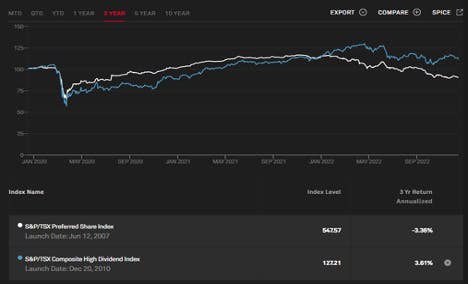
We can also notice that the outperformance stopped in early 2022, coinciding with the rise of inflation and subsequent interest rate hikes which have continued until today. This relationship makes perfect sense from a fundamental standpoint, as preferred shares have a fixed dividend amount (reminiscent of a bond coupon), which becomes less and less attractive as risk-free treasury yields increase. This (along with other factors) would explain the sudden change in trend of the Preferred Share Index, relative to the High Dividend Index which would exhibit positive dividend growth over a longer period of time, and be reflected in the price.
Advertisement
Comparing Preferred Shares to Investment Grade Corporate Bonds
Although preferred shares are higher up in the corporate structure than common equity, they rank lower than corporate bonds, which would get priority in the event of a default or bankruptcy.
Investment grade corporate bonds pay interest in the range of 3.5 – 6%, although they can go up to 9% depending on their credit rating. The yields are similar to the dividends paid out on preferred shares, however, investment grade bonds exhibit lower risk attributed to their more favourable position in the corporate structure, and the return of principal upon maturity, which is not guaranteed in the case of a preferred share. The return of principal, in particular, would have a positive effect on the total return of an associated ETF over a longer period of time.
As a consequence, we would expect an Investment Grade Bond index to outperform a preferred shares index over long periods of time, as they exhibit similar yields with less associated risk. This can be seen in the relative historical performance of ETFs tracking preferred shares, investment grade bonds and high dividend equities over the medium to long term:
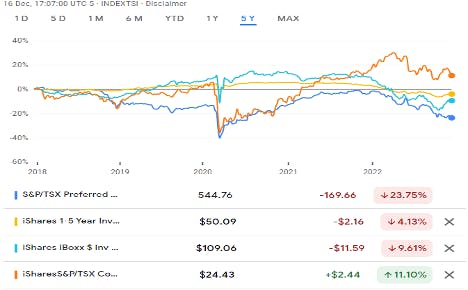
As we can see above, the Preferred Share Index ETF is by far the worst performer over a 5-year period of time when compared to Corporate Bonds and High Dividend ETFs (represented in orange).
Preferred Shares or Corporate bonds?
In conclusion, preferred shares and the associated dividend yields offer investors reliable income with the potential for preferential tax treatment, in certain jurisdictions that offer dividend income tax credits.
Investment grade bonds on the other hand provide similar yields with a higher ranking in the corporate structure, and return of capital upon maturity, which can be reinvested for compound purposes. Corporate bonds give those looking for longer-term returns the chance to collect periodic payments with additional interest along with minimal risk of defaulting on their investment.
Regardless of your investment goals, it is important to research all available options before deciding on which type of security best suits your needs.
Using the Trackinsight ETF Screener, investors can search and compare preferred share and corporate bond ETFs, such as the ones covered above:
- iShares S&P/TSX Canadian Preferred Share ETF
- iShares 1-5 Year Investment Grade Corporate Bd ETF
- iShares iBoxx $ Inv Grade Corporate Bond ETF
- iSharesS&P/TSX Composite High Div Idx ETF
Please note this article is for information purposes only and does not in any way constitute investment advice. It is essential that you seek advice from a registered financial professional prior to making any investment decision.
More articles


About Trackinsight
Since our founding in 2016, we have been at the forefront of the industry, delivering accessible, comprehensive, and reliable tools to support the evolving needs of investors.
Over the past decade, Trackinsight has expanded its operations across six countries, serving thousands of professional investors. We’ve consistently innovated to provide cutting-edge solutions that meet the changing demands of the ETF market.
In 2024, Kepler Cheuvreux, a leading independent European financial services firm, acquired a majority stake in Trackinsight, becoming the company's principal shareholder.
This strategic partnership solidifies Trackinsight's position as a premier provider of ETF selection and analysis tools, while strengthening Kepler Cheuvreux’s commitment to becoming a leading player in the ETF sector.
Together, we are committed to offering advanced services that empower professional investors, advisors, institutions, and issuers. This new step enables us to deliver even more comprehensive and innovative technological solutions, driving ETF investing to new heights.
More about TrackinsightETF TOOLS
PLATFORM
ETF NEWS & RESEARCH
Privacy policy | Cookie policy | | Terms of use | Imprint