Trackinsight is part of ETF One, the fully integrated ETF platform of Kepler Cheuvreux. Learn more →
Help us improve your experience. Please confirm your investor type:
Don’t Miss a Move in the ETF Market
Sign up and keep track of everything that moved the ETF industry this week. From new launches to regulatory shifts across the Atlantic.

The Hydrogen Economy: Creating the fuel of the future
The "Hydrogen economy" is an economy that relies on hydrogen as the commercial fuel that would deliver a portion of a nation’s energy requirements.


By Rony Abboud
November 3, 2021
- Energy
Advertisement
Hydrogen is the most abundant element, making up 90% of all the atoms in the known universe. It is a clean fuel, releasing water and heat when burned, and only water when consumed in a fuel cell. Light gas can be produced from a variety of domestic resources and can be used as a fuel option for electricity generation and transportation applications. The prospects of using Hydrogen as the fuel of the future created what we call today, the Hydrogen Economy.
What is the Hydrogen Economy?
Simply put, the "Hydrogen economy" is an economy that relies on hydrogen as the commercial fuel that would deliver a significant portion of a nation’s energy requirements. The term originates from a talk given by John Bockris at the General Motors (GM) technical center in 1970, envisioning a future where hydrogen can be produced from domestic energy sources in an economical and environmental manner, to replace polluting fossil fuels.
📊 Share your ETF outlook
From AI infrastructure to active strategies, the ETF landscape is shifting. Share your perspective in the 7th Annual Global ETF Survey and get exclusive early access to the final report.
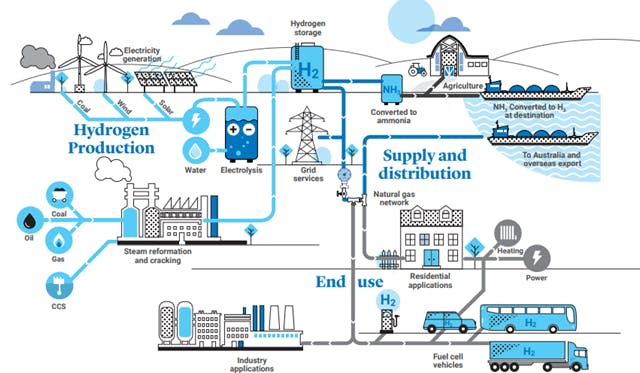
The Hydrogen Economy: Current and Future Markets
According to research firm Frost & Sullivan, global dedicated hydrogen production is estimated to rise from its current 71 million tonnes to 168 million by 2030. Revenue generation within the market is expected to increase from $177.3 billion in 2020 to $420 billion in 2030.
The IEA Future of Hydrogen report highlights multiple current and future applications in various industries including:
A- Oil Refining
- Current Demand: Used primarily to remove impurities from crude oil and upgrade heavier crude. Used in smaller volumes for oil sands and biofuels.
- 2030 Demand: 7% increase boosted by tighter pollutant regulations.
B- Chemical production:
- Current Demand: Used in ammonia and methanol production and several other smaller-scale chemical processes.
- 2030 Demand: 31% increase under existing policies for ammonia and methanol due to economic and population growth.
C- Iron and steel production:
- Current Demand: 7% of primary steel production takes place via the direct reduction of iron (DRI) route, which requires hydrogen.
- 2030 Demand: Doubling under existing policies as the DRI route is used more relative to the currently dominant blast furnace route.
D- High-Temperature Heat:
- Current Demand: Currently no dedicated hydrogen production for heat generations.
- 2030 Demand: 9% increase in high-temperature heat demand under existing policies.
E- Cars & Vans:
- Current Demand: 11,200 (2019) vehicles in operations mostly in California, Europe and Japan
- Demand Perspective: The global car stock is expected to grow, and hydrogen could capture a part of this market.
F- Trucks and Buses:
- Current Demand: Mostly demonstration and niche markets (25,000+ forklifts, 500+ buses, 400+ trucks, 100+ vans).
- Demand Perspective: Strong growth segment, long-haul and heavy-duty applications are attractive for hydrogen
G- Maritime
- Current Demand: Limited to demonstration projects for small ships and on-board power supply in larger vessels
- Demand Perspective: Maritime freight activity is set to grow by around 45% to 2030. 2050 greenhouse gas targets could promote hydrogen-based fuels.
H- Rail
- Current Demand: A few hydrogen trains in Germany.
- Demand Perspective: Rail is a mainstay of transport in many countries
I- Aviation
- Current Demand: Limited to small demonstration projects and feasibility studies.
- Demand Perspective: Fastest-growing passenger transport mode. Large storage volume and redesign would be needed for pure hydrogen, making power-to-liquid and biofuels more attractive for this model.
Is Hydrogen Green?
To determine the cleanliness of hydrogen, it is important to trace where it comes from. Currently, hydrogen is mainly produced industrially from natural gas (75%), which generates significant carbon emissions. That type is known as “grey hydrogen”.
"Brown hydrogen" comes from coal using gasification, accounting for an estimated 23% of global dedicated hydrogen production due to coal's dominant role in China.
A cleaner version is “blue hydrogen”, for which the carbon emissions are captured and stored, or reused.
The cleanest and least common one of all is “green hydrogen”, which is generated by renewable energy sources without producing carbon emissions in the first place. The electricity generated would be used to split water into hydrogen and oxygen, in a process called electrolysis.
Click here to know more about the different hydrogen production techniques.
The high dependence on natural gas and coal means that hydrogen production today generates significant CO2 emissions, with estimates of 830 MtCO2/year, roughly equal to the combined CO2 emissions of the United Kingdom and Indonesia.
Advertisement
Getting on board with the hydrogen economy
The ongoing and future investments in the hydrogen economy make the industry a potentially lucrative target for many investors to prey on. Out there, are many publicly listed companies involved in the hydrogen economy to choose from, including:
- Bloom Energy (BE): Manufactures and markets solid oxide fuel cells that produce electricity on-site.
- Ballard Power Systems (BLDP): Manufactures proton exchange membrane fuel cell products for markets such as heavy-duty motive, portable power, material handling as well as engineering services.
- Plug Power (PLUG): Manufacturer of hydrogen fuel cell systems.
- FuelCell Energy (FUEL): Designs, manufactures, operates and services Direct Fuel Cell power plants.
- Cummins Inc. (CMI): Specializes in diesel and alternative fuel engines and generators, and related components and technology.
- ITM Power PLC (ITM): Manufacturer of polymer electrolyte membrane electrolyzers for hydrogen production.
- Nel Hydrogen (NLLSF): Production, storage and distribution of hydrogen.
- Ceres Power Holdings PLC (CWR): Development and commercialization of fuel cell technology.
- Kolon Industries: Manufacturer of hydrogen fuel cell membrane humidifiers.
- Nippon Sanso: Industrial gas supplier.
- Doosan Fuel Cell: Fuel cell manufacturer.
- Advent Technologies: Develops, manufactures, and assembles complete fuel cell systems.
- Hydrogen Refueling Solutions: Manufactures hydrogen refueling stations for all types of vehicles, light and heavy fleets, for the mobility, industrial activities, storage, and energy markets.
- HydrogenPro AS: Designs, supplies, and installs hydrogen plants.
And the list goes on…So, how do you pick the best hydrogen stock? Well, you don't have to. The markets have been blessed with ETFs that provide a broad exposure to sectors, industries, countries, and themes, including the Hydrogen economy.
Investing through Hydrogen ETFs
Trackinsight data reveals 6 Hydrogen ETFs, all launched in 2021 and have attracted more than $720 million in inflows. We have ranked each ETF by size (as of November 2nd, 2021).
- L&G Hydrogen Economy UCITS ETF: $575.5 million
- VanEck Vectors Hydrogen Economy UCITS ETF: $81.6 million
- The Defiance Next Gen Hydrogen ETF: $69.1 million
- ETFS Hydrogen ETF: $47.4 million
- Global X Hydrogen ETF: $22.6 million
- Horizons Global Hydrogen Index ETF: $2.6 million
L&G Hydrogen Economy UCITS ETF (HTWO)
L&G Hydrogen Economy UCITS ETF (HTWO) is the first and biggest hydrogen ETF in the market with over $575 million in assets under management. The fund invests in companies within the hydrogen economy, involved in energy input, production, transport, storage, and end-use.
The fund's 32 holdings are well diversified across countries (United States 23.1%, United Kingdom 16.9%, Germany 12.7%, South Korea 10.8%, Japan 10.4%, other 26.1%) and sectors (Industrials 57.6%, Materials 22.7%, Consumer Discretionary 9.8%, Utilities 6.9% and Information technology 2.9%). Its top 10 constituents include Plug Power (5%), Kolon Industries (4.1%), Bloom Energy (3.9%), Nippon Sanso (3.9%), Doosan fuel cell (3.8%), ITM Power (3.8%) and Uniper (3.7%).
Since its inception on February 10th, 2021, HTWO generated a loss of over -16% which, however, is significantly less than some pure hydrogen players' decline in stock price ever since. But October was a different story, with more than 10% increase in the fund's price on the London Stock Exchange, amid resurging interest in clean energy ahead of the COP26 summit.
It is also worth noting that the underlying index, the Solactive Hydrogen Economy Index NTR was launched on the 15th of December 2020 and has returned +21.45% in USD terms as of 29th of October 2021. This better represents the long-term potential of investing in a well-diversified portfolio like HTWO, shielding investors from excessive concentration in pure hydrogen players.
Advertisement
HTWO also trades on the Borsa Italiana, Deutsche Börse, and SIX Swiss Exchange, charging an expense ratio of 0.49%.
Keep reading:
- Top ESG ETFs of October 2021
- Best ETFs of October 2021
- What are Blockchain Games?
- A good week for the bulls
INTERESTED IN SEEING LISTS OF TOP PERFORMING ETFS? CHECK OUT OUR NEW INVESTING GUIDES:
- Investing in Gold ETFs
- Investing in Silver ETFs
- Investing in Commodity ETFs
- Investing in Oil ETFs
- Investing in ESG ETFs
FIND AND COMPARE OVER 7,000 ETFS WITH OUR FREE TOOLS:
More articles


About Trackinsight
Since our founding in 2016, we have been at the forefront of the industry, delivering accessible, comprehensive, and reliable tools to support the evolving needs of investors.
Over the past decade, Trackinsight has expanded its operations across six countries, serving thousands of professional investors. We’ve consistently innovated to provide cutting-edge solutions that meet the changing demands of the ETF market.
In 2024, Kepler Cheuvreux, a leading independent European financial services firm, acquired a majority stake in Trackinsight, becoming the company's principal shareholder.
This strategic partnership solidifies Trackinsight's position as a premier provider of ETF selection and analysis tools, while strengthening Kepler Cheuvreux’s commitment to becoming a leading player in the ETF sector.
Together, we are committed to offering advanced services that empower professional investors, advisors, institutions, and issuers. This new step enables us to deliver even more comprehensive and innovative technological solutions, driving ETF investing to new heights.
More about TrackinsightETF TOOLS
PLATFORM
ETF NEWS & RESEARCH
Privacy policy | Cookie policy | | Terms of use | Imprint