Trackinsight Enterprise, a unified platform for institutional ETF research, analytics, and compliance, is now live. Explore Trackinsight Enterprise →
Help us improve your experience. Please confirm your investor type:
Don’t Miss a Move in the ETF Market
Sign up and keep track of everything that moved the ETF industry this week. From new launches to regulatory shifts across the Atlantic.

Active ETFs: Not a magic bullet
Beating the market is ultimate gratification active asset managers can get. Here we look at the Active ETFs and how they fared over the last few years.


By Rony Abboud
January 25, 2022
- Active
Advertisement
Beating the market is the ultimate gratification active asset managers can get. Despite the allure of this style of management, end results tend to be disappointing. In this article, we look at the Active ETFs landscape and how they fared over the last few years.
Active management failure continues
The premise that a blend of knowledge, skills, and talent in portfolio management can deliver consistently higher gains than the market or their respective benchmarks has been questioned for decades. While there's solid ground for that claim, data compiled by the S&P Down Jones Indices, have shown otherwise.
📊 Share your ETF outlook
From AI infrastructure to active strategies, the ETF landscape is shifting. Share your perspective in the 7th Annual Global ETF Survey and get exclusive early access to the final report.
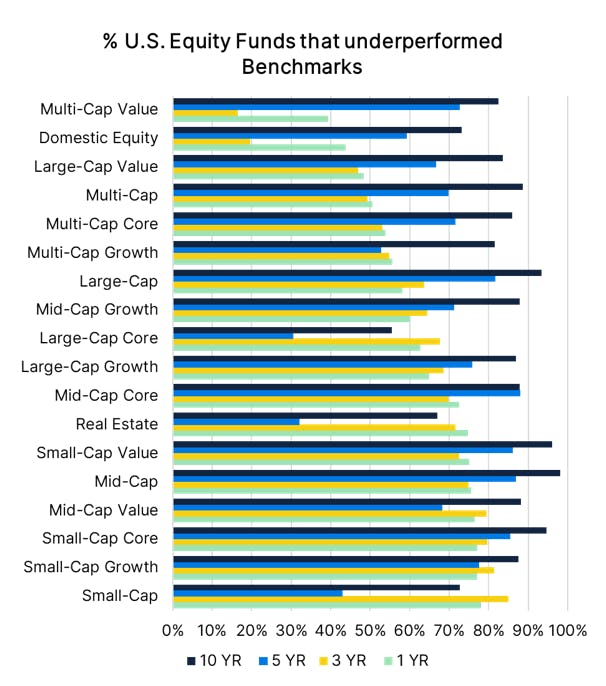
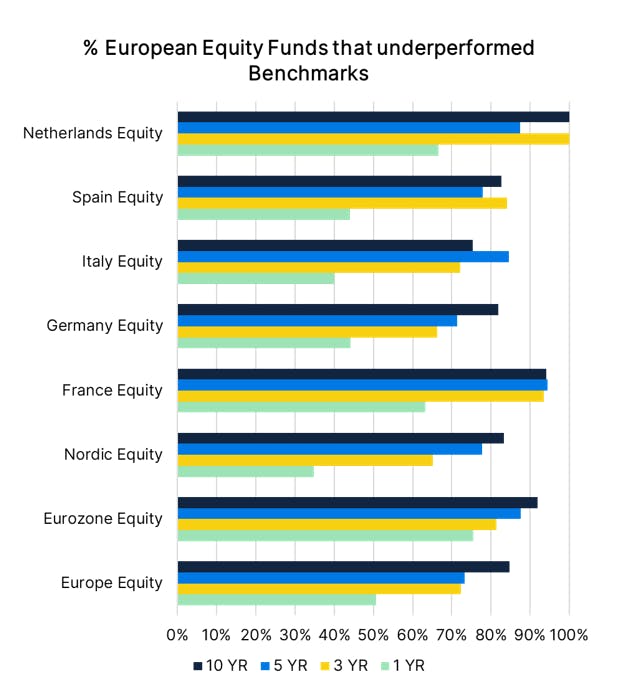
The semi-annual SPIVA research publication by S&P DJI compares actively managed mutual funds against their appropriate benchmarks. The research covers funds in Australia, Canada, Europe, India, Japan, Latin America, the Middle East, South Africa, and the United States.
Based on June 30th, 2021 SPIVA data, actively managed funds failed to take investors to the promised land after underperforming their benchmarks. For example, 58%, 67%, 73%, and 82% of Large-Cap U.S. Equity funds have failed to outperform the S&P 500 over 1YR, 3YR, 5YR, and 10YR periods respectively.
In Europe, Eurozone Equity Funds have also underperformed their respective benchmarks over the same periods. It is evident from the graphs below, that active management, for the most part, underperforms, regardless of their regional exposure, strategy, and holding's market capitalization size.
Active ETFs: a better failure medium?
Overview on Active ETFs
ETFs are predominantly associated with passive investing strategies. These funds track a wide variety of indices, provide diversification, and a high degree of transparency for the investors.
In 2008, active management strategies snuck into the world of ETFs when the U.S. Securities and Exchange Commission (SEC) authorized the creation of actively managed ETFs. The now-defunct Bear Stearns launched the first active ETF, the Current Yield ETF, on March 25, 2008, months before collapsing during the infamous 2008 Financial Crisis.
While both active mutual funds and active ETFs strive to their benchmarks through smart bets — active ETFs provide all the benefits of the ETF wrapper - lower costs, tax efficiency, intraday liquidity, and greater transparency. Over the past decade, active ETFs have poached investors from the traditional "2 and 20" active mutual funds and hedge funds and became popular mediums for the quest for alpha.
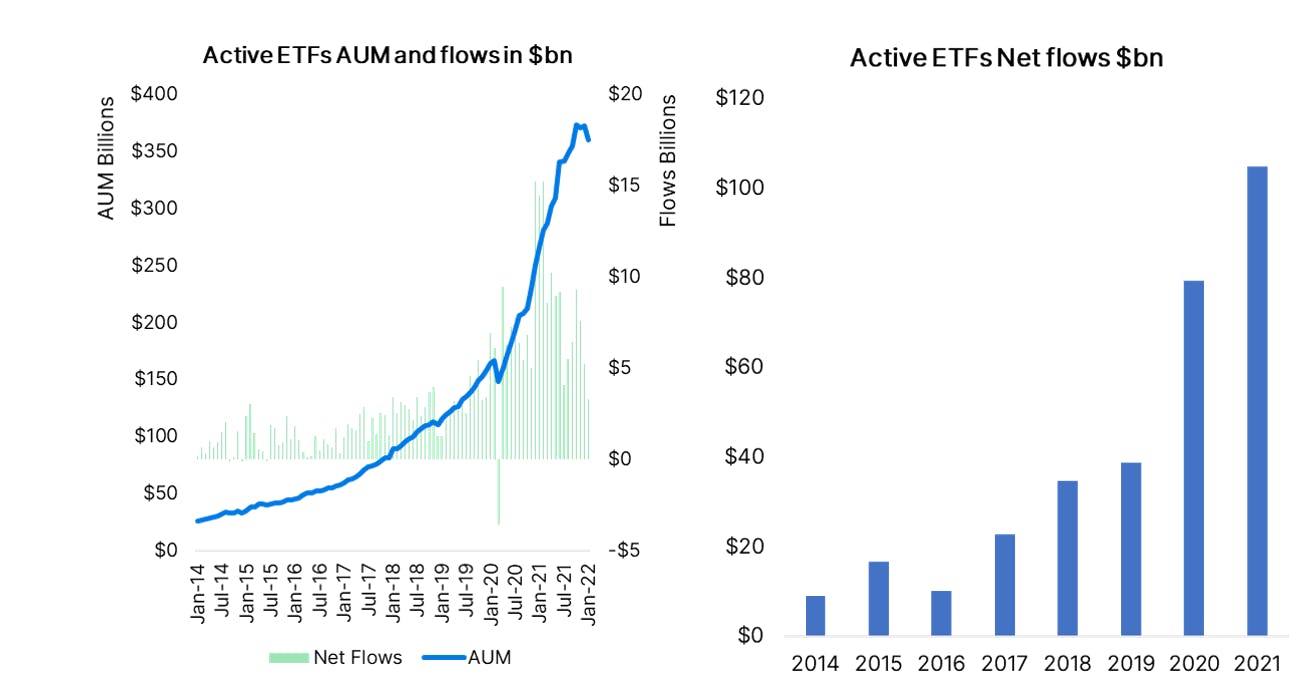
Today, over 1,400 Active ETFs exist worldwide with a combined $370 billion in assets under management (AuM), up from 208 Active ETFs with just $33 billion in AuM in 2014.
While passively managed ETFs still vastly outnumber actively managed ETFs, investors' interest in active ETFs has driven major growth in the category.
Advertisement
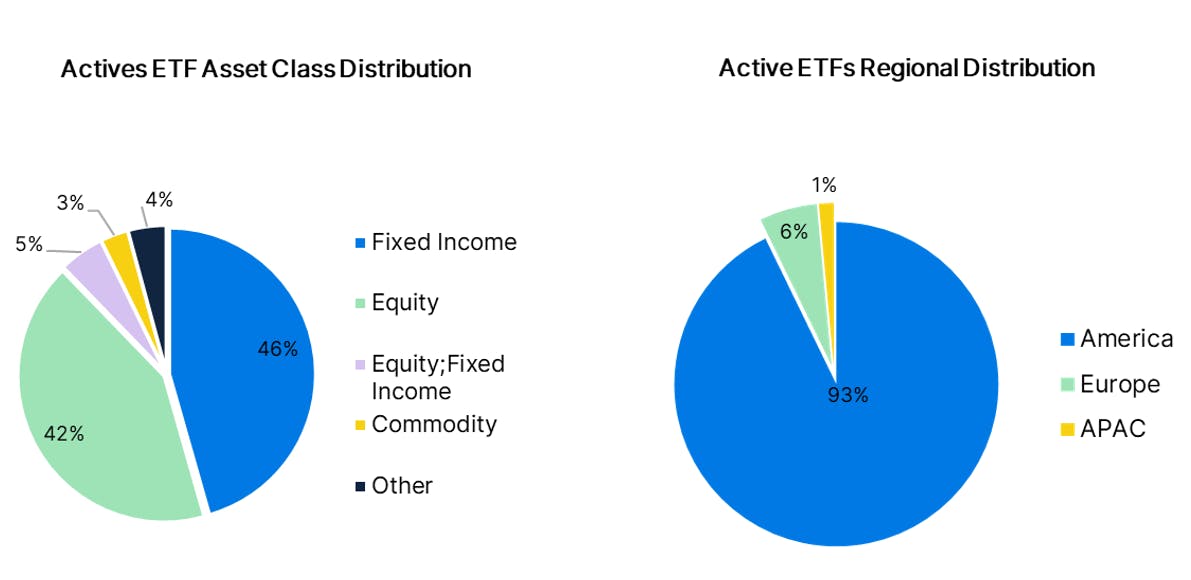
In terms of asset class distribution, around 45% of Active ETFs AuM are fixed income (350+ ETFs), 42% equities (950+ ETFs), 5% mixed and 3% commodities. As for regional AuM distribution, America holds 93% of the total Active ETFs AuM, while Europe (6%) and APAC (1%) share the rest.
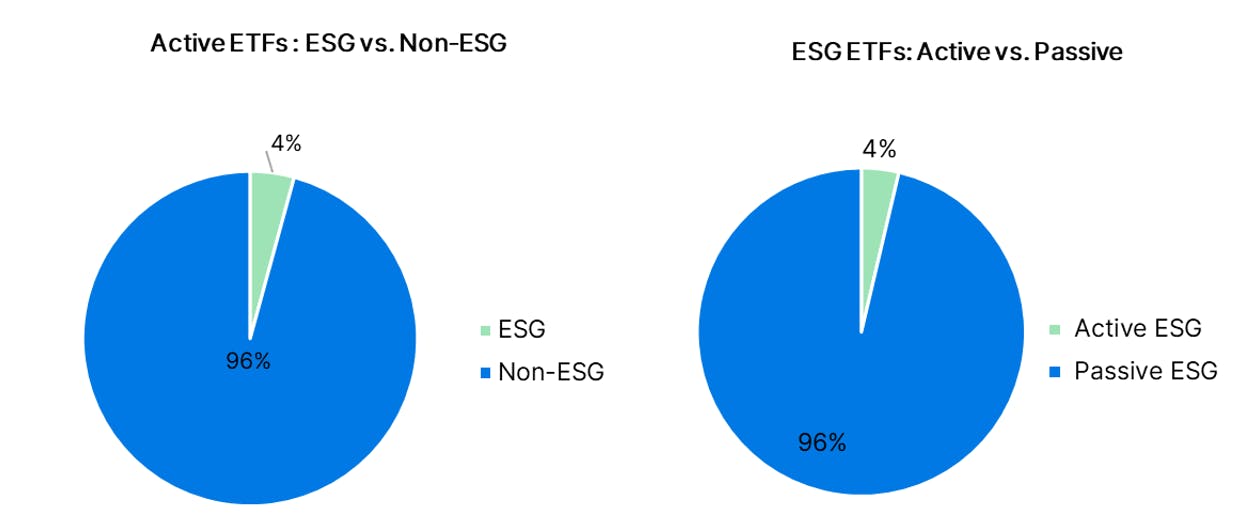
On the sustainability side, active Environmental, Social, and Governance (ESG) ETFs account for only 4% of the total active ETFs AuM ($370 billion) and 4% of total ESG ETFs AuM ($427 billion).
Rise of Active ETFs
Behind the rapid expansion in 2020 is a pile of saved-up cash as investors chase an economic recovery from the global pandemic. The spurt of enthusiasm toward the active style came after investors witnessed the success of Cathie Wood's actively managed ARK ETFs. The line-up, which includes ARK Innovation ETF (ARKK), ARK Genomic Revolution ETF (ARKG), ARK Next Generation Internet ETF (ARKW), ARK Fintech Innovation ETF (ARKF), and ARK Autonomous Technology & Robotics ETF (ARKQ) generated +152%, +180%, +159%, +108%, and +107% respectively in 2020.
The hype around Wood's fleet brought in over $20.5 billion into her funds in 2020, a quarter of the total net inflows pumped into Active ETFs that year. The popularity of active ETFs expanded, prompting other ETF issuers to capitalize on ARK's glorious run.
In 2021, 30% of the global ETF launched adopted an active approach, and along with pre-existing ones — received over $105 billion of new assets: 9% of all net flows pumped into ETFs over the year.
While Active ETFs certainly have their perks, performance remains the end game. As shown by SPIVA data, mutual funds with active management strategies failed to beat their benchmarks. So, have active ETFs done any better?
Did the hype pay off in 2021?
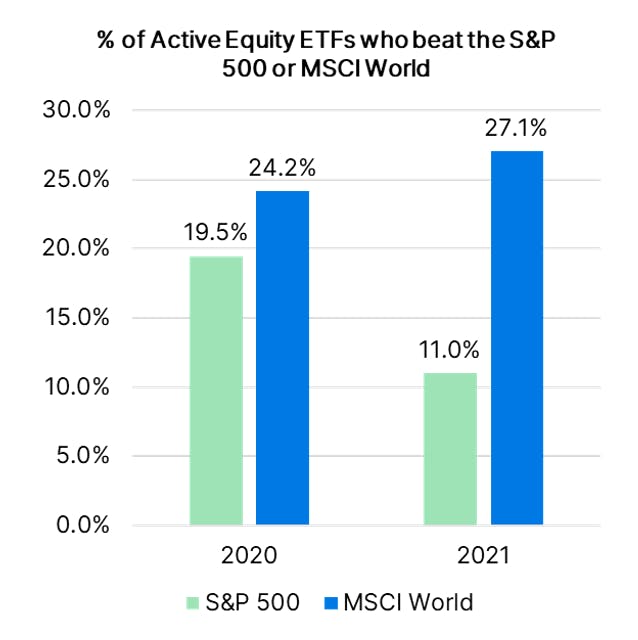
To answer that question, we've analyzed the 2021 returns of Active Equity ETFs vs. their prospectus benchmarks or other comparable benchmarks. According to our findings, 51% of the top 100 largest active equity ETFs beat their benchmarks in 2021. Meanwhile, only 27% of the total active equity ETFs universe beat the MSCI World (+21.82% NRR), and a meager 11% beat the S&P 500 (+28.16% NTR). The year before wasn't that much prettier, with just 27% of active equity ETFs beating the MSCI World (+15.9% NTR) and 21% — the S&P 500 (+17.75% NTR).
Advertisement
While this is just a two-year sample, the first impression aligns with SPIVA findings. Active management, regardless of its packaging (Mutual Funds vs. ETFs) — has a hard time keeping up with the broader market.
Despite the lackluster performance, active ETFs are bringing new opportunities for investors to access active strategies with the convenience of the ETF wrapper. They have also been a huge positive for asset managers who want to leverage the disruptive distribution potential of ETFs to build their business and reach new investors.
However, investors should keep in mind that ETFs are not a magic bullet that can guarantee performance and should always perform thorough due diligence on any active ETF strategy to understand if it is the right fit for their portfolio.
KEEP READING:
FIND AND COMPARE OVER 7,000 ETFS WITH OUR FREE TOOLS:
INTERESTED IN TOP ETF LISTS? CHECK OUT OUR INVESTING GUIDES:
- Investing in Gold ETFs
- Investing in Silver ETFs
- Investing in Commodity ETFs
- Investing in Oil ETFs
- Investing in ESG ETFs
More articles


About Trackinsight
Since our founding in 2016, we have been at the forefront of the industry, delivering accessible, comprehensive, and reliable tools to support the evolving needs of investors.
Over the past decade, Trackinsight has expanded its operations across six countries, serving thousands of professional investors. We’ve consistently innovated to provide cutting-edge solutions that meet the changing demands of the ETF market.
In 2024, Kepler Cheuvreux, a leading independent European financial services firm, acquired a majority stake in Trackinsight, becoming the company's principal shareholder.
This strategic partnership solidifies Trackinsight's position as a premier provider of ETF selection and analysis tools, while strengthening Kepler Cheuvreux’s commitment to becoming a leading player in the ETF sector.
Together, we are committed to offering advanced services that empower professional investors, advisors, institutions, and issuers. This new step enables us to deliver even more comprehensive and innovative technological solutions, driving ETF investing to new heights.
More about TrackinsightETF TOOLS
PLATFORM
ETF NEWS & RESEARCH
Privacy policy | Cookie policy | | Terms of use | Imprint