Global ETF Survey 2026: Answer now →
Help us improve your experience. Please confirm your investor type:
The Ultimate ETF Comparison Tool - Try Now!
Analyze up to 5 ETFs side-by-side and gain instant insights on performance, fees, holdings, and more to make data-driven investment decisions.
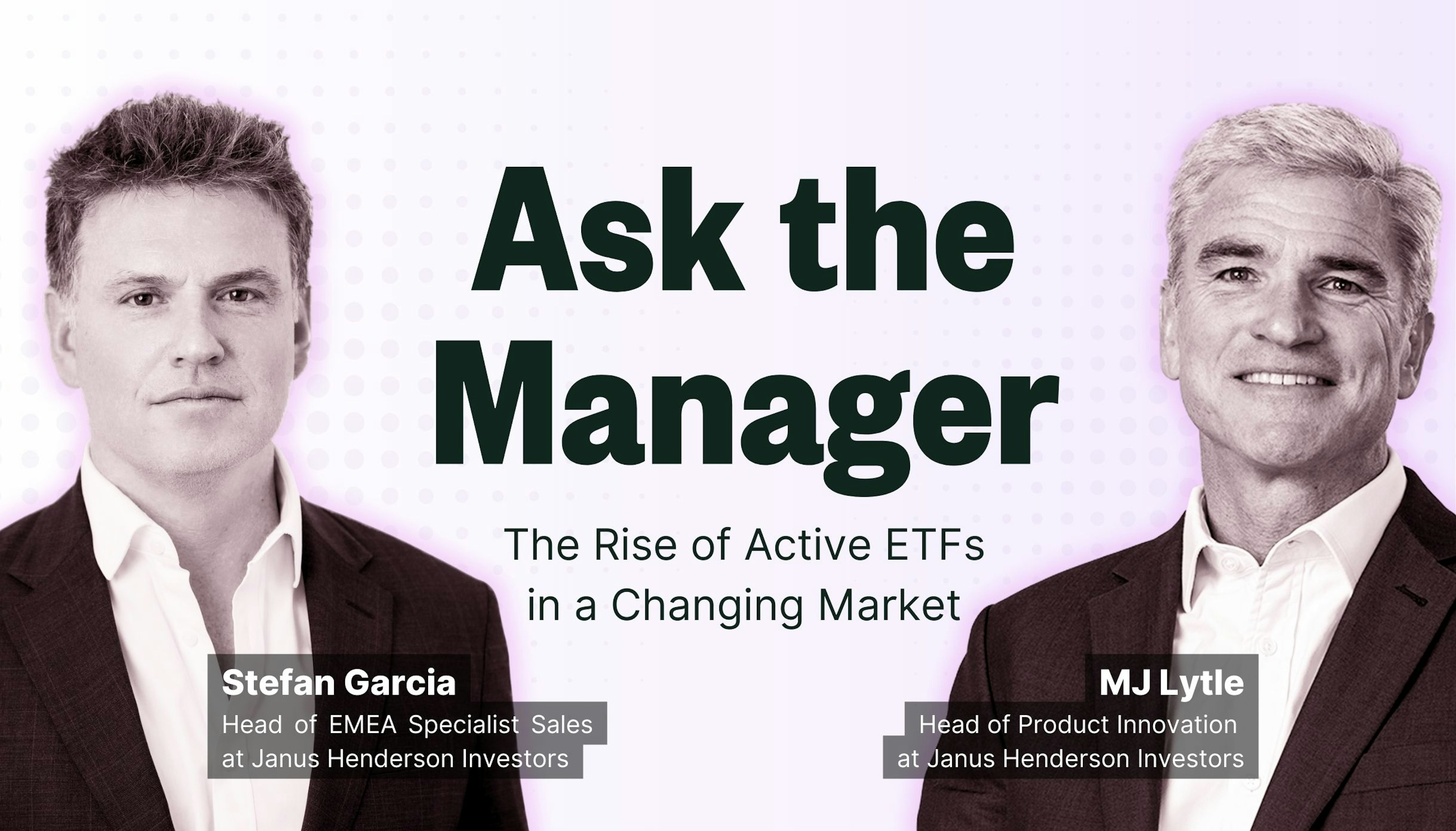
Ask the Manager: The Rise of Active ETFs in a Changing Market
Janus Henderson’s ETF leaders discuss how active ETFs are redefining access to alpha — from core allocations to complex credit exposures.

By Trackinsight
December 12, 2025
- Janus Henderson Investors
- Active
- CLOs
In this edition of Ask the Manager, Michael John (MJ) Lytle, Head of Product Innovation, and Stefan Garcia, Head of EMEA Specialist Sales at Janus Henderson, discuss how active ETFs are transforming portfolio construction. They discuss the macro environment driving the growth of ETFs, how these products differ from traditional UCITS funds, and what investors should look for when choosing an active ETF manager.
Active ETFs seem to be everywhere this year. Can you start by explaining what they are, and how they differ from traditional passive ETFs?
MJ Lytle: The ETF wrapper has long been associated with passive investing, simply because it originated within index-tracking teams. But the wrapper itself is neutral — what matters is the strategy inside. Active ETFs take the same efficient, transparent structure and fill it with an alpha-generating approach. Investors get liquidity and efficiency, but with the potential for outperformance. The key is execution: consistent performance and transparency within a trusted structure.
📊 Share your ETF outlook
From AI infrastructure to active strategies, the ETF landscape is shifting. Share your perspective in the 7th Annual Global ETF Survey and get exclusive early access to the final report.
We’ve seen remarkable growth in active ETFs, especially in Europe. What’s driving that momentum?
Stefan Garcia: The European market has expanded from roughly USD 50 billion to over 85 billion this year — that’s about 70% growth — and we see it more than doubling again in the near future. The growth is driven by accessibility and liquidity. Investors can now trade active ETFs like equities across multiple exchanges and currencies, with daily holdings visibility.
Lytle: Operationally, some investors still need to adapt — adding brokerage access or adjusting back-end systems — but the infrastructure is catching up fast. Platforms like Tradeweb and Bloomberg are making it easier to execute ETF trades electronically, which is helping accelerate adoption.
How do active ETFs compare to mutual funds — and should investors see them as substitutes or complements?
Lytle: They’re both UCITS funds and follow the same regulations, but the way investors interact with them is very different. ETFs are traded continuously in the secondary market, offering intraday liquidity and real-time pricing. Mutual funds transact once per day. So, the question isn’t passive versus active — it’s about flexibility of access.
Garcia: Exactly. Active ETFs can complement mutual fund allocations or be used tactically. They allow investors to adjust exposures quickly — say, adding credit risk or shifting duration — without waiting for end-of-day NAVs.
What role do “active core” and “high conviction” ETFs play in portfolios today?
Lytle: Both have a role. Active core strategies aim to deliver modest alpha over benchmark returns and can replace passive exposures. High conviction ETFs, on the other hand, seek significant outperformance through selective positioning.
Garcia: Fixed income is particularly well suited to this. The bond market is less transparent and more fragmented than equities, so there’s real opportunity for active managers to add value. At Janus Henderson, for instance, our active fixed-income ETFs are designed around this principle — using deep credit research and experienced portfolio management to capture inefficiencies that an index can’t.
Are there examples within your ETF range that illustrate how active management adds value?
Lytle: A good example is JCL0, our AAA EUR CLO ETF. It provides investors with access to high-quality securitised credit — a space that was previously only accessible to institutional portfolios. It’s actively managed to select and monitor the underlying CLO securities, balancing yield and risk in a way that a passive strategy simply couldn’t.
Garcia: It also shows how the ETF wrapper can open new markets to a broader investor base. Liquidity and transparency are maintained, but the underlying exposure — AAA-rated CLOs — offers a differentiated source of income, which is particularly valuable in the current rate environment.
What are the main barriers or misconceptions that still hold investors back from adopting active ETFs?
Lytle: Some of it is perception — the idea that active ETFs are fundamentally different from traditional funds. In reality they share the same regulatory safeguards and portfolio management discipline. The operational hurdle is often more practical: investors need brokerage access and trading processes in place.
Garcia: Education is key. Active ETFs require more dialogue — investors want to understand how managers are positioning portfolios or managing turnover. That’s something we focus on heavily at Janus Henderson: providing transparency and regular insight so investors can see how active decisions are driving outcomes.
Finally, what should investors look for when selecting an active ETF provider?
Garcia: Track record, scale, liquidity, and bid/offer spreads are obvious starting points. But transparency and the quality of the underlying investment process matter just as much. Investors should ask: is this manager bringing something differentiated to the ETF space?
Lytle: And just as important — has the firm truly invested in the ETF business? Supporting liquidity, market making, and capital markets infrastructure requires commitment. At Janus Henderson, we’ve built a dedicated ETF team across product design, portfolio management, and capital markets to make sure our active ETFs trade efficiently and deliver on their objectives.
Please note this article is for information purposes only and does not in any way constitute investment advice. It is essential that you seek advice from a registered financial professional prior to making any investment decision.
More articles


About Trackinsight
Since our founding in 2016, we have been at the forefront of the industry, delivering accessible, comprehensive, and reliable tools to support the evolving needs of investors.
Over the past decade, Trackinsight has expanded its operations across six countries, serving thousands of professional investors. We’ve consistently innovated to provide cutting-edge solutions that meet the changing demands of the ETF market.
In 2024, Kepler Cheuvreux, a leading independent European financial services firm, acquired a majority stake in Trackinsight, becoming the company's principal shareholder.
This strategic partnership solidifies Trackinsight's position as a premier provider of ETF selection and analysis tools, while strengthening Kepler Cheuvreux’s commitment to becoming a leading player in the ETF sector.
Together, we are committed to offering advanced services that empower professional investors, advisors, institutions, and issuers. This new step enables us to deliver even more comprehensive and innovative technological solutions, driving ETF investing to new heights.
More about TrackinsightETF TOOLS
PLATFORM
ETF NEWS & RESEARCH
Privacy policy | Cookie policy | | Terms of use | Imprint