Trackinsight is part of ETF One, the fully integrated ETF platform of Kepler Cheuvreux. Learn more →
Helfen Sie uns, Ihr Erlebnis zu verbessern: Welche Art von Investor sind Sie?
Was enthält der Bericht?
- Erkenntnisse von 600+ Investoren (1,1 Bio. $ ETF-Vermögen).
- Top-Trends: Aktives Management, Anleihen, ESG, Krypto, ETF mit Ertrags-/Optionsstrategien.
- 80+ Prognosen für 2025 von Branchenführern.
Potential US-Iran Conflict Stresses Oil Market
Rising oil prices, surging tanker rates, and market tension follow US strikes in Iran. Here’s how energy markets and equities are reacting.

Von Leverage Shares
24. Juni 2025
- Leverage Shares
- Iran
- Israel
- United States
- Oil & Gas
Werbung
The United States effectively entered the battle being waged between Israel and Iran in a full and official capacity on the 21st of June this year via Operation Midnight Hammer, wherein a number of American B-2 bombers and submarine-launched Tomahawk missiles struck Iran's Fordow Fuel Enrichment plant under the mountains of Qom, another underground enrichment facility near Natanz, and the Nuclear Technology Center (mostly Chinese-supplied reactors) near Isfahan. While the Iranian government hasn't confirmed the extent of its losses from the operation, the U.S. government has clearly stated that it won't be permitted to possess the means for developing a nuclear weapon.
With the stage set for another deadly war in the region, an immediate effect potentially on the world's economies is the region's primary export: oil.
Tanker Rates and Oil Futures
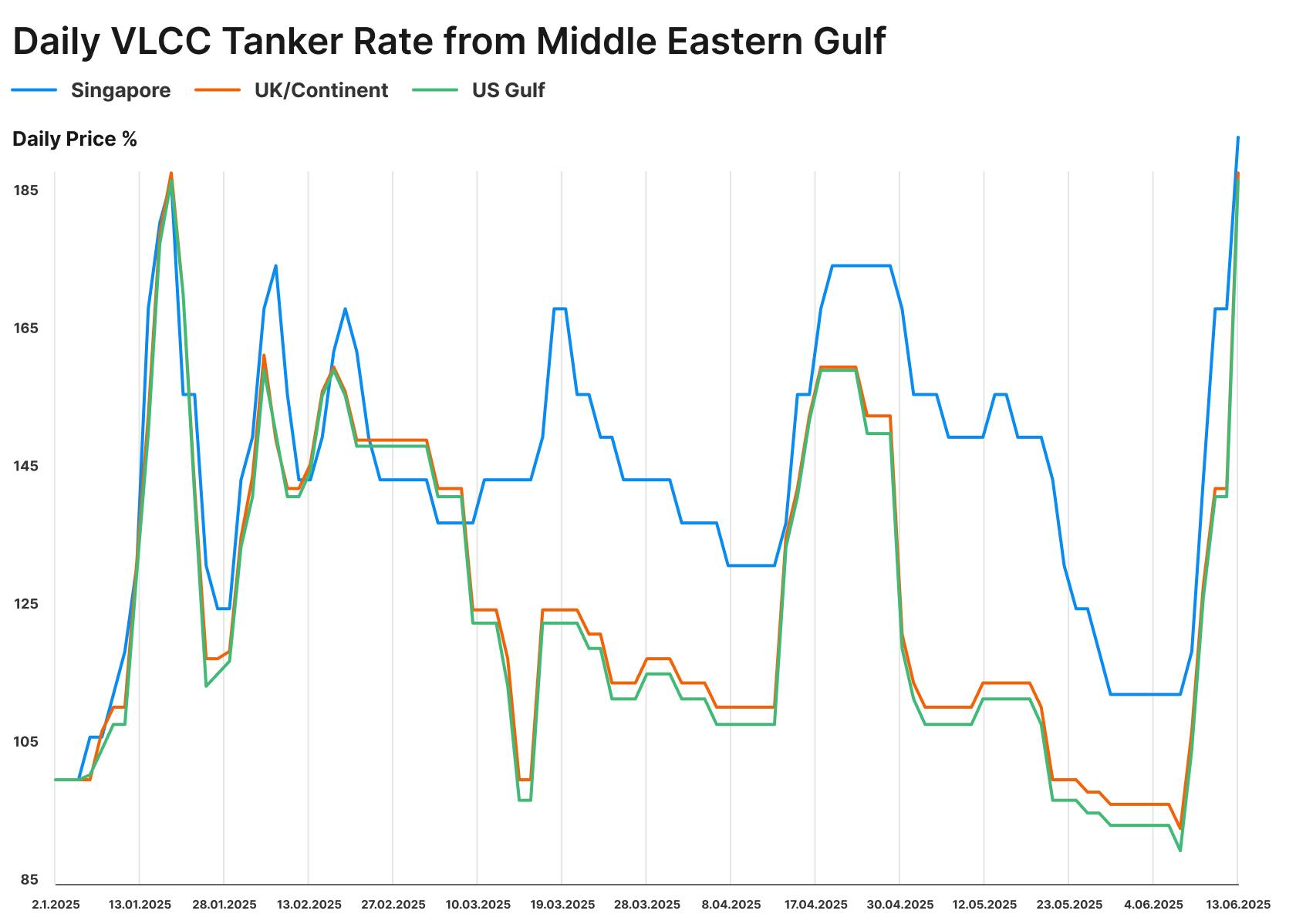
Despite ongoing tensions in the Middle East throughout the year, daily VLCC ("Very Large Crude Carrier") rates from the Middle East's Gulf regions to prime regions had largely settled by the end of May. Relative to the start of the year, VLCC rates to the United Kingdom/Europe ran flat, those to the U.S. Gulf were even down 3% while rates to Singapore were up 24% owing to an externality: port congestion.
As of the 20th of June, this rapidly changed.
Source: Leverage Shares analysis
Relative to the end of May, tanker rates as of the 20th of June rose 52% towards Singapore and a massive 83% and 88% towards U.K./Europe and the U.S. Gulf respectively. Thus, relative to the start of year, tanker rates have now grown by 88%, 83% and 82% towards Singapore, U.K./Europe and the U.S. Gulf respectively.
The primary cause of this is historical: during the Iran-Iraq War of 1980-1988, both belligerents targeted tankers in the Gulf regions, with Iran deploying Chinese and American missiles and Iraq employing mostly American and European weaponry. Over 451 tankers were hit, with the lives of hundreds of sailors from around the world lost.
In those days, the weapon of choice were anti-ship missiles while the means of tracking were more-or-less unreliable. In the present, Iran has a much larger variety of missiles and drones to choose from and a variety of sources to gather shipping data and track ship movements from. Since the U.S. operates out of major oil-exporting nations in the region such as Bahrain (which is also the headquarters for the U.S. Navy's Fifth Fleet), Qatar, Kuwait, Saudi Arabia, United Arab Emirates and Saudi Arabia, commerce from these regions could potentially be targeted via a variety of means.
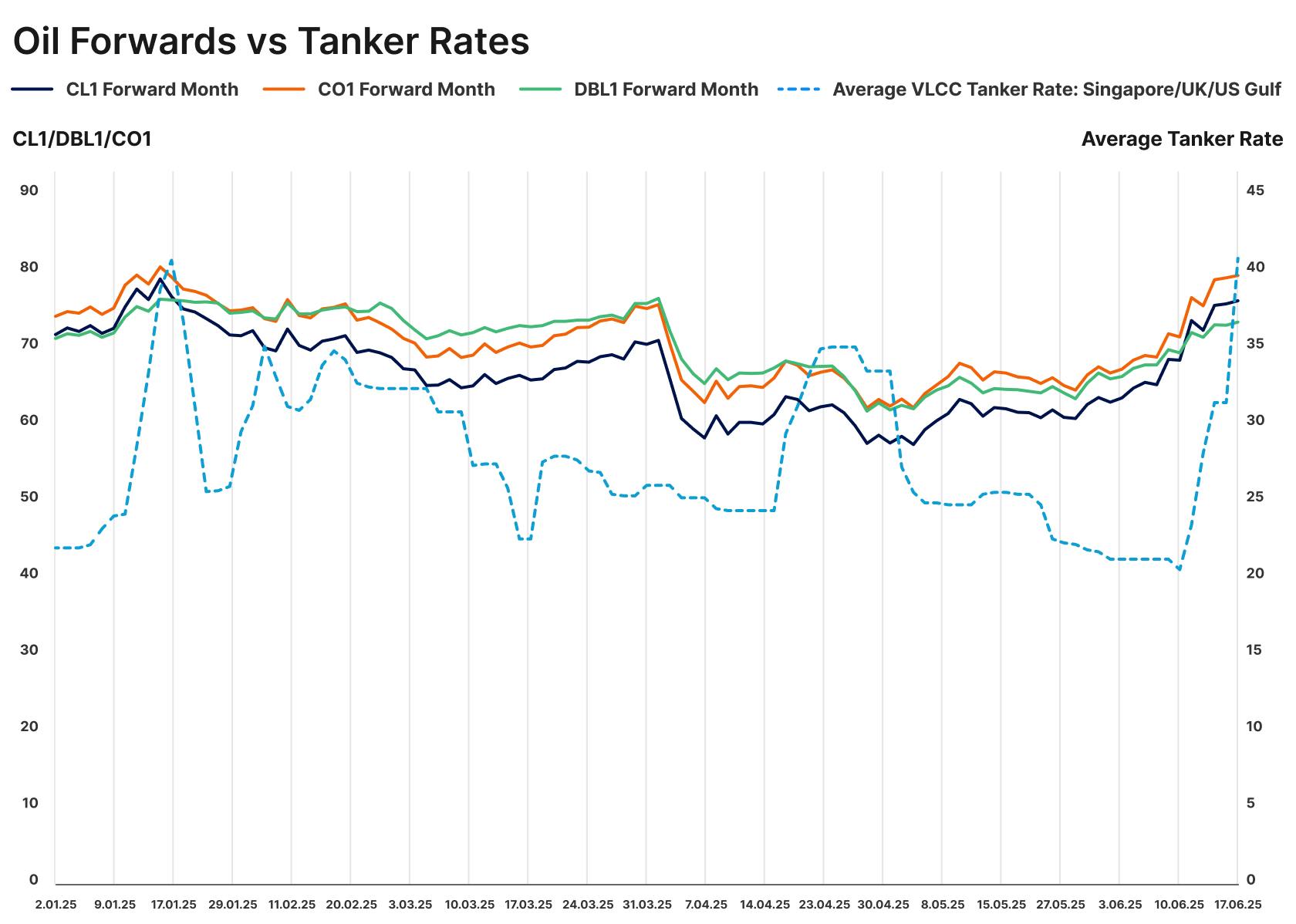
Now, American crude oil ("West Texas Intermediate" or "WTI", which is denoted as CL1 in forward contracts) tends to run a little cheaper than European Brent (denoted as "CO1" in forward contracts) while the latter is historically more sensitive to Middle East tensions and global geopolitics. Also, Dubai crude oil, which represents the region's prices that are primarily bought up by Asia (denoted as "DBL1") is obviously even more sensitive to said tensions. The price "at the pump" is influenced by the cost of shipping as well as the cost of the crude itself across sources, the cost of refining et al. Estimating an outright (i.e. not volume-adjusted) average tanker rate for the aforementioned three destinations and juxtaposing the result across trends seen in the three dominant oil forward contracts provide an indicator for the "at the pump" price outlook across most populated regions.
Source: Leverage Shares analysis
Werbung
Through much of 2025, relatively low tanker rates helped to tamp down importer costs to an extent. Since June, both forward contracts and tanker rates are steeply upturned, thus indicating importers' costs will rise - inevitably leading to higher "at the pump" prices.
Iran's strategic allies Russia and China have been vociferous in their opposition to American actions and have been growing steadily bellicose in their warnings. While Russia remains mired in its conflict with Ukraine, China has a problem somewhat exacerbated by recent geopolitical events: precipitous deflation.
Discord Among Allies
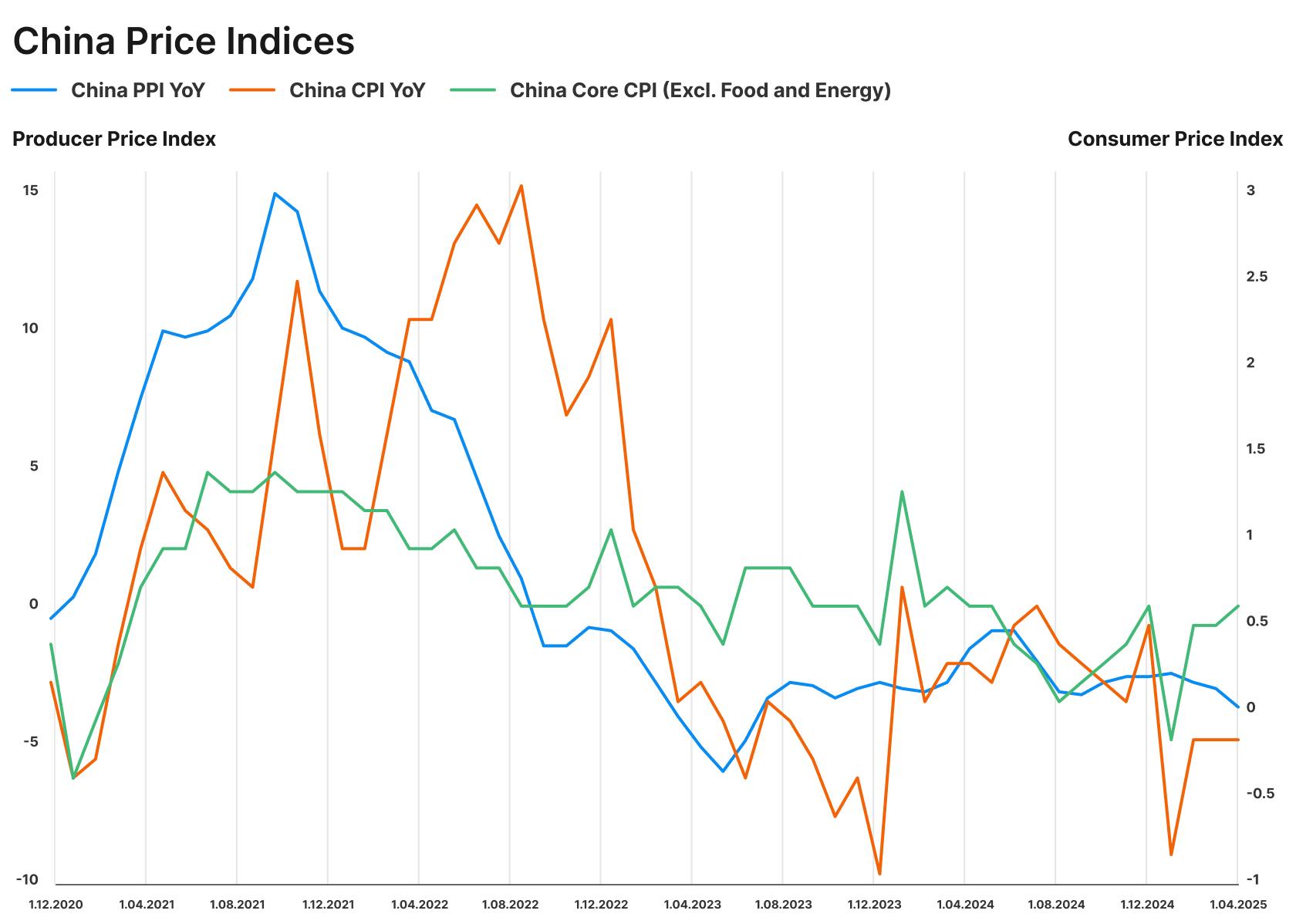
China's Producer Price Index (PPI) – which represents the price received for goods and services – has been in a downtrend since the fourth quarter (Q4) of 2022. Meanwhile, its Consumer Price Index (CPI) – which represents the price paid for goods and services – has been downtrending since the second quarter (Q2) of 2023.
Lower prices received and spent by producer and consumer should imply lower raw material prices for the former and higher purchasing power for the latter. However, when factoring in core CPI excluding food and energy – which is a stronger indicator of purchasing power – adds a different layer of nuance.
Source: China National Bureau of Statistics; Leverage Shares analysis
Since Q2 2023 till the most recent period, this indicator has been flat-to-downtrending. This implies that production of goods and services have been drawing progressively lower margins for businesses since consumers haven't been able to or are unwilling to spend. Progressively lowering purchasing power combined with lowering margins is a deflationary spiral, which experts estimate¹ will continue through all of this year and the next.
An endeavour to support Iran, thus, would be further strain on an already-fraught economic system. While China could share the burden with Russia, with which President Putin has recently described as having a deepening relationship² with, there might be more here than meets the eye. A specialized unit with the Russian intelligence service FSB has reportedly been working against³ Chinese attempts to acquire Russian military technology and expertise through clandestine means, leading the unit to dub China "the enemy".
Given limited options for succour from allies, Iran likely will have to go its own way in crafting a response.
Werbung
Market Reaction
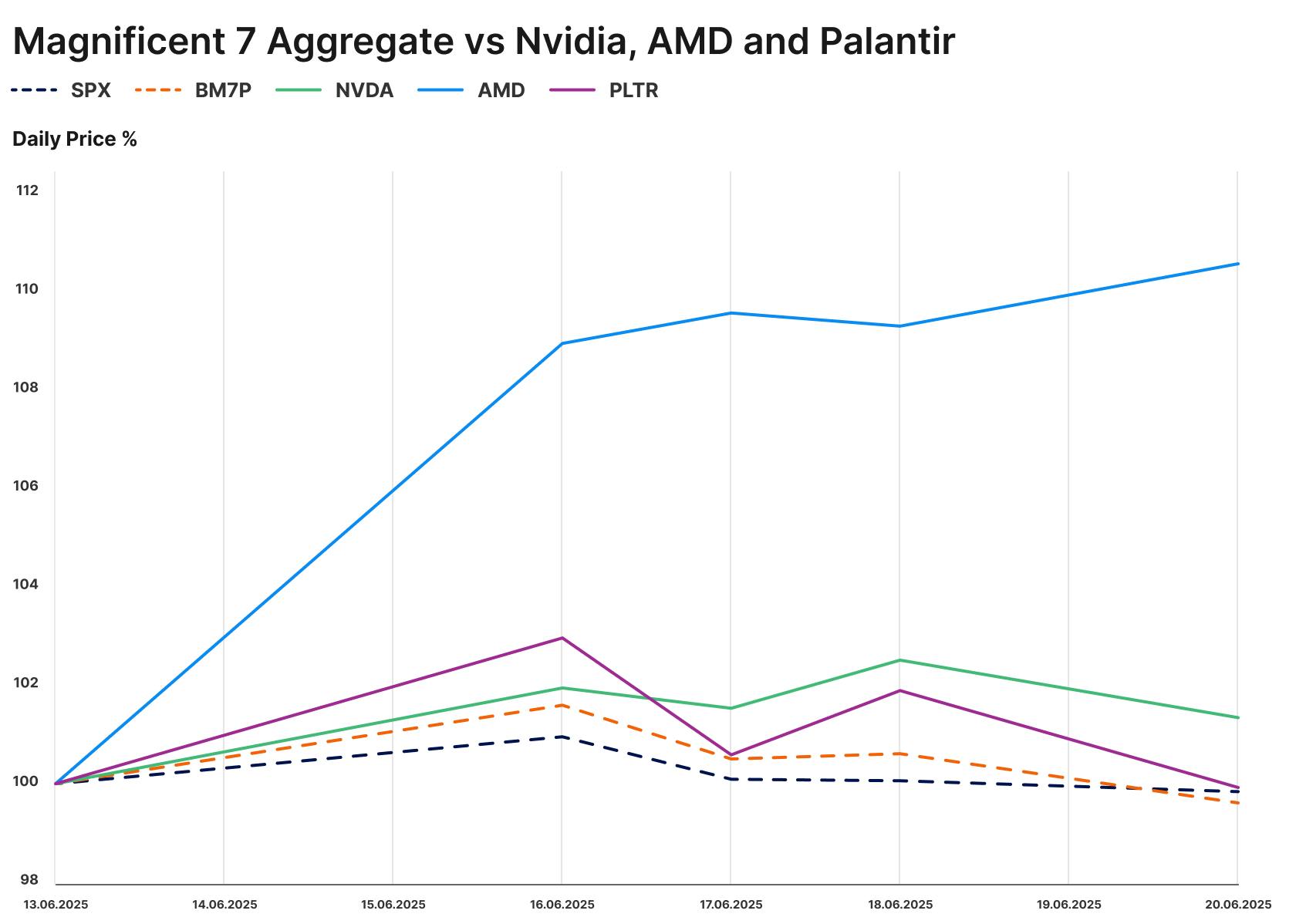
Interestingly, the broad market – as represented by the S&P 500 – largely remained flat through all of last week. One interesting trend that remained prevalent was a downturn in the Magnificent Seven.
Source: Leverage Shares analysis
The Bloomberg Magnificent Seven Index (BM7P), which tracks the seven stocks in an equal-weighted basket, more-or-less closed the week flat while Palantir – which potentially could have gained prominence given its work with the military – shared the same fate. The only outlier in the Magnificent Seven was Advanced Micro Devices, Inc (AMD) whose rose steeply after analyst revised the outlook on the stock following advances in AI capabilities. The performance of the BM7P and the broad market suggests that AMD's performance was effectively an adjustment among constituents.
Essentially, it seems markets have factored out any massive shifts on account of the conflict.
In Conclusion
On the 24th of June, President Trump has claimed on social media that a full ceasefire between Iran and Israel has been agreed upon and will be enacted within 24 hours. However, it is not clear that Iran has agreed to this: it simply stated⁴ that it will not attack unless it is attacked. Also, many a ceasefire lie shattered across history: the root causes of the conflict remain unresolved. In fact, Israel has already accused Iran of violating the ceasefire mere hours⁵ after President Trump announced the ceasefire and is re-engaging in the battle.
The energy industry – as evidenced by the tanker rates and forward prices for oil – is entirely warranted in its caution while the market's reaction (or lack of thereof) is either indicative of a disconnect or a mark of its overvaluation, thus leaving its efficacy in gauging sentiment in question. This conflict is far from over, with ramifications on markets and economies potentially pending. While the ostensible primary casus belli behind calls for a regime change – namely, Iran possessing the means for nuclear weapons production – might have been neutralized, celebrations might be premature and caution would be in order. For one, oil and gas prices can be expected to rise in tandem with future actions by belligerents in the region.
Furthermore, the relative disconnect seen in the U.S. equity market is interesting in and of itself. While it could be argued that most U.S. companies likely don't have significant exposure to Iran's market, nearly all U.S. companies have energy needs; if energy prices rise, their margins could be squeezed and forward outlook could be affected. Thus, any notion of a disconnect in the U.S. equity market from the current events relating to Iran needs re-examining.
For now, professional investors in Europe can consider the Brent Oil ETC (BRNL), which is likely to be much more affected by any bottlenecks in supplies in the Gulf as well as the WTI Oil ETC (WTIL), which will inevitably resonate as well, absent any measures enacted by the U.S. administration with regard to meeting global demand.
About Leverage Shares
Leverage Shares is the largest European issuer of single stock ETPs by AUM & trading volume. It is the only provider of physically-backed leveraged ETPs on single stocks, ETFs and commodities.
The opinions expressed in this publication are those of the authors and are subject to change. They do not purport to reflect the opinions or views of Trackinsight or its members. Trackinsight does not guarantee the accuracy, completeness, or reliability of the information provided.
Footnotes:
¹ “China’s factory-gate deflation worst in 22 months as economic headwinds mount”, Reuters, 9 June 2025
² “Xi and Putin agree to ‘deepen’ China-Russia ties during Moscow talks”, CNN, 8 May 2025
³ “Secret Russian Intelligence Document Shows Deep Suspicion of China”, New York Times, 7 June 2025
⁴ “Iranian state media says ceasefire with Israel has begun, after night of deadly strikes”, Sky News, 24 June 2025
⁵ “Ceasefire Appears to Collapse as Israel Accuses Iran of Missile Strike and Orders Retaliation”, Time, 24 June 2025
Mehr Artikel


Über Trackinsight
Trackinsight ist ein führender Anbieter von ETF-Daten und -Technologie, der Institutionen befähigt, fundierte Entscheidungen bei der Auswahl von ETFs, der Portfoliokonstruktion und der Optimierung zu treffen.
Seit unserer Gründung im Jahr 2016 sind wir an der Spitze der Branche und bieten zugängliche, umfassende und zuverlässige Werkzeuge, um die sich wandelnden Bedürfnisse der Investoren zu unterstützen.
In den letzten zehn Jahren hat Trackinsight seine Aktivitäten auf sechs Länder ausgeweitet und Tausende von professionellen Investoren bedient. Wir haben kontinuierlich Innovationen entwickelt, um hochmoderne Lösungen anzubieten, die den sich verändernden Anforderungen des ETF-Marktes gerecht werden.
Im Jahr 2024 erwarb Kepler Cheuvreux, ein führendes unabhängiges europäisches Finanzdienstleistungsunternehmen, eine Mehrheitsbeteiligung an Trackinsight und wurde damit zum Hauptaktionär des Unternehmens.
Diese strategische Partnerschaft festigt Trackinsights Position als führender Anbieter von Tools zur Auswahl und Analyse von ETFs und stärkt gleichzeitig Kepler Cheuvreux‘ Engagement, ein führender Akteur im ETF-Sektor zu werden.
Gemeinsam sind wir bestrebt, fortschrittliche Dienstleistungen anzubieten, die professionelle Investoren, Berater, Institutionen und Emittenten unterstützen. Dieser neue Schritt ermöglicht es uns, noch umfassendere und innovativere technologische Lösungen anzubieten, die die ETF-Investitionen auf ein neues Niveau heben.
Mehr über TrackinsightETF-Tools
PLATTFORM
PROFESSIONELLE LÖSUNGEN
Kontaktieren Sie uns
Datenschutzrichtlinie | Cookie-Richtlinie | | Nutzungsbedingungen | Impressum