Get your free ETF data sample from our comprehensive offerings. Start your free trial→
Help us improve your experience. Please confirm your investor type:
The ETF Industry Is Evolving Fast
From AI infrastructure to active strategies, the ETF landscape is shifting. Share your perspective in the 7th Annual Global ETF Survey.

Worst Thematic ETFs of 2021: How are they faring today?
Look at how Thematic ETFs battered in 2021 are faring in this new, but gloomy year.

By Rony Abboud
March 9, 2022
Advertisement
The rise of Thematic ETFs has accelerated, attracting almost $100 billion of net inflows in 2021. These funds have emerged as the preferred investment vehicles to gain exposure to themes, trends, and megatrends shaping our future. In this article, we will look at how Thematic ETFs battered in 2021 are faring in this new, but gloomy year.
The Global ETF Red List 2021
- Defiance Next Gen Altered Experience ETF (PSY): -53%
- Rize Education Tech and Digital Learning UCITS ETF (LERN): -50%
- Global X Education ETF (EDUT): -50%
- KraneShares CSI China Internet ETF (KWEB): -49%
- Horizons Psychedelic Stock Index ETF (PSYK): -49%
- Roundhill Streaming Services & Technology ETF (SUBZ): -43%
- AdvisorShares Psychedelics ETF (PSIL): -43%
- ETFMG U.S. Alternative Harvest ETF (MJUS): -41%
- Global X Cannabis ETF (POTX): -40%
- ProShares Long Online/Short Stores ETF (CLIX): -40%
- Samsung CSI China Dragon Internet ETF: -40%
- Global X Emerging Markets Internet & E-commerce ETF (EWEB): -38%
- VanEck Vectors Digital Transformation ETF (DAPP) : -38%
- CSOP China Healthcare Disruption Index ETF: -38%
- ARK Genomic Revolution ETF (ARKG): -34%
- CSOP Hang Seng TECH Index ETF: -34%
- Lion-OCBC Securities Hang Seng TECH ETF: -33%
- HSBC Hang Seng TECH UCITS ETF (HSTE): -33%
- BetaShares Crypto Innovators ETF: -33%
- ChinaAMC Hang Seng TECH Index ETF: -33%
Before and After of Thematic ETFs
In assessing the list, one cannot help but notice three clusters of poor performing ETFs:
- "At Home ETFs"
- Marijuana & Psychedelics
- Chinese Tech
ETF Data Built for Precision
Trackinsight delivers reliable and comprehensive coverage on 14,000+ ETFs
"At Home ETFs"
"At Home ETFs” Performance in 2021
- Rize Education Tech and Digital Learning UCITS ETF (LERN): -50%
- Global X Education ETF (EDUT): -50%
- Roundhill Streaming Services & Technology ETF (SUBZ): -43%
LERN, EDUT, and SUBZ were among the 2020 COVID rally beneficiaries as forced lockdowns and shutdowns promoted stay-at-home trends such as online schooling, online streaming, video gaming, and home workouts — to name a few. As vaccines emerged and economies reopened in 2021, life on earth began to normalize and people returned to their old outdoor habits. Students went back to school, employees gradually headed back to their offices, and sports enthusiasts to their gyms. Dependency on online professional and entertainment faded, leaving companies providing these services helpless against the subscribers' exodus. Consequently, financial results showed a decline in key growth metrics and profitability which led investors to dump the stocks. ETFs with exposure to these companies were dragged down — ending the year deep into the red zone.
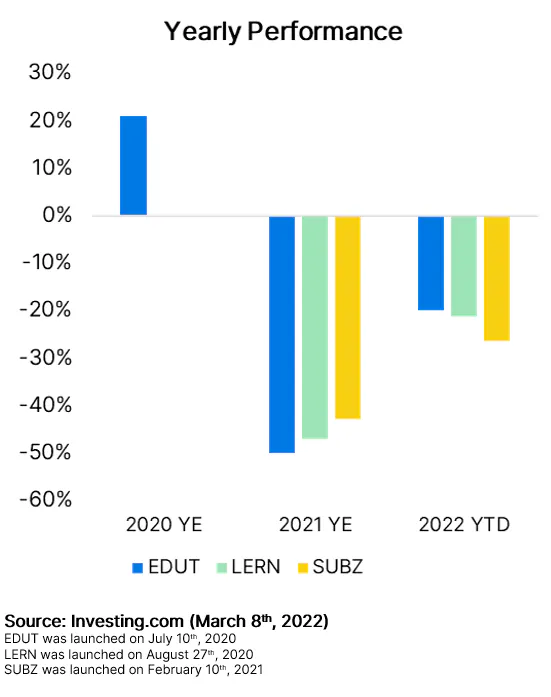
Just when investors thought it could not get any worse, it did. So far this year, EDUT, LERN, and SUBZ share prices dropped by over -20% after the U.S. Federal Reserve pointed to rate hikes to cool down inflation. Technology growth stocks, which constitute most of the underlying assets held in their portfolios, can negatively react to higher interest rates. Raising interest rates would reduce the value of a company's future cash flows and as a result, its overall value today.
Another factor in play is the lower rate of new COVID-19 cases after the Omicron wave infected and immunized millions of people in a short span of time. Between January 25th, 2022, and March 8th, 2022, the 7-day average of new cases fell by 55% around the world. Moreover, roughly 56% of the global population have been vaccinated and 64% have received at least one dose. (Source: ourworldindata.org). This prompted more schools and businesses to reopen — lowering the appeal of remote tools which people depended on during widespread lockdowns.
Marijuana & Psychedelics ETFs
Marijuana & Psychedelics ETFs performance in 2021
- Defiance Next Gen Altered Experience ETF (PSY): -53%
- Horizons Psychedelic Stock Index ETF (PSYK): -49%
- AdvisorShares Psychedelics ETF (PSIL): -43%
- ETFMG U.S. Alternative Harvest ETF (MJUS): -41%
- Global X Cannabis ETF (POTX): -40%
Investors rushed into cannabis and psychedelic stocks during the peak period of the Covid-19 pandemic in 2020 and reached astronomical levels in early January 2021 after Reddit traders turned them into meme stocks. The craze eventually died down and investors were stuck in an endless spiral of disappointment.
The marijuana industry is highly fragmented, mostly loss-making, and lacks the concrete legislative support required to tap into its full potential. Major catalysts ahead for the industry include increased legalization at the U.S. state level, ramped up levels of M&As, and possible European "Yesses" to recreational marijuana.
Early this year, the industry received a regulatory boost after Mississippi (U.S. State) legalized medical marijuana for people with debilitating conditions such as AIDS, cancer, and sickle cell disease. This makes Mississippi the 37th state to allow the medical use of cannabis, according to the National Conference of State Legislatures.
In Europe, Malta became the first country in the European Union to agree to formally legalize the use and growing of marijuana for recreational purposes. Germany, Italy, and Luxembourg are expected to jump on the weed bandwagon with government agencies already laying the legal groundwork.
On the other hand, the psychedelics industry is relatively nascent and the path to commercialization and disrupting the multi-billion-dollar market of mental health care treatment will take time. The companies engaged in the industry need to prove beyond a reasonable doubt that their medicines are both safe and more effective than current treatments for ailments like PTSD, depression, anxiety, ADHD, and more.
Advertisement
While there was some good news for the former "taboo" industries in Q1 2022, it was not enough to get Cannabis and Psychedelics ETF NAVs to the level seen in early 2021. On the contrary, the funds fell deeper into the red with the worsening global macroeconomics (hot inflation, impending rate hikes).
Marijuana & Psychedelics ETFs performance in 2022
- Defiance Next Gen Altered Experience ETF (PSY): -30.6%
- Horizons Psychedelic Stock Index ETF (PSYK): -28.4%
- AdvisorShares Psychedelics ETF (PSIL): -30%
- ETFMG U.S. Alternative Harvest ETF (MJUS): -25%
- Global X Cannabis ETF (POTX): -23.4%
Chinese Tech ETFs
Chinese Tech ETFs Performance in 2021
- KraneShares CSI China Internet ETF (KWEB): -49%
- Samsung CSI China Dragon Internet ETF: -40%
- Global X Emerging Markets Internet & E-commerce ETF (EWEB): -38%
- CSOP China Healthcare Disruption Index ETF: -38%
- CSOP Hang Seng TECH Index ETF: -34%
- Lion-OCBC Securities Hang Seng TECH ETF: -33%
- HSBC Hang Seng TECH UCITS ETF (HSTE): -33%
- ChinaAMC Hang Seng TECH Index ETF: -33%
Last year, Beijing unleashed a flurry of new regulations targeting internet-oriented tech companies, private education firms and overseas listings for Chinese companies, disrupting global markets and triggering huge losses for investors. The government has cited concerns over data privacy, national security, and the tech sector’s expanding influence on society as reasons for tighter oversight. Chinese authorities have also ramped up their efforts to eradicate poverty through their "Common Prosperity" initiative and support the middle class — a move away from prioritizing economic growth at all costs.
Indices tracking Chinese technology stocks listed in Mainland China, Honk Kong, or the U.S. were battered down with the Hang Seng Tech Index and the Nasdaq Golden Dragon China Index dropping by -32% and -56% respectively.
Despite this market correction, investors went bargain hunting for ETFs with exposure to these stocks. By year-end, over $10.5 billion were injected into the above-mentioned ETFs — out of which $8.2 billion were picked up by the popular KraneShares CSI China Internet ETF and its European variants.
This year, the line-up remains out of favor as stock investors see no signs of easing from the Chinese government. In early January, Beijing passed new rules that tighten controls on tech companies’ overseas listings and activities, while forbidding “unreasonable discrimination” in pricing based on user habit data, a key monetization tool for China’s largest e-commerce and short-video platforms. That, coupled with the ripples of the U.S. Federal Reserve's hawkish stance to combat inflation, has weighed down on the ETFs' performance.
Chinese Tech ETFs Performance in 2022
- KraneShares CSI China Internet ETF (KWEB): -22.5%
- Samsung CSI China Dragon Internet ETF: -21.3%
- Global X Emerging Markets Internet & E-commerce ETF (EWEB): -21.8%
- CSOP China Healthcare Disruption Index ETF: -26.3%
- CSOP Hang Seng TECH Index ETF: -32%
- Lion-OCBC Securities Hang Seng TECH ETF: -20%
- HSBC Hang Seng TECH UCITS ETF (HSTE): -20%
- ChinaAMC Hang Seng TECH Index ETF: -16.5%
Find and compare over 8,000 ETFs with our free tools:
Interested in seeing lists of top-performing ETFs? Check out our new Investing Guides:
- Investing in Gold ETFs
- Investing in Silver ETFs
- Investing in Commodity ETFs
- Investing in Oil ETFs
- Investing in ESG ETFs
Advertisement
More articles


About Trackinsight
Since our founding in 2016, we have been at the forefront of the industry, delivering accessible, comprehensive, and reliable tools to support the evolving needs of investors.
Over the past decade, Trackinsight has expanded its operations across six countries, serving thousands of professional investors. We’ve consistently innovated to provide cutting-edge solutions that meet the changing demands of the ETF market.
In 2024, Kepler Cheuvreux, a leading independent European financial services firm, acquired a majority stake in Trackinsight, becoming the company's principal shareholder.
This strategic partnership solidifies Trackinsight's position as a premier provider of ETF selection and analysis tools, while strengthening Kepler Cheuvreux’s commitment to becoming a leading player in the ETF sector.
Together, we are committed to offering advanced services that empower professional investors, advisors, institutions, and issuers. This new step enables us to deliver even more comprehensive and innovative technological solutions, driving ETF investing to new heights.
More about TrackinsightETF TOOLS
PLATFORM
ETF NEWS & RESEARCH
Privacy policy | Cookie policy | | Terms of use | Imprint