Global ETF Survey 2026: Answer now →
Help us improve your experience. Please confirm your investor type:
The ETF Industry Is Evolving Fast
From AI infrastructure to active strategies, the ETF landscape is shifting. Share your perspective in the 7th Annual Global ETF Survey.
With GBP at historical lows, Bank of England restarts Quantitative Easing
The Bank of England will buy bonds in response to the pound tumbling following Truss and Kwarteng's mini-budget.


By Daniel Chivu
October 3, 2022
- United Kingdom
Advertisement
The Pound Sterling has suffered its worst YTD performance since 1985, falling 20% against the USD in 2022. A slew of economic issues ranging from energy insecurity to the highest inflation in decades, have been pulling the GBP/USD Rate lower for the better part of the year. However, the panic set in when a new government budget revealed the most aggressive tax cut measures since the 1970s, causing investors to lose confidence in the currency’s stability and sell the currency as well as government bonds.
U.K Government Bonds, also known as Gilts, saw a dramatic spike in interest rates between September 23 and September 28, with 30-year Gilt yields reaching 5.092% in the early trading hours on September 28th, which represents the highest yield since 2002. In light of the tightening financial conditions observed in the 2.1 trillion-pound U.K bond market, the Bank of England announced an emergency restart of its quantitative easing operations “on whatever scale necessary”, in order to restore confidence and liquidity to the market. The iShares Core UK Gilts ETF, which saw a decline of over 5% since September 23rd, saw a spike of +7% once the BoE announcement was made, signalling some of the market nervousness had subsided, at least on a temporary basis.
ETF Data Built for Precision
Trackinsight delivers reliable and comprehensive coverage on 14,000+ ETFs
Likewise, Gilt yields across the maturity spectrum saw a considerable decline post announcement, especially on the 30 Year Gilt which dropped 106bps, fully erasing the 105bps increase over the last month.
Effects on Mortgages and other Fixed Income investments
With fixed income making up a considerable portion of Pension Plan investments, there has been considerable stress put on Pension Plan managers to get rid of Gilts and Mortgage Backed Securities (MBS) within their portfolios, further exacerbating the initial sell-off. Persons familiar with the decision of the BoE confirmed that its radical change in policy was primarily due to the issues faced by pension funds, which were “running out of cash”.
The mortgage market has also experienced considerable stress since the budget announcement. Hundreds of residential mortgage deals have been pulled off the market, with major lenders such as HSBC and Santander Bank pausing their offerings. Though it is unclear how these actions have affected MBS products, as there are no publicly traded ETFs focusing on UK Mortgages, it does bring up another area of diversification for Fixed Income.
Infamously known for their role in the 2008-2009 Financial Crash which originated in the U.S, MBS products have received a notoriety that is perhaps unwarranted. At their core, they are structured in the same way as any bond or private credit product and are effectively a bet on the ability of the borrower to continue making payments to their lender. Conventional wisdom states that mortgages are at the top of the priority list for most people, and so they generally rate as relatively low-risk investments, especially if backed by the government.
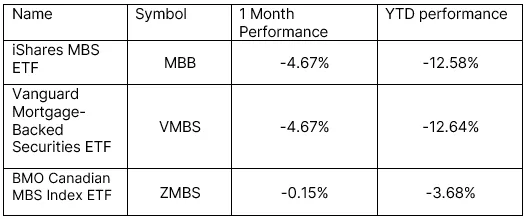
Investors can get exposure to various MBS either through direct investments in Mortgage Pools or through ETF products which provide diversification across a wide spectrum of maturities and credit ratings. Products such as the iShares MBS ETF and the Vanguard Mortgage-Backed Securities ETF are excellent ways to get exposure to this area of fixed income, though investors should always consult a financial professional for more details on suitability. Other options include the BMO Canadian MBS Index ETF, for exposure to the Canadian Mortgage market which historically has been resilient even through the Financial Crisis
Summary of mentioned ETF Performance (1 month, YTD)
Advertisement
More articles


About Trackinsight
Since our founding in 2016, we have been at the forefront of the industry, delivering accessible, comprehensive, and reliable tools to support the evolving needs of investors.
Over the past decade, Trackinsight has expanded its operations across six countries, serving thousands of professional investors. We’ve consistently innovated to provide cutting-edge solutions that meet the changing demands of the ETF market.
In 2024, Kepler Cheuvreux, a leading independent European financial services firm, acquired a majority stake in Trackinsight, becoming the company's principal shareholder.
This strategic partnership solidifies Trackinsight's position as a premier provider of ETF selection and analysis tools, while strengthening Kepler Cheuvreux’s commitment to becoming a leading player in the ETF sector.
Together, we are committed to offering advanced services that empower professional investors, advisors, institutions, and issuers. This new step enables us to deliver even more comprehensive and innovative technological solutions, driving ETF investing to new heights.
More about TrackinsightETF TOOLS
PLATFORM
ETF NEWS & RESEARCH
Privacy policy | Cookie policy | | Terms of use | Imprint