Global ETF Survey 2026: Answer now →
Help us improve your experience. Please confirm your investor type:
The Ultimate ETF Comparison Tool - Try Now!
Analyze up to 5 ETFs side-by-side and gain instant insights on performance, fees, holdings, and more to make data-driven investment decisions.

When will the Fed put an end to reducing its balance sheet?
Fixed Income Recap for the Week From January 22 to January 28, 2024.

By Edouard Caillieux
January 29, 2024
- Fed
- Balance sheet
Advertisement
During the pandemic, the Fed reduced its interest rate target to near zero and bought approximately $4.8 trillion in Treasuries and mortgage-backed securities to invigorate the economy and keep longer-term interest rates low. The excess liquidity created from this process resulted in rapidly increasing reserves and balances in reverse repo agreements.
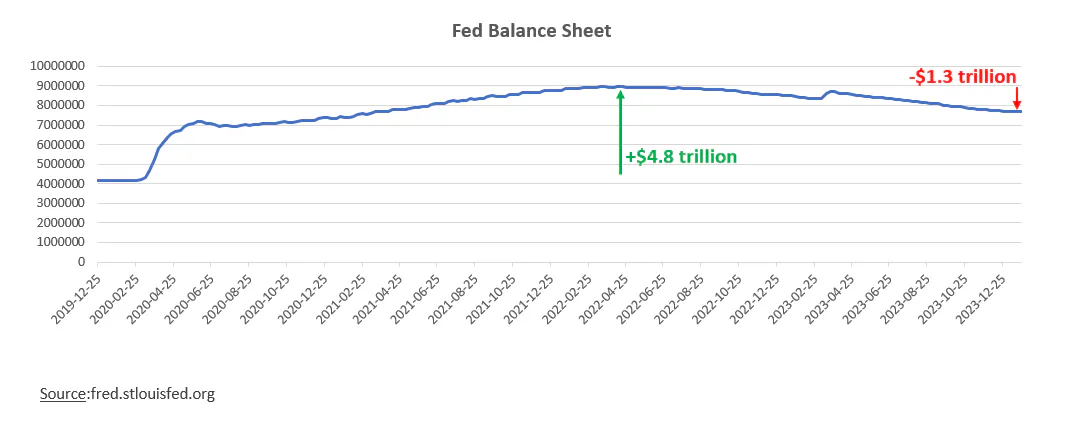
In response to inflation standing well above its long-run target, the U.S. central bank began unwinding its accommodative monetary policy in Q2 2022. In practical terms, it stopped reinvesting in maturing Treasuries and MBS, passively shrinking its assets as those securities expired without being replaced. From April 2022 to January 2024, the size of its balance sheet has been reduced from $8.97 trillion to $7.68 trillion.
ETF Data Built for Precision
Trackinsight delivers reliable and comprehensive coverage on 14,000+ ETFs
With a $35 billion reduction from December 27 to January 24 alone, it’s clear that the quantitative tightening policy is not over even if Powell indicated a minimum of three rate cuts in 2024. Unfortunately, he did not provide further details about the policy pursued by the Federal Reserve on the size of its balance sheet.
Beyond the expected rate cut starting from May, the key question market players are likely to ask is: when the Fed will stop its quantitative tightening? Or said differently, how far can it shrink its balance sheet without causing dislocations in places like the repurchase-agreement market or derailing its broader policy goals?
Please note this article is for information purposes only and does not in any way constitute investment advice. It is essential that you seek advice from a registered financial professional prior to making any investment decision.
More articles


About Trackinsight
Since our founding in 2016, we have been at the forefront of the industry, delivering accessible, comprehensive, and reliable tools to support the evolving needs of investors.
Over the past decade, Trackinsight has expanded its operations across six countries, serving thousands of professional investors. We’ve consistently innovated to provide cutting-edge solutions that meet the changing demands of the ETF market.
In 2024, Kepler Cheuvreux, a leading independent European financial services firm, acquired a majority stake in Trackinsight, becoming the company's principal shareholder.
This strategic partnership solidifies Trackinsight's position as a premier provider of ETF selection and analysis tools, while strengthening Kepler Cheuvreux’s commitment to becoming a leading player in the ETF sector.
Together, we are committed to offering advanced services that empower professional investors, advisors, institutions, and issuers. This new step enables us to deliver even more comprehensive and innovative technological solutions, driving ETF investing to new heights.
More about TrackinsightETF TOOLS
PLATFORM
ETF NEWS & RESEARCH
Privacy policy | Cookie policy | | Terms of use | Imprint