Trackinsight Enterprise, a unified platform for institutional ETF research, analytics, and compliance, is now live. Explore Trackinsight Enterprise →
Help us improve your experience. Please confirm your investor type:
The ETF Industry Is Evolving Fast
From AI infrastructure to active strategies, the ETF landscape is shifting. Share your perspective in the 7th Annual Global ETF Survey.
Tesla Q1 Highlights: Declining Sales, Squeezed Margins, and Ambitious AI Bets
Explore Tesla's Q1 earnings report with a focus on the 9% decrease in revenue compared to the previous year.


By Leverage Shares
May 3, 2024
- Tesla
- Artificial Intelligence
- Leverage Shares
Advertisement
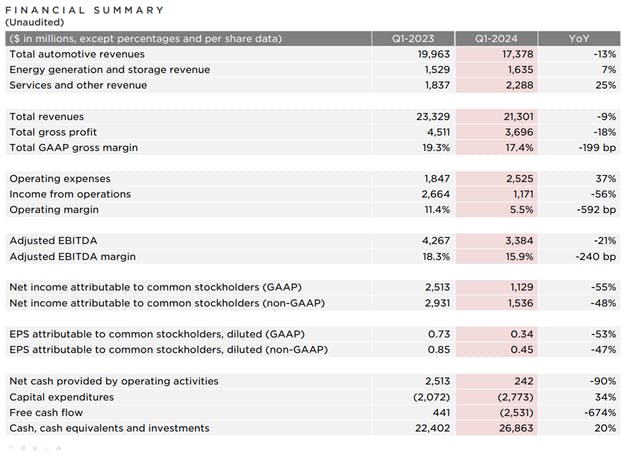
Tesla's Q1 earnings report largely reflected pre-existing concerns regarding declining sales. Year-over-year revenue decreased by 9%, with the automotive segment experiencing a steeper decline of 13%. While these figures represent a headwind, other areas of the business were less impacted.
Tesla Q1: Margins Squeezed, Investors Look Ahead
Despite a 37% increase in operating expenses and a 34% increase in capital expenditures, Tesla's adjusted EBITDA (earnings before interest, taxes, depreciation, and amortization) declined by 21%, and earnings per share fell by 55%. This highlights the impact of the intense price competition within the electric vehicle (EV) market, as evidenced by the 18% decrease in gross margin.
📊 Share your ETF outlook
From AI infrastructure to active strategies, the ETF landscape is shifting. Share your perspective in the 7th Annual Global ETF Survey and get exclusive early access to the final report.
Given the increasing competition in the EV space and the maturity of Tesla's current product lineup, the company's recent financial performance was largely anticipated and may persist beyond Q1. However, the post-earnings stock price surge was unexpected. This positive movement likely reflects investor optimism surrounding the company's future plans and potential innovations.
Tesla's Affordability Gamble: Can Stripped-Down Models Deliver?
Tesla's 2006 Master Plan envisioned a $25,000 electric car, the Model 2, funded by revenue from its premium vehicles. Recent reports confirmed the project's cancellation, as it required a new platform. Instead, Tesla's latest earnings call revealed a focus on "affordable" iterations of existing models using current platforms and production lines. However, achieving this affordability target remains unclear. CEO Elon Musk, during the Q4 2023 earnings call in January, acknowledged the company was nearing the "natural limit" of cost reductions for the current lineup.
Tesla might offer "stripped down" versions of their existing models. These base trims of the Model 3 and Model Y (both sharing the same platform and priced around $40,000) may see slight price reductions, but likely won't reach the ambitious $25,000 target.
Additionally, the earnings call confirmed no plans for new Gigafactories. This decision, considering the known sales decline and cost trends, begs the question: why the months-long hype surrounding potential plant locations in Mexico and India?
Tesla Shifts Gears: From Mass Market to High-Margin Truck
Tesla's recent earnings call revealed a curious strategy. While cost-cutting for existing car lines seems to have reached its limit, the company continues to invest in production facilities for the high-margin Tesla Semi and Cybertruck. These trucks, priced between $81,000 and $180,000, cater to a very different market segment than the originally envisioned $25,000 Model 2. This shift suggests Tesla might be prioritising profitability over mass-market affordability.
Musk Pushes "AI Robotics" as Tesla Redefines Itself
Tesla's identity crisis took centre stage during the earnings call. For nearly two decades, analysts viewed them as a car manufacturer. However, Elon Musk repeatedly emphasized Tesla as an "AI Robotics" company. This shift, while intriguing to investors interested in the field, lacks substantial evidence of Tesla's leadership in AI Robotics.
Tesla Robotaxi: Aiming for Fleet Domination with FSD Boost
Tesla's Robotaxi, slated for an August unveiling, aims to be the "fleet operator's choice" for self-driving taxis. This ambitious goal hinges on significant advancements in Tesla's Full Self-Driving (FSD) software, enabling autonomous operation with minimal errors. As with any AI system, achieving this requires massive training data and powerful computing resources.
Tesla has ramped up data collection by exponentially increasing the miles driven using FSD over the past year. This strategy aims to accelerate the development of a reliable self-driving system for the Robotaxi.
Advertisement
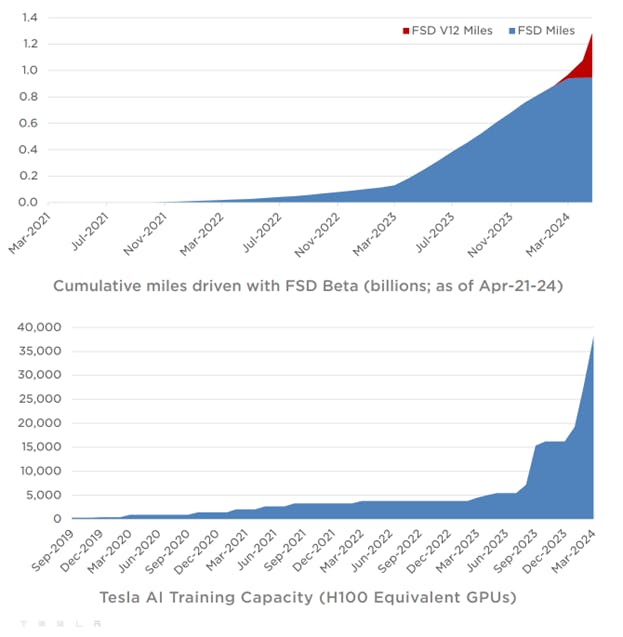
Tesla's FSD V12 boasts stronger neural networks and a massive dataset of driving miles, thanks to 40,000 Nvidia H100 GPUs. While this paves the way for more autonomous driving features, experts still predict 3-5 years before truly driverless cars with minimal risk become a reality.
Conclusion: Future Hype Masks Short-Term Challenges
Tesla's latest earnings call painted a picture of a company prioritising future ambitions over immediate market concerns. While glimpses of futuristic projects like the robotaxi-sharing "Cyber Cab" app and the 2025 Optimus robot were presented, both face significant roadblocks. Regulatory hurdles could keep the Cyber Cab app on hold indefinitely, while the Optimus robot's current capabilities, limited to basic factory tasks, raise questions about its wider industrial application. This focus on potentially game-changing technologies overshadows the short-term pressure Tesla faces from a declining market. The company's push towards high-margin vehicles like the extravagant $200,000 Roadster further suggests a prioritisation of profits over affordability, a strategy that might not resonate with a broader customer base. Until these ambitious projects translate into tangible solutions, Tesla remains primarily a carmaker grappling with a potentially long-term market decline. The "AI Robotics" rebranding feels more like a marketing strategy than a reflection of their current capabilities. True innovation requires more than just flashy concepts; it demands concrete solutions that address immediate market needs.
Note: Leverage Shares is one of Europe's most prominent ETP issuers and has a number of publicly traded products based on Tesla's stock that are available to professional investors. For instance, TSL3 offers thrice the daily returns as the stock does while TS3S offers the inverse, i.e. it is a "leveraged short" product.
About Leverage Shares
Leverage Shares is the largest European issuer of single stock ETPs by AUM & trading volume. It is the only provider of physically-backed leveraged ETPs on single stocks, ETFs and commodities.
The opinions expressed in this publication are those of the authors and are subject to change. They do not purport to reflect the opinions or views of Trackinsight or its members. Trackinsight does not guarantee the accuracy, completeness, or reliability of the information provided.
More articles


About Trackinsight
Since our founding in 2016, we have been at the forefront of the industry, delivering accessible, comprehensive, and reliable tools to support the evolving needs of investors.
Over the past decade, Trackinsight has expanded its operations across six countries, serving thousands of professional investors. We’ve consistently innovated to provide cutting-edge solutions that meet the changing demands of the ETF market.
In 2024, Kepler Cheuvreux, a leading independent European financial services firm, acquired a majority stake in Trackinsight, becoming the company's principal shareholder.
This strategic partnership solidifies Trackinsight's position as a premier provider of ETF selection and analysis tools, while strengthening Kepler Cheuvreux’s commitment to becoming a leading player in the ETF sector.
Together, we are committed to offering advanced services that empower professional investors, advisors, institutions, and issuers. This new step enables us to deliver even more comprehensive and innovative technological solutions, driving ETF investing to new heights.
More about TrackinsightETF TOOLS
PLATFORM
ETF NEWS & RESEARCH
Privacy policy | Cookie policy | | Terms of use | Imprint